Wednesday, December 30, 2015

SHE KNEW POL POT - AND LIVED TO TELL THE TALE

2 disarmed landmines in Cambodia
Mali's legs are different. Each of her legs is a different color. Really. One is darker, one is lighter, and they will always be that way...

It took me a while to finally notice this. Mali owns the travel agency that I've used to arrange my trips around the Angkor Temples  and Siem Reap, so I'd been in her office many times. You’d think I would've noticed before that her legs were different colors, since she walks around her office in a skirt, barefoot. Like other Khmer’s, Mali's skin color is darker than most Asians. The exception is her left leg, with a lighter tone. That’s when I realized that this was not her real real leg. It’s a prosthetic.

Mali lost her leg to a landmine.

You’d think this would be a sensitive subject, but she had no problem telling me all about it. In fact, she was quite proud to show off her prosthetic leg to me. The injury had happened many years back, when she was 18. She was on her way out to work the farming fields. She was just walking along the side of the road, and that’s when it happened. She stepped on a mine, and the explosion threw her 30 feet. She lost her leg below the knee. That was years ago, when she used to live in Anlong Veng.

When Mali mentioned Anlong Veng, that perked my ears up even further. Further north, Anlong Veng was one of the last strongholds of the Khmer Rouge during the war years. "Was your family in the Khmer Rouge?" I asked.

"Oh, yes," she said. "You see that picture there? My father was commander in Khmer Rouge." Up above a cabinet, was an enlarged photo of her father. He's a big, imposing looking Khmer. Half of his left arm is missing, so I asked how he lost it.

"He lost it fighting, in 1970," she answered. In the photo her father wears a blue sash; the type government officials wear for special occasions. He's standing next to none other than Hun Sen, the current Prime Minister (dictator) of Cambodia. Hun Sen is also an ex-Khmer Rouge commander.

I quickly see her resemblance to her father, except that he lacks her smile. In the photo, he wears a very serious face, while Hun Sen smiles at his side. The picture was taken at a government function. Apparently, as part of the peace agreement in 1998, the Cambodian government allowed many Khmer Rouge commanders to keep control of their zones of control, as long as they laid down their arms to join the government.

Given his Khmer Rouge past, her father was probably a war criminal, and should be in jail for life. But like most former Khmer Rouge commanders, he remains untried, and unconvicted of his crimes. Instead, Mali’s father holds a senior position in Anlong Veng's provincial government. That's Cambodian politics.


She did laundry for the genocidal Pol Pot (photo: Wikipedia)
Given her father's Khmer Rouge history, I now had to ask her the million dollar question.

"Did you ever see Pol Pot?" I asked a bit nervously.

"Yes," she answered.

"Did you talk to him?"

"Yes, many times. I saw him almost every day. I brought him food." Not only that, she even did his laundry sometimes!

I show no reaction, but inside I’m absolutely stunned. I’ve just discovered that this sweet, lady travel agent was part of history. She had long term contact with one of the worst butchers the world had ever known. Not only that, she had lived to talk about it. It’s as though I’m speaking to Hitler’s maid.

There had been more than one assassination attempt on Pol Pot, including in 1976 when some KR cadres tried to poison his food. One of his guards died instead. Given that event, he must have had a great deal of trust for Mali and her father. Since he ordered the deaths of so many close to him, she’s very lucky to be alive today.


In remote northern Cambodia, Anlong Veng is a former Khmer Rouge stronghold
I continued my questioning. "Was he nice to you? Was he mean?" Since I was asking about a genocidal leader, her answers were not what I expected.

"He was a simple man," she said. "He was gentle." More like simply evil, I think. I suppose Pol Pot may showed a kinder side of himself to Mali, than he did to others, since she cooked for him. Her opinion of him surprises me.

“I know he was cruel,” she says, “but he could also be generous.” She says that he saved her family. She does have a point. Years before, when the Vietnamese Army was closing in on their position, they killed every Khmer Rouge they could find. Pol Pot was responsible for protecting 20,000 people, including her family, from their wrath. Fortunately, Mali never had to be a soldier. There were few female Khmer Rouge fighters, and her father had influence to keep her out of the ranks.

Not all of Mali’s family survived those years. Her mother and three sisters managed to survive, but not her younger brother. He died at the age of seven. "Fever and poison," are the reasons Mali gives for his death. It may have been malaria.

Mali eventually married a Khmer Rouge cadre. Not surprisingly, their marriage didn’t last. After having one daughter, they divorced. Mali has been through so much. She lost a leg. She lost a young brother. She lost her husband. For some years, she even lost her country, and lived in refugee camps.

I’m amazed at what a survivor Mali is. Perhaps her father was within Pol Pot’s trusted inner circle. Still, many of the people that ‘Brother Number One’ said he trusted, ended up dead in Cambodia's killing fields. 

Yet, I look at her now, and she’s strong. She’s capable. She walks on her artificial leg, without a limp, and without complaint. She runs a thriving travel business. She speaks Khmer, English and Thai that she learned as a young refugee. She’s a single mother, and takes good care of her daughter, ensuring that she receives the education that war denied her.

Her father's guilt is not being passed on to her anymore. The Khmer Rouge are gone, and she’s doing well now. After all she’s been through, and with all that she’s survived, she deserves the better life that she has now.

What a survivor.

Thursday, November 19, 2015

BEAUTIFUL DANCE OF KHMER WOMEN

An Apsara dancer strikes an elegant pose
The beautiful young ladies are adorned with gold necklaces, and gold earrings. Gold armbands, and gold bracelets are worn on both wrists and ankles. Gold trim is woven throughout their elegant dresses, colored blue, red or yellow. A bright yellow flower sits over each ear as they dance.

Their headdresses are also gold with studded, circular layers rising above them like a bent Buddhist stupa. Some headdresses look like those seen on topless dancers carved into the walls of the temple of Angkor Wat, that I saw earlier. The dancers on stage before me are all young Khmer women, but the only thing that looks modern about them, is their bright red lipstick.

I'm at the Temple Restaurant in Siem Reap, enjoying an upstairs dinner show. The gold may not be real, but the dance is authentic: this is Apsara. It's unlike any dancing you'll ever see in the west; it has the charm of an Asia that was lost centuries ago.

This ancient art was nearly lost after the communist Khmer Rouge banned it
For those who don't know any better, they might think that these dances and costumes are from old Siam, a.k.a. Thailand. But it's better not to say that to the Khmers. They'll tell you that many centuries ago that the Thais copied them from Khmer dancers of the ancient Angkor kingdom.

The only western dance that looks anything similar to this, is classical ballet. Apsara movements are slow, deliberate, and beautiful. Foreigners quickly notice the women's hands; their thumb and forefinger touch together. The remaining three fingers are pulled back, with each succeeding finger pulled further back. The flexibility of the fingers on these dancers is amazing.

The dancers never smile, keeping their red lips together for the entire performance. Like ballet, their dances and movements tell stories; classical Khmer stories about life and love.

As I watch mesmerized, a traditional Khmer band plays acoustical string instruments, while old style drums keep the beat.

Apsara dancing was often performed for Khmer royalty
Slow and elegant, one dancer balances on only one foot, and pivots around, keeping her other foot elevated. The display of balance and control is amazing. At times this style resembles Hawaiian hula dancing, without the hip movements.

This beautiful Khmer dance tradition was nearly lost from Cambodia forever. When the communist Khmer Rouge took over, Apsara dancing was banned. Nearly all of the master teachers of Apsara were either executed, died from disease, or fled Cambodia.

Later after the radicals were forced from power, a cultural revival began. A few surviving refugee dancers returned to Cambodia. With a princess's support, this traditional dance began to be taught again in Phnom Penh. Slowly but surely, Apsara made a comeback.

Now Apsara is popular once again, and dancers regularly perform for royalty, for Khmer audiences, and for tourists like me. 

Despite all the tragedies that Cambodia has endured, it's good to know that one of their most treasured cultural traditions still survives today. 

Sunday, September 27, 2015

TOMB RAIDER TREES

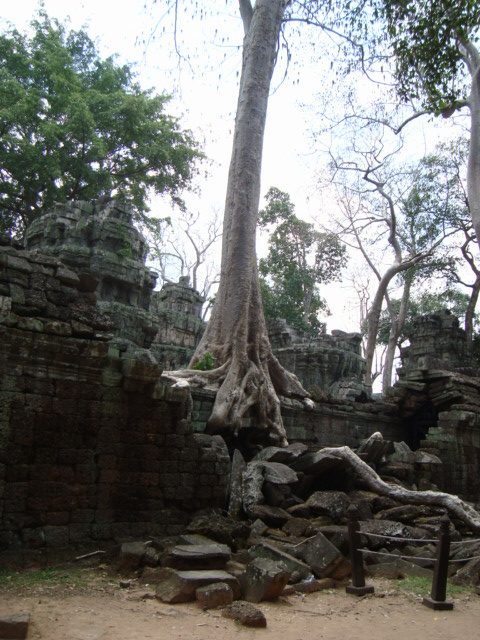
This monster tree knocked down a wall!
When it comes to ancient Asian temples, everyone has seen that romantic image of an overgrown temple ruin in the jungle, as put forth by Hollywood movies. Massive carved stone heads are surrounded by immense stone pillars. Abandoned centuries ago, green vines cover the stone walls, while trees grow out of collapsed ceilings.

For once, Hollywood was right. That place does exist, and I'm looking at it now. It’s found here in Cambodia, in the Khmer temples of Angkor.

Part of the amazement of experiencing these temples in person, is seeing the variety of condition these many temples are in. Some like Angkor Wat are fairly well preserved. 

Others lie completely collapsed and destroyed. Several have been completely overgrown with jungle growth. Others seem to be a combination of all of the above.

But perhaps none quite captures the human imagination, as the temple of Ta Prohm.

Part temple, part ruin, part nature, as I approach Ta Prohm, the first sight that grabs my attention, is what can only be described as a great tree of destruction.


Is it a giant snake?? No, it's tree roots!
This massive tree sits on top of a wall, and towers high above it. Meanwhile, the tree’s roots look like the tentacles of a giant squid, as though formed from Jules Verne’s imagination. The roots appear to have pushed over this strong stone wall, with no more effort than it takes for a child to push over a wall of toy blocks. A gaping section of the wall, is now only a pile of stone bricks. A root of the great tree has creeped across them, burying itself in the earth beyond these measly human cut stones. The tree’s light bark contrasts with the blackened stones that have tumbled down below.

If you have read J.R.R. Tolkien, this tree could have been an ent from Lord of the Rings. It’s as though a mythical tree hopped up on the wall one night, and reasserted the power of mother nature, bringing back the jungle to cover the vanity of man. 

'Tomb Raider Tree' made famous by Angelina Jolie
Along another part of the wall, a colossal tree has grown up on both sides of the wall, towering over the tons of stone below it. This one gives the impression that it is supporting the wall, and holding it in place.

Others great trees have their roots flowing down over the walls smoothly, reaching downward like running water. They resemble a waterfall, frozen into tree roots. Still another has grown lengthwise over stone blocks, appearing as a giant serpent.

Movie buffs may recognize one stone gripping temple tree, from a scene in the film, ‘Tomb Raider’. I once chatted with a Khmer policeman, who had worked with the production crew while the film was in production here. “I see Angelina Jolie,” he told me perkily. “She beautiful!”

As a melding of temple and nature, Ta Prohm truly is a place of wonder and romance. I wonder if this exotic locale had any influence on Angelina Jolie. Cambodia certainly made some impression on the famous actress; she adopted a Khmer orphan to be her own son.

There used to be far more jungle growth covering Ta Prohm temple, but most of it was removed during restoration. When they got to these impressive trees however, they noted that removing them would damage the walls and monuments even further. Leaving the great trees where they are leaves a visual balance; it shows that Angkor is not just about temples, it is also jungle.

Restoration laborer, hard at work
Closer examination on some walls and reveals perfectly round holes dotting stone building blocks. These are not bullet holes as I saw at Angkor Wat; these are all holes left over from the days of original construction. Ancient Khmer construction methods had these blocks moved by sticking wooden rods into these holes for easier lifting.

I come to one of the temple's stone archways, and it’s blocked off. A sign reads, “NO ENTRY, WORK AREA”. Looking in near the sign, I find a workman lying asleep on a dislodged block. So much for working. That’s one thing I’ve noticed about Khmer men, they can sleep soundly on almost any surface. Whether it’s grass, concrete, a motorbike seat, or a stone block, you can find them snoozing almost anywhere.

Besides Ta Prohm, restorations are in progress in several other temples around the Angkor complex. As Cambodia is such a poor country, most of the funding comes from foreign sources. India is providing financial aid to restore one temple. That's not surprising, since India is the home of the Hindu religion. When these temples were first built, the Khmers were Hindu, before later turning Buddhist. The Japanese and German governments fund repairs on other temples. There are so many hundreds of temples around Angkor, that all of them will never be restored in our lifetime.

I know an American Vietnam War veteran, who spent time in Cambodia in recent years. He decided he would personally visit every single ancient Khmer temple in the Siem Reap region. 

It took him six weeks to see them all!!

The towers and trees of Ta Prohm


Wednesday, August 26, 2015

MYSTERY OF THE FAMOUS STONE FACE

These many stone faces beg the question: what was he smiling about??
It's a warm morning here in the ancient jungle temple complex near Angkor Wat, and I've arrived at another iconic temple.   Looking up as I approach this old temple, I see one's man serious stone face, repeated over and over again as statues across the complex. One question dominates my thoughts.

Who is this guy?

This stone temple is known as Bayon and its dominated by one man's huge face everywhere I look. 

Rising above each smiling face are immense stone headresses. These reach far above, making each face not just a statue, but a tower. There are more towers than I can count, all made of his slightly smiling stone semblance. Singular towers have four faces on them, giving his face views in all directions. This gives the impression that he is all seeing, all knowing, and watching all corners of the Khmer kingdom.

Each tower has 4 faces, covering all directions. Is he watching over his former kingdom?
So who is he? Researchers over the years have disagreed as to who this smiling man really was. Many say that this was King Jayavarman VII, who ruled the Angkor kingdom more than 900 years ago. Others claim that this is really the god known as Avalokiteshvara. Still others claim that this face is actually a combination of both of them.

Although Angkor Wat’s central towers are the most well known symbol of the Angkor temple complex, the second most well known symbol has to be this enigmatic face. His heads are everywhere on this temple. Lining walls, looking out from lower towers, peering high above from the upper ones.

Rather than a smooth surface, each tower, and each face, is made up of fitted stone blocks. Each block is black, grey or white, and dotted with the discolorations of time. With these connecting gaps, it gives each face the appearance of a giant mosaic, or jigsaw puzzle.

Smoke is rising from the nearby jungle
This multi-story stone temple raises so many other questions. What was this place used for? Why was it built? And just what is this king or god smiling about?

Beyond the towers, are the tall trees of the jungle. Smoke rises from the jungle floor. It is probably just a brush fire, but the rising smoke between the stone faced towers gives the temple an eerie, fog-like look.

Bayon temple, grand as it may be, is only one of hundreds of temples in the area, of varying styles and sizes built over the centuries. I once knew an American Vietnam veteran who spent extended time in Cambodia, and he decided to visit every single ancient Khmer temple in the Siem Reap region. It took him six weeks to see them all!

Another amazing experience about the Angkor temples, is seeing the variety of conditions that they are in. Some, such as Bayon and Angkor Wat, have been reasonably well preserved or restored. Some are partly preserved. Others lie completely collapsed and ruined, piles of stone bricks, leaving you to guess at their original appearance. Still others have been completely overgrown with jungle growth. Many of these ancient temples, are a combination of all of the above.

These musicians are landmine survivors! Landmines are still buried in jungles not far from the temples.
Heading out to another temple, I walk along one of the many jungle paths. On the way, I hear the sound of an acoustic band. Walking up, I find a seated musical sextet, all Khmer men playing various traditional string instruments and drums. Propped up next to them are signs, in Khmer, Chinese, Korean, and finally in English. It says, “VICTIMS OF LANDMINES”. I hadn’t noticed before, but some of the musicians are missing a leg. Now I understand why they are seated.

The Angkor temple complex, was not spared the plague of landmines that spread throughout Cambodia during the long era of wars. Plenty of landmines were laid here too. There was a time back early in the war, when the Vietnamese Army were joined with the Khmer Rouge, fighting together against government forces in these jungles. At one point in the conflict, they agreed to stop shooting, and allow preservationists to cross the battle lines, so they could continue working on preserving the temples. That didn’t last. Later, the Vietnamese would fight here against their former Khmer Rouge allies. With all of this conflict around the temples, more and more landmines were being laid by all sides. Also, more and more temples were damaged, and more and more statues were looted, or defaced.

Many area temples are quiet and rarely visited by tourists, such as this secluded temple.
Later when tourists first started to return to Cambodia in the 1990’s, one of the first priorities for the Ministry of Tourism was to have all the landmines and unexploded ordinance (UXO) removed from around the temples. They desperately needed to make this area safe for tourists again. One of the deminers was killed doing this dangerous work. Many more Khmer civilians died or were maimed by these evil weapons, after they returned to the region.

There are still mines buried within the Angkor complex, but they have been cleared from all of the most popular temples. If you manage to venture out to the more remote temples, where there are few tourists and thicker jungle, sooner or later you will come across a little red warning sign. Keep your eyes open for these, for these signs are there to tell you that mines are still buried there. Take one step too far from a well beaten path, and it could be your last. If you survive a landmine blast, you'll be lucky if you lose only a foot.

I don't know it yet, but I will soon learn that one of my Cambodian friends had her life nearly ended by one of these hidden horrors.

Thursday, July 30, 2015

AMAZING ANGKOR WAT

Stone sentinels on the causeway, leading to the famous Angkor Temples
The kingdom of Angkor was once the greatest empire that Southeast Asia had ever known. Their lands included not only Cambodia, but what are now parts of Thailand, Laos and Vietnam. They were a culture far ahead of their time, accomplished in architecture, engineering, irrigation and agriculture. 

Recent history during the Khmer Rouge era was a low point in Cambodia, but through it all the glorious sights of Angkor survived the wars, survived communism, survived the jungles, survived the ages. Long unknown to the outside world, these wondrous Angkor temples are again open to foreigners like me. 

On this tropical day, I’ve departed Siem Reap, an unromantic town that is awash in hotels, restaurants and bars aimed at tourists. Fortunately, the town is far from the temples. I've rented a tuk-tuk and driver for the day, and headed out to the temples to explore. I won't be disappointed. 


Archway used by royalty to mount elephants!
On my way into the temple complex, my tuk-tuk crosses onto a long causeway bridge. The railings on both sides are like those I’ve never seen. Each is formed from a long line of ancient stone statues. Stern warrior faces are topped with Khmer headresses. The long snake-like railing they bear has broken off in some places. Some of these statues have been decapitated by looters, in years gone by. 

Reaching the end of this bridge, I'm met by an amazing archway of stone. At the top, enormous faces look out from three towers, as if keeping watch over all who enter. This high archway was made for elephants! Used by Angkor royalty, the king and his family used to mount and dismount elephants from the steps beneath the arch. Elephants still occasionally walk through here today, though most traffic passing through these days are tuk-tuks and bicycles. As I pass through, I look up to see numerous bats clinging to the high ceiling. Like most of Angkor nowadays, there are more animals here in this ancient city than anything else. 

Continuing on through the jungle, we soon reach my destination, and I leave my ride. My eyes widen, and I stare. 

Angkor Wat! 

I gaze at a wonder of the ancient world. It is the unmistakable outline of Angkor Wat, the largest religious building in the entire world. It's spectacular, awesome, stunning, mind blowing. The Angkor temples are one of those places, where adjectives are insufficient in describing them. Angkor Wat is so synonymous with Cambodia, that this temple is on the country's national flag.


Amazing Angkor Wat, the largest religious building in the world
Approaching the complex another causeway leads me across an ancient man made lake, arriving at a stone entranceway. A doorway between two stone pillars leads inside. I notice some lightly colored dots and marks to the sides. These were bullet holes from the war years, only recently filled in with cement. Renovations are still underway. 

The doorway takes me through the outer wall of this grand complex, and onto a long stone walkway. Angkor Wat is directly in front of me in the distance. It’s blazingly hot! It’s afternoon, and the tropical heat is at it’s peak, easily over 90 degrees. I’m unfazed though, since the heat at this time of day will keep away many tourists. There are some visitors about, but not the masses that will be here for sunset. It’s a long hot walk; seems a mile. But it’s fitting for me to walk this way. It is better to approach Angkor Wat just as its pilgrims did centuries ago, on foot. With each step, the great 12th century edifice grows larger in front of me. 


Remains of a brightly painted interior hallway, the whole temple was once this color
Finally arriving at the temple itself, I climb the steps and walk into the cool shade inside. 

Along the interior, there is a noticeable splash of color. The exterior is all dark stone, but here I see the originally painted colors. These pillars still have patches of dark crimson. As magnificent as this temple looks now, I can only imagine how Angkor Wat must have looked back before the paint started to fade.

There are many great carvings upon the walls. Common among  them, are the Apsara nymphs. These female Apsara dancers are depicted performing their graceful dances in front of the Khmer king. They wear shapely outfits, low cut skirts, tight tops, and ornate headdresses. Some have mysterious smiles. 

There are few statues to be found in Angkor Wat, and I soon find out why. Coming into one hall, I find many Buddhist statues. Most have been decapitated, by looters, or by the atheist Khmer Rouge. With so much else to fill the senses here, the lack of statues is hardly noticeable. 
Monkey resting in temple shade

There are many faces, friezes and bas reliefs all over the walls, along with the stunning architecture. I find a long covered walkway in the back, with a bas relief stretching the entire width of the temple depicting a religious scene from antiquity. It’s crowded with carved Hindu deities, royalty and mythical figures. Gods, chariots, and soldiers, with fighting depicted. Like many of the Angkor temples, Angkor Wat was originally made for Hindu worship, and converted to Buddhist use later. 

As I walk along, I notice a stray dog far ahead of me, and it walks out a corner doorway. Taking my time, I finish my stroll admiring the huge bas relief, until I walk out the same door. 

I freeze in my tracks. That wasn’t a dog walking in front of me, it was a monkey, and a big one at that! It’s now only two steps in front of me. Brown with a long tail, and white fur on his chest and neck, it’s a macaque monkey. He’s seated, resting in the shade of the entranceway. 

Upon seeing him, I jump back with a start, and he glares up at me, perhaps annoyed that I’ve disturbed his privacy in the shade. He turns, walks down the steps, and makes his way across the grass before disappearing into the jungle. 

Before it gets too late, I take my leave of this magnificent place. 


Buddhist monk walks in Angkor Wat

On my way out, I head down the walkway from whence I came. A Buddhist monk slowly walks towards me, on his way to the temple. He wears the simple orange robe and sandals that all Buddhist monks wear. The only thing modern about him is his orange umbrella, which is  shielding him from the hot sun. 

As these temples were once a place of conflict, I'm glad that they are once again a place of peaceful religious worship. Angkor Wat is now a place loved by many; both tourists and Buddhists alike. 


Apsara dancers on the temple walls