Showing posts with label French. Show all posts

Sunday, April 10, 2016

SURVIVORS AND JUSTICE IN BATTAMBANG

Old French colonial buildings in Battambang
Sok has a shocking story of survival. He's lucky to be alive, like so many others that lived through the years of the Khmer Rouge genocide. 

But today, he's my guide and translator. Sok is 67 years old, and I tell him he looks much young for his age. He runs his fingers over his head, and tells me, “I paint my hair.”

He’s better dressed than your average Cambodian; wearing dark dress pants and a collared pink shirt. He looks like a teacher, except for the safari hat he wears for shade.

Years ago, Sok used to be a French teacher until Khmer Rouge guerrillas overran the country. He apologizes for his English; it’s not as good as his French. I tell him his English is better than many other translators I’ve had in Cambodia. Driving through the northwestern city of Battambang, I learn his story.

When the Khmer Rouge captured Battambang, his hometown, Sok wisely hid the fact that he was a French teacher. The Khmer Rouge hated colonial influences. I ask him what happened, the day the city fell to the Khmer Rouge. Sok says, “Khmer Rouge say all rich man, all teacher, go on bus. They say 'go to Phnom Penh to see (King) Sihanouk'. They go three, five kilometers on the road, and (they were all) killed.” Demonstrating, Sok makes a slash motion across his throat with his hand. During the course of the day, he uses this motion often, as he tells me how the Khmer Rouge executed many people.

Rice paddies here are among the richest in Cambodia
Escaping death that day, Sok and the city's population were forced to march into the countryside.

“In 1975, I work rice fields. I tell (Khmer Rouge) I from poor family in the country,” he explains. “If I tell them my history, they cut.” Then Sok makes the throat slashing gesture again. Sok was forced into slave labor on a farming commune. He says Battambang Province is big on agriculture, and very fertile with the best land for growing rice in the country. He says they used to load rice onto boats on the Stung Sangker River, sending it south all the way to Phnom Penh.

“It’s good soil here,” Sok says. He describes how they worked the fields all day, harvesting crops. The Khmer Rouge took it all. They took all food, and cooked it only for themselves. They gave the field workers nothing.

“There was very little food. Maybe no food,” he says of those awful years. “(My) three brother died from starvation.” Sok's sister died too.

I ask Sok how he managed to survive, while others died around him. “I eat everything,” he answers. “I eat leaf, small frog, insect. I eat like dog.”

Finally, the day came when the communists fled. “I free from Khmer Rouge when Vietnam Army and Khmer Army push Khmer Rouge to the Thailand border,” Sok recalls. “I free April 25, 1979. I very happy. Very happy,” he continues. “I cannot compare my happiness.”

Sok left the commune, walking for days in search of food. He passed many weak, malnourished seniors by the road on the way. “It was very difficult. I see many old people, sit under tree, no rice,” he recalls sadly of the dying elders he saw. Nearly starved himself, he could do nothing to help them.

Our tuk-tuk heads south on a Cambodian 'highway'
Eventually, he made his way back home. “I go to Battambang City,” he says. “Three months after, they need me to be a teacher.” He returned to his chosen profession. The Khmer Rouge had abolished currency, so there was no money for his salary. So he was paid with rice.

Sadly, his tough times didn't end after the Khmer Rouge years ended. In the 1980's his wife was killed by a drunk driver. He managed to raise his three children himself, and support their education. One son became a math teacher; he tragically died in a drowning accident. His other son became a banker. His daughter immigrated to Australia.

As I listen to Sok, our tuk-tuk (motorcycle-trike-taxi) continues through Battambang, Cambodia’s second largest city. Crossing the Old Iron Bridge, we head through the town center. Looking through a wrought iron fence, I spot large old yellow buildings. “Before in 1904, the governor stay there,” Sok says, pointing to a well preserved colonial mansion. It still houses government offices today. Sok is old enough to remember the colonial years; he’s a great source on local history. We pass two fabulous looking French mansions, and I ask who lived there during colonial times.

“Rich French, or rich Khmers," Sok says. Back in colonial times, Khmer elite wanted to emulate the French. But not all of Battambang's old French buildings are preserved, as many were torn down in the name of progress. We pass a downtown construction site. “Years ago, that was prison,” he says. “Now they build market.”

Ieng Sary on trial for crimes against humanity
We head west out of Battambang, and the road turns rural. This road is safe enough, but many nearby villages have yet to be cleared of landmines and old munitions. Shortly before my visit, a local woman and her teenage son were killed outside Battambang when their oxcart rolled over an anti-tank mine. The scourge of landmines still claims innocent lives here. 

Sok describes the journey ahead. “Up there, road not like this,” he says. “Bad road.” True to his word, soon our tuk-tuk is off the blacktop, and on a It's a slow, dusty dirt highway. Motorbikes, tuk-tuks, and trucks loaded with cargo pass in both directions.

“This road to Pailin,” Sok informs me, as the paved road ends and we continue on aj reddish dirt road full of potholes. When the Khmer Rouge fled from Battambang, they weren't completely defeated. Pailin became one of their remote hideouts by the Thai border. By the 1990's, cold war support for the Khmer Rouge disappeared, so they turned to the black market for money.

“There many gemstone and ruby (mines). They cut down tree, they dig gemstone. Now, all gone,” Sok says. The Khmer Rouge sold lumber and gems from Pailin to Thailand, with the help of unscrupulous Thai generals. This black market economy kept the guerrillas equipped well enough to fight on for years.

“Ieng Sary, Khieu Samphan, Nuon Chea had house in Pailin,” Sok says. These former Khmer Rouge politburo members, pushed on in their losing war from their border hideout.
A Buddhist memorial for those murdered at the caves
With the war dragging on, in 1996 Ieng Sary and 3000 of his fighters finally defected from the Khmer Rouge, making their own separate peace with the Cambodian government. It was a giant leap towards ending the war. That separate peace didn’t keep them from being arrested later though. All three of these communist radicals ended up in a Phnom Penh prison, on trial for genocide at the Khmer Rouge Tribunal.

Even though Ieng Sary went to prison and died during his trial, his family still has some power in Pailin. Sadly, his son Ieng Vuth is now deputy governor there. They still have influence in Battambang too. “Nuon Chea family have house in Battambang,” Sok says. “He from rich family.”

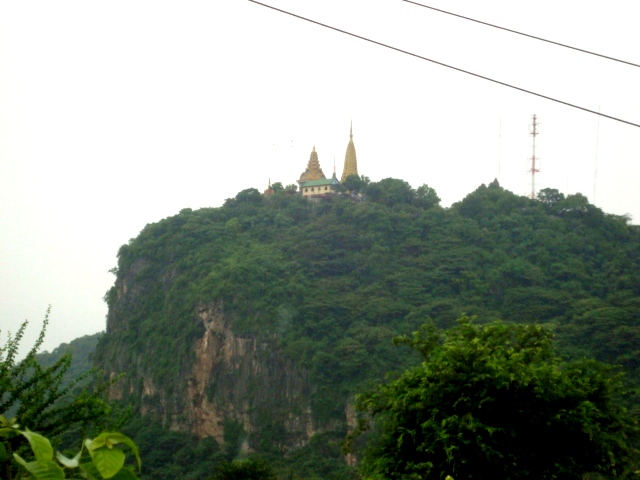
Our tuk tuk passes a tree covered hill with a Buddhist pagoda and stupa visible at the top. This is Phnom Sameau. I'd like to go up for a look, but Sok stops me. What's up there is a very sad memorial. “This killing field too,” Sok says somberly. “They have one cave for adult, have one cave for the children. (Khmer Rouge) kill baby with rock. The other cave for the parents. I don’t like see that."

What Sok is trying to tell Me, is that he doesn’t want to go to that horrific place again. I don't blame him. I’ve already seen too many cracked skulls and human bones at other killing fields during my stay in Cambodia, so I agree to travel on. We continue in our tuk tuk, heading down the bumpy dirt road. Next stop: the scenic, and tragic site of Kamping Poi.  

Sunday, January 25, 2015

FRENCH GHOST TOWN

Deserted French colonial resort community atop Bokor Mountain
I'm standing in the middle of a ghost town. A very empty, very eerie, ghost town. It's a French ghost town at that. I may be in Cambodia, but all these dark old buildings were built by the French colonials. 

It’s very eerie up here. I look around at the old buildings, and decide this 'hill station' was poorly named. This was once much more; a glorious colonial hill top resort. But no any longer, it's been abandoned for decades. 

Old concrete colonial buildings in various states of decay lie by a small mountain lake. By the placid waters, a two story hotel waits to receive guests that will never come. A larger building beside it housed a restaurant and night club. Beyond the lake are even more derelict buildings, including an old police station. Between them all, uncut green grasses are swaying in the cold mountain wind. 

After a strenuous seven hour hike up the mountain, I'm here to explore this place. The Bokor Mountain Hill Station was first constructed back in the 1920's. Given the tropical heat and lack of air conditioning in Cambodia then, this cool highland spot was built as a weekend getaway for French colonists. It later expanded, to include a casino. The decaying French architecture that I see everywhere, has an air reminiscent of the long gone roaring 20's. 


One of the few colonial era churches left in all of Cambodia
Closest to me is a Catholic church, with a cross reaching from the tower steeple. Heading up the hill, I enter. More chapel than church, this is one of the few old Christian places of worship left in Cambodia that was not destroyed by the Khmer Rouge communists. (Even the historical Notre Dame cathedral in the capital was leveled by the radicals.) Catholic priests that were found by the Khmer Rouge were executed, as were many Buddhist monks. After the communists' fall, the Buddhist faith recovered, but Christianity has not. The % of Christians left in Cambodia is now lower than before the Pol Pot years. 

Surprisingly, the church is relatively intact, save for graffiiti on the yellowish interior, and a hole in the wall used for a gun slit during the war. The old altar still remains. I wonder how many happy couples were married here. Since the main attraction at Bokor was the casino, I wonder if this chapel was used to marry young couples, much like the chapels in Las Vegas. 

Exiting and descending the hill, I look back up at the old church. My view is clear until moments later, a smoky mist comes across the sky behind the church. The mist parts around it and passes over it, giving an impression of spirits flying out from the church. An eerie feeling, an eerie sight. 


Ruins of the French colonial post office (click to enlarge)
There's much more to explore, so I follow the ridgeline road towards the cliff, rising up the hill to the resort’s peak. I find a shell casing on the road; it’s small in size, probably from a pistol. There is more evidence of violence on the building right in front of me. 

The Bokor Post Office is a reddish two story building, curiously large for such a small mountaintop community. It won't be handling any mail anymore. One whole corner of the building has been blown away, due to fighting that took place here between the Khmer Rouge and the Vietnamese Army. Bullet holes dot the exterior. The fighting here was fierce. 

Not all of the destruction here was from the Vietnamese fighting to dislodge the Khmer Rouge. The first conflict up here took place way back in the late 1940s. Back then anti-colonial Khmers known as the Khmer Issarak, (Free Khmer) charged up the mountain to oust the French colonists. 


Bokor Casino during colonial days

Passing the post office, I continue up. There were many landmines buried here during the war, and they've been cleared, (so they say.) Not taking chances, I stay on the road, and head for the largest building on the mountain. The once majestic, Bokor Palace Casino. This is nothing like a Vegas casino, but the abandoned palace is an intimidating structure. 

Approaching, it has a very forboding look. Four floors high, the wind is blowing mountain mist over it. Patches of dark orange paint have fallen away, revealing dark cement beneath. Dark green moss creeps across the exterior, looking for sunlight in this gloomy place. Grass and weeds grow from ledges. Even darker are the empty open windows, all broken or looted long ago. Their great black vacant spaces stare out at me like ghostly eyes. 


The spooky old abandoned casino today
I climb the staircase, and walk through the front doorway. I can almost hear the doorman from the casino's glory years: “Bon soir monsieur, bienvenue.”

Passing the vacant reception desk, I enter the largest room in the building. This was the casino. I can almost feel it: A luxurious weekend during the roaring 1920’s. French colonists in tuxedos, smoke cigarettes, and talk politics with the rich elite of Cambodian society. The roulette wheel whirrs, as gamblers try their luck at the tables. Their wives and girlfriends in the latest Paris fashions look on and gossip. Smartly dressed Khmer waiters bring around trays of champagne.The opulence, the luxury; this was the glory of French colonialism, an apt example of the decadence0 and opression of the time. 

Now the gaming tables are gone, along with every other bit of furniture. The casino is bare. The paint is faded or stained. I can hear the sound of running water, and looking up I see water lightly pouring in through the ceiling, leaving puddles dotted on the floor. The air is cold and damp, but there will be no heat coming from the empty fire place. The lavish lifestyle, gourmet French cooking, and high rollers are gone. The party’s over; the celebration of colonial life here is but a dim memory. 


Now looted, fortunes were made in the casino
I climb the casino's marble staircase to the top floor verandah. Looking out, just steps beyond this old ruin is a sheer cliff. The view up here is incredible. The drop is practically vertical, revealing a commanding view of the surrounding landscape. The plain far below the mountain is covered in a blanket of jungle, reaching the Gulf of Thailand beyond. Now I see why the Khmer Rouge fought so hard for this place. From this vantage point you can see any movement along the coast, whether by road or by sea. Well, at least they could see everything when the view was still clear. As I watch, a cloud of fog moves across my view, totally obscuring the scenery down below the cliff. 

With the wind and weather up here, visibility changes in seconds. These passing clouds are even more impressive outside the casino.You can be a hundred feet outside the front door, and watch the fog roll in. The mist grows thick and in seconds, the casino disappears completely from view. A minute later, the mist fades away, revealing the old palace again. It’s better than any TV magic trick. 

Walking the roof to the building’s west side, I find walls peppered with bullet pockmarks. Glass block windows are full of bullet holes from rifle fire. These are reminders of when the Vietnamese Army were here, blasting away at the Khmer Rouge. Fighting was heavy, until the radicals finally gave up and fled into the jungle. The Bokor hill station has been quiet and mostly abandoned ever since. Nature has gradually reinvaded the mountain top. Manicured lawns and landscaping have given way to lush green foliage and wildflowers. 


Rear view of casino, with young explorers sitting on railing
Nearby is a  rare sign of modernity up here in this ghost town; two new mobile phone towers. The mountain's altitude is appealing to cell phone companies. Phone towers aren't the only recent construction here. Just west of here, laborers are busy working today on a foundation. They plan to build a new '5 star' hotel and casino here, although there isn't a 5 star hotel in all of Cambodia. It’s an ambitious project that will take years.

It's beginning to darken, so I head to the only semi-modern building here that is actually inhabitable. The sign out front says: “National Protected Area Training Center”, the defacto hotel and ranger station, built with foreign aid money. It's where I'm sleeping tonight. 

My guide Tri leads our group in, and unfortunately for us, all guest rooms are taken by a Chinese construction crew. So our entire group is forced to bunk together in the ranger’s bedroom. I let out a groan; seven people will be packed into bunkbeds, in a small room with little ventilation. 


Casino looks over cliff to jungle below and Gulf of Thailand
After dinner, I lie down on my bunk bed. There’s no sheet, and the stench from the mattress is unbearable. I recall the words of the travel company clerk that sold me this trip. “Oh yes, first class accommodation. You have your own bedroom,” she promised me. I shouldn't be surprised, many third world travel agents, will say anything to make a sale. I politely explain my displeasure to my guide Tri, who apologizes. He can’t find me a sheet, but he does bring me a large clean towel. I lay it down on the offending mattress, and the stench is contained. 

Before going to sleep, our luck improves. Tri speaks to one of the monks from the monastery, and they have a truck leaving to drive down the mountain at 6am. We are welcome to ride along on the back if we want. Thankfully, my fellow trekkers vote to avoid the long sweaty hike back down the mountain. 

I lay down in the darkness, and slowly drift off to sleep. Tomorrow I'll leave Bokor, and I'll learn more of the compelling story of my guide Tri, a former soldier and survivor. 


The old chapel rises over the surrounding scenery.
Sunset on Bokor. Tomorrow I head down the mountain.

Thursday, January 15, 2015

CLIMBING A CAMBODIAN MOUNTAIN

Bokor Mountain, on Cambodia's southern coast
I've never climbed a mountain before.

Today I’m riding shotgun in a pickup truck. The windows are down, sun is out, and a few hearty souls riding with me are heading for Bokor Mountain in southern Cambodia. We've left the the town of Kampot to climb this mountain in one day, aiming to reach the old French hill station at the top.

We pull over, and a Cambodian park ranger climbs on, donned in a brand new khaki uniform and wide brimmed hat. He’s young; looks barely out of his teens, I wonder how long he’s been a ranger. Our destination: Preah Monivong Bokor National Park, a protected reserve (at least officially) so climbing groups must have a ranger accompany them. Our ranger isn’t armed; how will he protect us if a problem arises?

Our pickup turns off the highway, and onto a rutted dirt road, crossing railroad tracks from the old French built railway. There's no need for crossing gates; the trains haven't run for years. The dirt road narrows to a path, and the pickup halts. Climbing out, we grab our backpacks, and begin our trek. The wide dirt path soon narrows, and the greenery grows thick. The path steepens, and soon we are rising up the mountainside and into the jungle.

Grabbing our backpacks off the pickup, we start our trek
We stop for our first break by a creek, and I'm startled by two young Khmer men. They are walking back down the mountain path, each with a bicycle. It’s too steep to ride the bikes, and strangely, each bike has a long plank of newly cut wood strapped to it. I quickly realize who they are: wood poachers!

The ranger accompanying us stops them, and a long conversation in Khmer begins. Though they have been caught red handed, they don’t make any effort to run, which wouldn’t have been easy, since they both wear sandals.

Then our guide says it’s time to go. He takes us up out of sight of where the ranger and poachers are, and then we stop to wait for the ranger. When he finally rejoins us, we depart again. Hmmm.... Since the ranger dealt with the poachers out of our sight, I wonder if he had collected a bribe from them. Poaching of all kinds is a serious problem on Bokor Mountain.

We continue climbing, and we run into two more poachers! They're probably working with the others we saw earlier. Each carries a chopping tool, which looks like a cross between a machete and a meat cleaver. We walk up out of sight, and wait for the ranger again. When he rejoins us again, this time he's carrying the confiscated cleavers.

We encounter wood poachers on our way up the mountain path!
Although we are mostly in the jungle's shade, it’s still very hot and humid as we climb. Soon my shirt is soaked through, complete with a couple holes torn into it from a passing thorny vine. Six climbers have joined me on this ascent, including three Israelis, an Englishman, the park ranger, and our Khmer guide.

Continuing our jungle ascent, we reach a scenic waterfall. The wildlife is beginning to show itself. A lizard with a spiny back glares at me without moving, as I try to stare him down. He wins. He lives here on this tree branch, and I’m just passing through.

This mountain is a good choice for a national park. Along our journey I will see two pelicans, a hawk, and a large black monkey that ambled across our path. There are even elephants and tigers here too. Sadly, their numbers are very few, thanks to all of the poachers.

We find other wildlife here as well, but the unwanted kind: LEECHES! Our guide finds a leech on his neck. An Israeli spots one on his lower leg. I'm glad I'm wearing long pants; it’s not a good idea to wear shorts in the jungle. They remove the unwanted hitchhikers, and we continue on our way.

Dangerous White-Lipped Pit Viper by the path
Suddenly our guide stops our progress. Coiled in the brush right next to the path, is a bright green snake with yellow eyes. It’s not very long, it's no cobra, (of which Cambodia has many) but when it comes to venomous snakes, size isn’t everything. “Very dangerous,” our guide says. We've encountered a White-Lipped Pit Viper! Our guide pokes at it with a long stick, and it slowly slithers away into the jungle. Our climb continues.

As the day heats up, we rest again on a surprisingly wide dirt road that crosses our path. This road follows the tracks of the old original road up the mountain built in 1921. Supervised by the French, the heavy work was done by indentured Cambodian laborers. Some worked so hard, that they died from overwork. The new widening of this track today is being done by a Chinese construction company, and they've been troubled with labor disputes. Cambodian laborers working here now complain about being overworked for little pay. Exploitation of local labor continues.

Before this project began, visitors to the mountain top drove up the old road in pickup trucks, spent the day there, and were back down before dark. But now the Chinese construction company totally closed down the road to visitor traffic. So we're going up the only way we can: on foot. After spending the night up top, we'll go back down tomorrow morning.

Odd looking lizard stares me down
After hours of climbing steep trails, drinking two liters of water, and with muscles growing sore, we reach a dark stone building sitting on the edge of a cliff. It’s time for lunch, and we’re having it at the 'Black Palace'. I walk into this abandoned shell, and it's not much of a palace, it’s more of a ruined villa. Khmer naga heads sticking out from the rooftop corners let on to its royal ownership: this was once owned by the king. But since then the palace has been totally looted. There’s not only no furniture, but the windows are gone, bathroom fixtures are gone, even some of the floor tiles have been torn up.

Sitting on the window ledges looking out towards the cliff and the ocean, we dive into our lunches of vegetable fried rice. 'Black Palace' is an odd title for this place, as the inside walls are covered with bright orange paint!

With lunch in our bellies, we pick up our packs and move on. The rest of our hike up will be on the road, so it’s not so steep. Now that we are at higher altitude, the temperature is noticeably cooler.  I breathe a sigh of relief in the clean mountain air. From here on in, the climb will be easier.

Waterfall on the way up the mountain
A couple more hours into our trek, a light rain begins to fall. Fortunately we're prepared, and we all don rain gear. We pass a Buddhist shrine, and down a side road I make out a Buddhist monastery. This was built recently, after the departure of the brutal Khmer Rouge communists. Normally this would be worth a visit, but we're all anxious to reach the old hill station, so we press on.

Finally, after seven hours of hiking and climbing, we arrive. I've made it: the top of Bokor Mountain. I have to admit, I'm proud of myself. I've never climbed a mountain before, and having lost lots of energy in the climb, I'm relieved. The heat and humidity I suffered on the way up are forgotten, as up here at the top of the mountain, it’s very windy, even cold.

But even more, I'm amazed at the view. This is isn't just an old hill station, it's much, much more.  It's a French ghost town! I'm re-energized by this historic scenery, and I can't wait to explore what covers the peak of Bokor Mountain.


CONTINUED IN NEXT TRAVEL STORY: FRENCH GHOST TOWN


'Black Palace', once owned by King Sihanouk

French ghost town atop Bokor Mountain

Friday, May 2, 2014

PHNOM PENH RUINS & NIGHTMARE EVACUATION

Crumbling French colonial building with collapsed ceiling in Phnom Penh
Stepping out for a walk around today’s Phnom Penh, I find a vibrant city, humming with commerce. Strolling through the old downtown, I spot a group of French tourists also out for a stroll. I’m surprised I’ve seen so many French in Southeast Asia. These countries used to be their colonies, and they had lost them. There weren’t many Americans around, except me. 

The French certainly feel at home with the surroundings, as French architecture is still dominant. Familiar French shutters, ornate mouldings, and neoclassical designs leave a hint of romance for the colonial days. 

Yet the years of neglect and tropical weather have taken their toll. All over the city, these old colonial shells are crumbling. 

Unlike in Vietnam, only a small percentage of Cambodia’s French colonial buildings survive in excellent condition. The former French Embassy – gone. The Notre Dame Cathedral – also gone, destroyed by the atheist Khmer Rouge. With so many decades of poverty and war in Cambodia, survival had to take precedence over the maintenance of old buildings. 
Vacant ex-colonial government building

Continuing my walk on Samdech Sothearos Boulevard, I pause before a faded gem of a structure. A former French colonial government building, it’s glory days are but a memory. Romanesque pillars hold up sagging ceilings. Shutters have been looted, leaving gaping holes for windows. The yellow colonial paint has weathered away, leaving a dark bare underside. 

What should be an architectural treasure, is totally vacant. This is prime real estate downtown, and nobody is living there. It sits empty of life. There was a time, when all of Phom Penh was as empty as this old building. 

It wasn’t so long ago, when Phnom Penh was a ghost town. 

When the radical communists known as the Khmer Rouge captured the capital on April 17th, 1975, Cambodia’s long civil war had finally ended. The people of Phnom Penh were hoping for a peaceful transition. They hoped that the Khmer Rouge would be reasonable. They were wrong.

And none of them could have predicted what was about to happen next. The victorious Khmer Rouge immediately forced everyone out of the city that same day. 

Everyone. Without exception. 

Upon entering the capital the Khmer Rouge soldiers, some not even teenagers yet, ordered the entire population of the city to immediately evacuate Phnom Penh. Blaring orders over truck borne loudspeakers, they announced the ludicrous claim that “the Americans are coming to bomb the city”. 

Anyone who resisted the order was killed. More than 10,000 people were murdered that fateful day, including many high officials of the former US backed government that had peacefully surrendered. The people of Phnom Penh quickly learned that the end of the long civil war, had only meant the beginning of a whole new nightmare. 


At the point of a gun, Phnom Penh’s city folk were forced to walk for days out into the countryside. Families were separated, many never to see each other again. Everyone was forced to live in rural communist work camps and agrarian communes. City folk were instantly converted to farmers. They had became slave labor, working rice fields for the Khmer Rouge in their ‘communist paradise’. 

Individual freedoms, private business, and even money were outlawed. Any resistance brought beatings, or death. The brutal Khmer Rouge leadership officially declared this new beginning as, ‘Year Zero'. For nearly three years, ALL of the apartments, shops, hotels and offices that I see around me in Phnom Penh, were totally vacant. The city’s empty streets saw only the passing of a rare Khmer Rouge patrol. 
Phnom Penh became a ghost town after the Khmer Rouge takeover (museum photo)


Today as I look around at all the Khmers going about their daily business here, one undeniable truth exists for everyone I see that's over 30 years of age. Anyone in Phnom Penh old enough to remember that time, has a heartbreaking personal history. Absolutely EVERYONE was left traumatized from those horrific years. All can tell you shocking tales of relatives that were tortured, and killed. Others are still missing, having disappeared long ago. These Khmers survived years of repression, slave labor, and famine. And that’s just the beginning of the horrors that they went through, the list goes on. The only thing good that can be said of those awful years, is that they’re over. 

These Khmers are true survivors. 

Thursday, January 30, 2014

LOST CIA BASE AND BUDDHIST RUINS

Photo of secret CIA base of Long Tieng during the war (from cia.gov website)
I’m looking to go to a mysterious, formerly secret US built air base, but it’s going to be much more difficult than I thought. “You can only go there with special permission from the military,” a Laotian travel guide is telling me. “It’s a military base.” 

The 'Secret War' in Laos had a secret city, and this was the remote, hidden base known as Long Tieng, south of the Plain of Jars. During the long war in Laos, it was the busiest airport in the country. For years it was a key air base for the CIA’s Air America, and US spotter pilots. It was also headquarters for famed general Vang Pao and his 20,000 strong Hmong militia. To the communists Vang Pao was Public Enemy No. 1, and the general lived in his mountain hideout with thousands of Hmong families that had fled the fighting. Many ethnic Hmong villages were destroyed during the war. 

As with many things connected to the Secret War, Long Tieng did not officially exist, and wasn’t found on any public maps. This was odd since at its peak, this ‘secret city’ sheltered 40,000 people, making it the second most populated city in Laos back then. Its cover was blown in 1970 when two foreign journalists snuck in. 

As major fighting ended in 1973, Long Tieng was taken over by the communist government, and it’s been their base ever since. Vang Pao left for exile in the US, joined by thousands of Hmong refugees. He settled in California, though he never forgot his mountain homeland, and his long suffering people still fighting the communists. In 2007, he was arrested near Fresno, charged with plotting to overthrow the Laotian government. The charges were later dropped, and he died in California in 2011, still a hero to the Hmong community. 

I’d like to see his infamous base, but as I’m being denied, I hear a tone of concern. The Laotian explains that real danger is involved. “There are still guerrillas fighting up there,” he says quietly. Despite my inquiries, he won’t elaborate further. Just like I had heard in Vang Vieng, there are still groups of Hmong holding out up in the mountains. They’re not only hiding, they’re resisting, and with force. Since seeing Long Tieng is out of the question, I book a trip to another seldom visited place, the once destroyed town of Muang Khoun. The next day, I’m on my way there. 

* * * * *

Antique French tile, covered with greenery
I’m looking down at antique European tile. Decorated with intricate handmade designs; interlocked circles are interspersed with diamonds. The tile’s original colors have faded; it’s now mostly black and white. The bright green color now surrounding the tile beneath me, is what has been reclaimed by the environment. Grass and weeds have taken over the floor as the decades have gone by, re-covering the tiles with a natural carpet. 

These natural grasses are able to grow inside this building, because the roof is gone. The tile, the arched doorways and the windows give away the origin of the former occupants. This was the French commissariat, and now it’s just a bombed out shell. Where the old darkened plaster has fallen from the walls, another color has peered out, that of bright orange brick underneath.  

I’m in the former provincial capital of Muang Khoun. Back when it was the capital, this town bore the same name as the province; Xieng Khuang.

It’s not just old French buildings that were destroyed here, practically the whole town was leveled by US bombing as the North Vietnamese Army invaded. After the NVA occupied Xieng Khuang, Hmong troops later retook the town for a while, although they couldn’t hold it. With most of the country rural, there wasn’t fighting in Laotian cities very often, and here was an exception. 


Ruins of French built commissariat that was destroyed during the war
Destruction was so heavy here, that the town was abandoned by the war’s end. My guide explains: “Move capital to Phonsavan. One reason, already destroyed. Number two reason, very high UXO." (Un-Exploded Ordinance)

In decades that followed, the town has been re-inhabited, but old tensions from the war still remain. In 2000, fighting erupted again in this region between minority Hmong and ethnic Laotians over a land dispute. Some homes were burned to the ground, five ethnic Laotians were killed, and more were wounded. As has happened before, the military came in to put down the Hmong uprising. The number of Hmong casualties from these events are unknown.

Today I’m stuck with another Laotian guide, so unfortunately the Hmong who remain here won't tell me about the troubles, since an ethnic Laotian is present. Much of Muang Khoun has been rebuilt, and the town now has around 14,000 people living here. 


Centuries old Buddhist temple in Muang Khoun. This Buddha statue survived the bombing.
The rain picks up, and we leave the ruin to wait out the weather in our SUV. I ask my translator to turn on the radio, but in this remote region there's little selection. He finally tunes into an AM station. As rain pelts on the roof, I listen to a Hmong singer, accompanied by Laotian music. My guide explains, “This radio (station) paid by UNDP. (United Nations Development Program) It’s the only station you can receive here.” In between music, they give the listeners health and hygiene messages. 

The rain lets up a little, and we walk down the road, finding the remains of a temple ruin. A group of geese waddle by me, as I climb the front stairs. This is called Wat Piawat, which means ‘biggest wat’. My guide says it is 600 years old, though experts say it's less. This once grand temple is from the old kingdom of the Lao Puan. Like so much of Laos, they would later be subjugated by the Thais, and the Vietnamese. 

Not much of the temple has survived. Up on a raised platform, some old pillars reach skyward. Much like the French colonial structure, the roof is gone, and sections of bare orange brick walls remain. Given the destruction of the rest of the temple, it’s amazing that a tall Buddha statue is mostly intact. Only an arm and the head have been damaged, The stone Buddha is seated, reaching higher above the rest of the ruins. 
Buddhist stupa looted by Chinese invaders
Despite the temple’s condition, the local Buddhist faithful still have occasional ceremonies here. I note that a bright orange sash is wrapped over the icons shoulder, with a few offerings left at the base. 

Hopping back into our vehicle, we make a final stop in town. After parking the SUV, my guide directs me up a hill. It’s a steep dirt road, and he’s afraid of getting the vehicle stuck in the rain. He warns me to stay out of the deeper grass to the side. 

As I head up, I wonder why he warned me about the grass. Rising high ahead of me, I find a large old Buddhist stupa coming into view atop the hill. Somehow this stupa survived all the heavy bombing, though it isn’t intact. There is a great hole that has been dug through the base, going all the way through to the other side. This is unlike any stupa I’ve ever seen before, it’s mostly covered with grass and brush, and it’s also leaning to one side. As I look at it from a distance, it resembles an old pointed wizard’s hat. 

Like all stupas, the interior of this tower once held relics or artifacts, but they were removed by looters long ago. The offending tunnel was dug straight through the stupa by Chinese Ho invaders in the 1800’s. I’m learning that it wasn’t just the 1964 - 1973 war that destroyed Laotian heritage. This had also happened to earlier generations, from invasions by the Chinese and Vietnamese. 

I walk through the tunnel underneath, and looking up, I can see lighter colored stone; part of an older stupa encased within the larger outer one. I ask my guide about the stupa’s history, and for once he doesn’t offer much. The relic is somewhat of a mystery to the local population. They don’t know how old it is, or what it’s original purpose was. 
Remains of another Buddhist stupa, destroyed during the war

From the stupa platform I look to a nearby hill, and see another ruined stupa, destroyed almost down to the base. Sadly, there are many of them around town. My guide says there used to be more than 30 wats and temples in Muang Khoun before the war, and all were destroyed. He laments that if the war hadn’t happened, this town would have become a UNESCO world heritage site, much like beautiful Luang Prabang is today. 

On the way back down the hill, my guide discovers a leech on his ankle. Now I understand why he told me to stay out of the deep grass! He quickly kicks it off into the brush, before it can dig into his skin. Since I also walked through grass, I’m surprised that the leeches didn’t latch onto me as well. 

Maybe they prefer Asian food to American food.


Thursday, November 14, 2013

ICE CREAM SOLDIER FOUGHT FOR 2 ARMIES

He’s standing alone on a Luang Prabang street corner, and you might hear him before you see him. 

“Hello!” he calls out loudly to those walking by. “You want ice cream?” He speaks energetically through a plastic cone held up to his mouth, much like a cheerleader. His outspoken salesmanship is unusual for normally reserved Laotians. But the passing potential customers still turn him down. 

Undaunted, he cheerfully sends them positive wishes as they walk away. “I wish you good luck! I wish you happiness!” Short and thin, he’s the excitable type, with an infectious energy that most street vendors lack in Laos. His mismatched clothing is too big for his small stature. He has a full head of grey hair; despite his age he still has a youthful gleam. 

His name is Tay, and he doesn't peddle his product from an ice cream truck, or an ice cream cart for that matter. He sells his treats from a simple bicycle, with a small cooler strapped onto the back. With such a positive attitude, I knew that this senior ice cream salesman must have an interesting story to tell. He did. 

Tay is 74 now, but he’s not originally from Luang Prabang. He grew up in a village further north. As a youth in French colonial Laos there was little opportunity available, so he decided to join the military. 

“1952, I go to French Army,” he tells me. At that time the colonial years were waning, and Laos soon became independent. But the French Army's departure didn’t end Tay’s military career. 


A Royal Laotian Air Force T-28, taxis during the war (Photo: Wikipedia)
“French go back to Paris,” Tay continued. “1957, Americans come to Luang Prabang.” 

Now he was in the Royal Laotian Army (RLA), on the side of the Americans. Tay gestures across the Khan River towards Luang Prabang airport.  Back when the Americans were here, it was a major air base for both Laotian and American aircraft. Tay was based there.

“T-28 fly here,” Tay says, recalling the days when US made T-28s flew combat missions from the base. The T-28 Trojan was an old World War II propeller plane, refitted for combat use by Laotian pilots. He remembers the much faster US Air Force jets as well. F-104s and F-105s flew in from bases in Thailand, and circled overhead. 

In those years Tay already knew how to speak Laotian and French, and soon he picked up English too. So the military put his language skills to use, assigning him to communications. His rank rose to Sergeant. He frequently operated a radio while airborne, assisting the Royal Lao Air Force. 


This former military air base is now Luang Prabang's current airport
“I see my friend (below),” Tay said, while pantomiming how he would wave out the window to his army buddies, as their plane swooped down low over RLA ground troops. In those days Vietnamese infantry were pushing into Laos, and American air power joined together with Laotian government soldiers on the ground to push them back. 

Tay summed up all three eras of power here, in three short sentences: “In Luang Prabang, French responsible. Then America responsible. Then Lao responsible." 

When control of Luang Prabang shifted for the last time, it meant the end of Tay’s 23 year military career. When the communists took control of Luang Prabang in 1975, the RLA ceased to exist, and Tay was stripped of his military rank.  He was sent into the 're-education' camps. Imprisoned far from his family, he won't talk about those years. But everyone knows conditions were bad in those prisons, and some prisoners died. Tay survived.

When he was finally released five years later, Tay made his way back to Luang Prabang. He sold ice cream for a while. Then foreign tourists began returning to Luang Prabang, and his language skills served him again. 

“I go to travel with the tourists,” he says, describing his tour guide job. In those post-war years there weren’t any Americans visiting Laos, it was mostly French and other Europeans. To this day he still speaks French well, even better than his English.

In 2004, he decided he was getting too old for the tour business, so he retired from it. But without any pension, he still needed an income. “I go sell ice cream again,” he explains, “because I’m poor.” 

As we’re chatting, a light rain starts to fall. Tay’s ice cream business is always slow during monsoon season. He’s looking forward to the dry season, when sales pick up during Luang Prabang’s annual festivals. 

I purchase one of the ice creams Tay has on offer. I’m a little leery of the quality, but after tasting its sweet coconut flavor, I have to admit that it was delicious. I give him a generous tip, although it seemed such an insignificant gesture. Tay had joined the side of two powerful foreign armies, hoping to better himself, and provide for his family. Both of those armies departed. Both of them let him down. Rather than having the good army pension he deserved, he was left in poverty. 

Still, like most Laotians, Tay’s life is not focused on money. He may not have much cash in his pocket, but he is rich in family. His four children are grown and married, and now he has grandchildren. 

As I shook his hand to depart, Tay said goodbye in his usual positive manner. “I wish you good luck, I wish you good health, and prosperity!”

I wish that I could give him all of those things. 

Thursday, August 15, 2013

FRENCH ARCH IN ASIA

The 'Patuxai', modeled after the Arc de Triomphe
I'm on Lane Xang Avenue, and a towering arch before me rises high above the surrounding city landscape. As I approach, I’m impressed by the architecture. The Arc de Triomphe immediately comes to mind. But I’m not in Paris, I’m still in Vientiane.

This arch, known as the Patuxai, was obviously inspired by the Parisian version. Built after the independence of Laos, the French colonial influence is obvious. Even the street lamps in the surrounding park are French in style.

Constructed in the early 60’s, the arch at one time was originally to be a monument to Laotian war dead. The cement used to construct it was stolen from an American aid project, that was meant to build a runway. The theft was no surprise, given at how corrupt the Royal Laotian Government was back then.

An informational sign on the arch has the following amusing sentence: “From a closer distance, it appears even less impressive, like a monster of concrete.” That’s a rather harsh observation. It does have a drab grey concrete color, since the arch was never completely finished, and left unpainted. From a closer viewpoint, what is more noticeable is the detailed artwork. Pointed Asian spires reach for the skies from three towers at the top. Buddhist figures appear as though they were carved right out of the walls. The arch may need a coat of paint, but it’s still very impressive.

There are three viewing levels, so I head up the arch's stairwell. Looking down from the highest tower, I can see all the way to the Mekong River. Surveying the surrounding scenery, I notice that no building in all of Vientiane is taller than the arch, and apparently that’s by design. There’s an old local law requiring that all buildings constructed in the capital must be shorter than the Patuxai, which helps Vientiane keep its small town atmosphere. The only exception is the rather odd looking Don Chan Hotel, down by the river. The rest of the view is serene.

View from atop the arch, looking down Lane Xang Avenue
From high above, I look down on Lane Xang Avenue, which runs straight towards the arch. As usual, traffic is light. The boulevard was named after one of the old powerful kingdoms of the north, and as such it became the widest street in all of Vientiane. It’s the only six lane boulevard in all of Laos.

I take a deep breath, enjoying the best view of the city. I can see far off mountains, the Buddhist temples, the Mekong, everything. It’s from this viewpoint that I notice that Vientiane is the greenest capital in Southeast Asia. There are plenty of trees reaching higher than the surrounding buildings. Only the mobile phone towers reach higher. Like in Vietnam, Laos has leapfrogged past land line phones, and opened up their markets to the mobile phone craze. 


Before I descend down the arch, I stop in a souvenir shop. Looking
through a stack of framed photos, a striking image stands out. One shows a group of US soldiers holding up an incredibly long snake skin! The caption says: “Queen of Nagas (a mythical snake) seized by American
US soldiers hold up the skin of a 7.8 meter long snake! (Photo: Patuxai Shop)
military on Mekong River, Laos military base on June 27, 1973 with the length of 7.8 meters.” That has to be some kind of a record for snake length.

Besides the other usual gifts of figurines, jewelry, and coins, I notice something else on offer that isn’t sold back home. Disturbingly, they are selling what appear to be tiger claws! Laotian laws prohibit the sale of products from endangered species, but it’s not often enforced.

I ask to see one, and the salesman pulls one from the glass case. It looks and feels real; judging by the size it must have come from an adult. I decline to purchase it, since buying it would only encourage more poaching. Being caught with one at the border might even get me arrested.

I head for the stairs, and soon I’m back on the ground, walking the streets of Vientiane. There’s still a great deal to be seen in this city.

Tuesday, August 6, 2013

FADED COLONIAL LIFE OF VIENTIANE

Presidential Palace of Laos in downtown Vientiane

I stand at the gate of the Presidential Palace. A grand, classic French dominion painted grey and white, this is one of the few colonial buildings in Vientiane that is well preserved. Appearing as though it was transported directly from the French countryside, the colonial governor used to reside in this mansion of stone.

What may be the largest Laotian flag in the whole country, flies from a flagpole out front. Curiously, the Laotian flag is not your usual communist flag. Blue and red with a large white circle, it more closely resembles the flag of Thailand.

From what I can see there is little activity inside. In fact, looking around I don’t see a single soul. There’s not even a security guard around. I’d love a tour, but the palace isn’t open to the public. Sadly, the grand edifice is only used for occasional government functions and ceremonies, so I depart down the street to further acquaint myself with Vientiane.

One of the quietest capitals in all of Asia, Vientiane has a sleepy feel to it, as though it is still waking up after a
Buddhist monks pass a deteriorating old French colonial house
decades long nap. With a population of less than a quarter million, it’s far less crowded than Hanoi, or Bangkok to the west.

“I like Laos more than Thailand,” I heard from Tony, a retired English soldier who works on mobile phone towers in Laos. “It’s quieter here. Life is better.” For most of the small expat community that lives here, the slower pace of life here is their preference.

As I walk around Vientiane, a capital void of skyscrapers, it resembles a town, not a big city. There isn’t much garbage lying in the streets either. Like the rest of Southeast Asia, the crime rate here is fairly low, and violence is rare. When there is a murder once in a blue moon, it’s usually connected to drug trafficking.

A pair of monks pass me by in their bright orange robes, a common sight in the downtown. Buddhism in Laos is even stronger here than it is in Vietnam, and there are many Buddhist monasteries in this part of town. A few blocks on, I reach a legacy of the French; old
Dilapidated French colonial house; few are well preserved
mansions with French architecture. Vientiane is actually a French word, their own pronunciation of the Lao name for the city, “Vieng Chan”, which means “city of sandalwood”.

Passing once luxurious homes, the glory years of these deteriorating buildings are long gone. French colonists who inhabited them left in 1953 when Laos regained its independence. These high ceiling mansions were once the envy of Laos, homes to French officials living the quiet life. Vientiane was a  backwater in those days, as Laos was one of the most isolated, least desired outposts in the French empire. For today’s foreign diplomatic corps, not much has changed.

Some of the original French colonial structures I’m passing are now government buildings, and they obviously need of a coat of paint. Although some chateaus have been fairly well preserved, most are not, and look dilapidated. I pass one with an exterior wall so deteriorated, that large sections of plaster have fallen away, exposing bare brick underneath.

Unoccupied riverfront home is overgrown with weeds

When the French left these homes, they were replaced by the Laotian elite, but by the late 1970’s the upper class had gone as well. Members of the ruling elite were either sent to prison, or had fled the country due to the rise of the Pathet Lao. Most houses were taken over by the communists and their families. As the economy took a dive in the late 70’s and 80’s nobody had the money to repair these once opulent homes, so these beautiful old buildings simply fell apart. The destruction of Vientiane’s beautiful old colonial buildings didn’t happen from the war, it was caused by age and a lack of maintenance. Passing more old mansions and chateaus with closed French shutters, I find a group fenced off. These are completely unoccupied, with grass and weeds growing out of control. I wonder if these are in line for renovation, but its more likely that they will be torn down to make way for new construction. It’s sad but true, that much of Vientiane’s rich heritage is falling to the wrecking ball.

Unlike Hanoi or Saigon, Vientiane’s old colonial buildings didn’t face much destruction due to the war years, except for one battle after a 1960 coup. As different factions took sides in the cold war, forces led by an army centrist,Colonel Kong Le, seized power to keep Laos neutral. When soldiers loyal

Old USSR built building is nearly vacant
to the previous government moved to retake Vientiane, fighting left 600 people dead, and some areas of the city were in ruins. That would be the last major battle in Vientiane, until the present day.

As I walk through Vientiane’s neighborhoods, there are few reminders of those decades past. I do see a couple of US military style jeeps driving around town, but they aren’t original. These olive green copies weren’t built in the US, they’re counterfeits!


There are some folks here learning English, but it’s not as widely spoken as in Vietnam. I saw one Laotian woman walking down the street wearing a tee shirt that said, “Just two women away from a threesome.” Obviously she didn’t know what that meant.

Traffic in Vientiane is a welcome change from other capitals of Southeast Asia. It’s light, rarely crowded, even for rush hour. Most Laotians in town travel on motorbikes, or crowd into a bus or truck. Annoying tourist buses are few. Very common are tuk-tuks; open air vehicles that look half motorbike, half golf cart. 


Along with the slow pace of traffic in the city, commerce here is relatively quiet. There are many cafés, restaurants and hotels downtown, but advertising is muted. Vientiane is the economic center of Laos, but big business is not very visible. There is no rising skyline, and few large billboards. The advertising I see most often, is for the most popular drink: Beer Lao.

For a one party communist government, I’m surprised at the small number of government billboards in town. I suppose that when the government returned to capitalism, they decided hard line communist propaganda wasn’t the way to go anymore. Their public presence is low
Old communist flag, hanging near a Buddhist shrine??!!
key, even the police are less visible. Still, everyone knows the communist party are the real people in charge in Laos. 

Passing through Nam Phu, a downtown fountain plaza, I look up at a gloomy, brown and white building that looks like something out of hard times Russia. One of the larger buildings in the downtown, this boxy structure looks totally out of place, mostly abandoned. An Aussie expat told me that this seven story monstrosity was built with aid from the former Soviet Union. 

“It used to have a communist logo sticking out from the roof,” said Robin, a restaurant owner, “but that’s gone now.” Office buildings built during the Soviet era were never really known for their quality, or their aesthetic value.

Away from the government ministries, there are few visible reminders of the lean days of communism, but I spot one as I head towards the river. Walking by a row house, I see a red flag marked with the hammer and sickle hanging over a balcony railing above. Also on the same balcony, is a small Buddhist shrine. I suppose the resident here felt the need to pay homage to both. Such contradictory symbols, but that’s how Vientiane’s residents survive.