Showing posts with label Buddhist. Show all posts

Monday, April 17, 2017

TEMPLE OF THE LAST HOLDOUT

The roof collapsed on this old temple building in Preah Vihear
I’m at the ancient Preah Vihear temple site, where Thai troops have recently had gun battles with Cambodia soldiers over control of the temple. There’s no shooting today. So far.

It’s a long climb up the ancient stone block steps, and eventually I reach the top. To Khmer worshipers of old, perhaps this was a metaphorical climb towards heaven.
With sore legs after the climb, I reach the top, The old temple sits on a stone platform, and it’s somewhat ruined. The roof has totally collapsed, leaving immense stone pillars and beams. Some stones are jacked up by strong wooden supports, to keep them from collapsing further. 

The style is obviously the same as the temples at Angkor Wat. It makes me wonder why the Thais would want to fight for this temple, when it was so obviously built for a Khmer king.

As I look around, a Cambodian policeman walks up. I discover that he speaks a fair amount of English; his name is Kuhn. He says there’s no fighting here today, (at least not yet,) so he offers to show me around the temple.

Barbed wire blocks the border to Thailand
From high up on here the hill, I can see well over the line of control onto the Thai side of the border. On the horizon is a vast green plain, eastern Thailand. On a nearby hill, I can make out a couple of Thai civilians walking down a modern paved road that ends at the closed border. No wonder so many Thais used to come here before, they didn’t have to endure the long trip on a nasty dirt road I just traveled. They could take nice air conditioned buses all the way here, walk across the border, visit the temple, walk back to the bus, and be way back in Thailand before dinner. But not anymore, the border is closed due to the recent fighting.

There are few buildings visible on the Thai side, it’s mostly trees and brush.
Kuhn points to a prominent white government border building flying the Thai flag. “Ta Mok’s house was there,” he tells me. This is the third house I’ve seen that belonged to the murderous Khmer Rouge war chief. I wonder how many more houses he had.

From this high vantage point, I can look down on the Cambodian Army’s dugouts and bunkers. Trenches cross over the hill, and out of sight. I don’t see any such fortifications on the Thai side, but they are over there somewhere, well camouflaged.

Kuhn takes me behind the temple, onto a long, wide walkway reaching up the hill. It’s made entirely of heavy stone blocks, and has many more stones than the temple I just saw. It must have been a monumental effort to haul these blocks up the mountains, all those centuries ago.

View of conflict zone. On left: Thailand. On right: path for Cambodia soldiers along trench line.
Continuing up the hill, we reach another temple building, bigger than the first. I discover that Preah Vihear isn’t one temple building, but several, with adjacent shrines and a pool. This place is bigger than I thought.

I explore two more temple buildings, one has elaborate carvings and a collapsed roof above. The other is a stone Khmer style tower. Curiously, a large green tree is growing out of the roof.

Kuhn points out his temporary house off to the side, not 100m from the temples. Between the trees are some lean-tos, and flimsy buildings. “I live there with my wife and daughter,” he tells me.

For years, nobody could live on that land, as it’s a former minefield.

Heavy stone blocks make a path connecting the temples
Back in the 1980’s when the Vietnamese communists occupied Cambodia, many Khmer Rouge fighters were crossing back and forth from sanctuary in Thailand, so the Vietnamese laid more than 2 MILLION landmines along the Cambodian border, known as the K5 belt, where they continue to kill and maim today.

Many of the minefields close to the temples have been cleared, but with the current border conflict, I wonder if they are laying more mines elsewhere. One step forward, two steps back…

Along the wall of this old temple complex, is a tunnel opening. It opens into a large military shelter; an artillery casing sits at the entrance. Close by is another bunker for the soldiers, and parts of the wall were made from ancient stones they took from the temple. Preservationists would be horrified. These were originally built by the Khmer Rouge; this religious site that was sacred to both Hindus and Buddhists, became a military base for communist atheists.

A tree grows atop a temple tower
Some of the walls on the last temple building are peppered with bullet holes. This was the last holdout of the Khmer Rouge. Even after the communists laid down their weapons near Anlong Veng, hardliners still held out here. The Cambodian Army perhaps could have beaten them here, but they were restrained, as they didn’t want to destroy the temple. They could have used heavy artillery, but they didn’t; one artillery barrage could have irreparably destroyed the entire temple complex. The last communist holdouts finally agreed to peace with the Cambodian government in 1998.

Looking from up high to the east, I can see far along the Dangkrek mountain chain. Not far away in that direction, the opposite side of the border changes from Thailand, to Laos.

I enter the last highest temple building near the cliff: the Central Sanctuary.

Within are Angkor era carvings and architecture, familiar to me by now. There’s an inner courtyard, with some collapses surrounding walls, and others still intact. Impressive hallways and arched ceilings are made entirely of stone. I wonder how many of the ceilings have collapsed over the years from age, or from the violence of men.

While some stones have collapsed, other temple walls are still standing strong
In the courtyard’s center is the innermost shrine. Much of it is still intact. The intricate decorative carvings have survived, though the colors and paint have faded from time, leaving faded grey and white stone underneath. Ducking inside, I see a Buddhist statue through the shadows. Some old offerings from rare pilgrims are left at its feet.

Walking out behind the last temple, a dirt path leads to bare bedrock on the edge of a cliff, it’s well over 1,500 feet down. There are no trees blocking my view. In front of me is the most amazing view in Cambodia. Far beneath me is a vast carpet of a greenery, a flat plain that stretches to the horizon. Only a couple of dirt roads cut across the green scene. 


From atop the cliff I get a fantastic scenic view of Cambodia
Small dots clumped together by a crossroads are the village houses of Kor Muy, where my driver Shanghai awaits me.

I’m in awe of this view. No wonder the Thais are fighting them for it.

I bid goodbye to Kuhn, and mount a motorbike taxi for the trip down the mountain. On the way down, we pass a convoy of government officials on their way up, with journalists in tow, carrying cameras and camcorders.

Soon I’m down the mountain, and the motorbike driver drops me in Kor Muy. Word is going around the village that while I was up by the temple, there was another border incursion by Thai soldiers. The conflict here isn’t over yet.

I find Shanghai, and we head back to his muddy car. He fills his old Toyota Corolla’s radiator with water, and we start the long drive back to Anlong Veng.

Landmine warning sign. Stay on the path, or your next step might be your last.
After the long journey, I’m back at my hotel, and I flip on the news. CNN is reporting, “Tensions along the Cambodia – Thailand border”. They are saying that 100 Thai troops crossed ‘briefly’ into Cambodian territory. The Thai government says that the situation is 'calm', and denies the border breach.

It’s calm all right, as this time there wasn’t any shooting. Fortunately.

Two weeks after I leave Preah Vihear, fighting erupted again near the temple. When the shooting stopped, 2 Thai soldiers were dead, and 9 were wounded. 12 Cambodian soldiers were injured.

As Cambodia is a country still recovering from several wars, I really hope that the Thais will finally leave them in peace.

*NOTE* - The events described above took place in 2009. Violent conflict between Cambodian and Thai soldiers in the region surrounding the temple has continued to occur sporadically in the years since then.


Saturday, May 28, 2016

WORKED TO DEATH

At this 'gas station' our fuel comes from a plastic bottle
I'm far off the tourist trail, in a tuk-tuk traveling down a dusty dirt road in Cambodia. I'm south of the city of Battambang, in what used to be dangerous, hard core Khmer Rouge territory. A roadside sign directs us towards Kamping Poi, where my wise local guide Sok is taking me. Approaching a small shop on this bumpy road, our driver pulls inn.

We need gas, but there’s no petrol pump at this shop. Instead, a Khmer woman with a towel over her head walks out of the door, carrying a plastic bottle that looks like orange soda. She dumps the entirety in the gas tank. Apparently this passes for gasoline around here. This little hole-in-the-wall is an odd place to shop, but Sok walks inside to buy a few things. I don't know it yet, but his purchases will later surprise me, and make me feel guilty about this whole trip.

We resume and drive ahead through poor farming villages, stopping on a wide dirt road. Getting out, I see trees on both sides. To one side through the greenery, is a vast lake, Kamping Poi. It's huge. Other than Tonle Sap Lake, this is the largest I've seen in Cambodia. But this isn’t a natural lake. It's a reservoir, created by the hated Khmer Rouge regime, with a very high human cost.


Road atop dike built by slave labor. Thousands died here.

“They build Kamping Poi by hand,” Sok tells me. “No machine.” The dike which created this reservoir, was built with slave labor between 1975 – 1978.

I look at this unnatural dam we're standing on, and it's huge. “They fill this,” Sok says motioning to the immense dike, “eight kilometers (long).”

Life for the unfortunate Khmers who were forced to work here as slave labor, was nothing but never ending back breaking work. Conditions were abominable. “Work six am to six pm,” Sok says. “They smell like animal after three to four days. Over there river. Every five day or seven day, they let people have bath.”

With such a low level of hygiene, combined with overwork and scant food, many of the Khmers that suffered here didn’t survive. As many as 10,000 people died working on Kamping Poi from the slave labor conditions.
Khmer Rouge forced labor site. Thousands died from overwork and starvation. (Photo: Cambodia Government)


“They die of diarrhea, they die of starvation, they die of fever here,” Sok tells me.

Since the Khmer Rouge were obsessed with collective farming, the Kamping Poi reservoir was built to improve irrigation for the surrounding rice paddies. “5,000 hectares of rice field over there,” Sok points out to me. So two people died for each hectare of irrigation? What insanity.

The Khmer Rouge destroyed so much in Cambodia. This dike is one of the few things they built that still survives today. But as with everything else those communist maniacs did, it was only built by destroying many lives in the process.

We walk to another part of the dike, overlooking a concrete sluiceway. The flood gates here are lined up one after the other, to control the reservoir water levels. After the Khmer Rouge were forced from power this section collapsed. It was only rebuilt with foreign aid a few years ago. I’ll bet nobody died rebuilding this.

Once the site of brutal tragedy, the scenic reservoir is now a site for weekend picnics
Walking back along the shoreline, I find simple thatch shelters with hammocks hanging inside. They're empty today, but on weekends folks from Battambang who can afford it, drive here to picnic and enjoy the scenery. It’s hard to believe that a place that was built at the cost of so many lives, has become a place of relaxation and fun for families. But such is Cambodia.

I peer out over the vast waters of the reservoir, and one side of the lake appears to have many bright green islands, which are curiously dotted with pink. These are not actually islands, but enormous bunches of lily pads. The pink dots I see are flowers.

Also out on the water, are several small boats filled with Khmers on holiday. At this point I learn, that this reservoir is a very sad place for Sok. His son died here. He didn’t die here from the Khmer Rouge years, but afterward. His son came here one day, and went out boating. He fell into the water, and didn’t know how to swim. Sok doesn’t like going to Kamping Poi, but he came today because I wanted to come here.

A wave of guilt washes over me. Now I feel like a heel for having him bring me here. I've brought Sok back to one of the saddest places that he knows.

Still, Sok is making the most of his visit. Since we've traveled all the way here from Battambang, he planned on leaving a Buddhist offering for his departed son. Now I know why Sok went into that roadside shop earlier today. While our tuk-tuk got gas, he went inside to buy food for his offering. He explains his gifts for his son: “He like coconut, he like sugar, he like noodle.” His son's favorite foods, Sok bought them all.

My translator and guide Sok
We drive further on atop this dike of sadness, and stop. I stay near the tuk-tuk to give Sok his privacy. He walks through the brush and down the slope, pausing to pray and leave his offering for his son at the lake’s edge. His devotion is touching.

I've seen all I needed to at Kamping Poi, and soon we're back on the long dirt road, headed towards the highway. Along the way we pass a long forested ridge, known as 'Crocodile Mountain'. It’s well named; the outline of the ridge looks much like the horizontal reptile. Some of the very first Khmer Rouge attacks took place in Battambang Province way back in 1968, and they continued to fight trying to hold this mountain well into the 1990's. Who would have thought that the war here would be going on for three long decades?

Sok tells me that there was a lot of see-saw fighting in villages along this road, especially during harvest time. “1995, have lot of fighting here between government and Khmer Rouge,” he tells me. “In morning, government come fighting, get rice. In evening, Khmer Rouge fighting, get rice.”

Those who were wounded here had a long, deadly trip ahead of them, as medical care in these villages was non-existent. “No ambulance,” Sok says. “Then, the wounded take eight hour (to) get to Battambang. Then no road. They go in hammock, or oxcart. Sometime die.”

As we travel slowly on this bumpy dirt road, I see some local farmers lounging outside their shack homes. Many of these men are ex-Khmer Rouge fighters. Back during the war, they would have killed or kidnapped any westerners they found, so I'm wondering if any of these men might still pose a threat to me. But Sok says not to worry.

“Here no problem. If you here 8 pm, (when it’s dark) your motorbike broken, they help you,” Sok reassures me. “They give you dinner. They take you back to Battambang. Good people.”

Sok (at right) views the lake atop the repaired flood gates
“Now peace everywhere. No problem,” Sok continues. Given that Sok lost many family members to the Khmer Rouge genocide, I'm surprised he shows no anger towards them. “Khmer Rouge people, normal people, we combine. Live together, no problem. Take away communist (communism), simple people.” I imagine that his Buddhist faith has something to do with his attitude.

We finally reach the dirt 'highway'. Bumping along in the tuk-tuk, we pass a roadside billboard with Khmer writing showing an M-16 rifle that's been cut in half. Sok tells me it's for a disarmament campaign. After the war ended, they needed to get all those deadly weapons away from ex-Khmer Rouge.

“All the guns turn in now,” Sok says to me at first, but then he thinks better of it. “Some bad people still have (guns),” Sok says, “they hide.” I quiz Sok to clarify who 'they' are, and he's referring to bandits.

Sok told me earlier that it was now safe here in the evening, and yet, some 'bad people' here still have machine guns?

With this news, I'm glad we're on our way out of here. I'm glad we'll be back in Battambang before it gets dark.

Sunday, September 27, 2015

TOMB RAIDER TREES

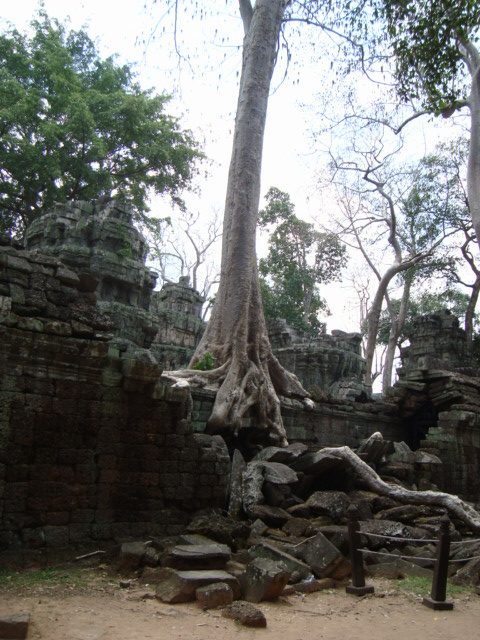
This monster tree knocked down a wall!
When it comes to ancient Asian temples, everyone has seen that romantic image of an overgrown temple ruin in the jungle, as put forth by Hollywood movies. Massive carved stone heads are surrounded by immense stone pillars. Abandoned centuries ago, green vines cover the stone walls, while trees grow out of collapsed ceilings.

For once, Hollywood was right. That place does exist, and I'm looking at it now. It’s found here in Cambodia, in the Khmer temples of Angkor.

Part of the amazement of experiencing these temples in person, is seeing the variety of condition these many temples are in. Some like Angkor Wat are fairly well preserved. 

Others lie completely collapsed and destroyed. Several have been completely overgrown with jungle growth. Others seem to be a combination of all of the above.

But perhaps none quite captures the human imagination, as the temple of Ta Prohm.

Part temple, part ruin, part nature, as I approach Ta Prohm, the first sight that grabs my attention, is what can only be described as a great tree of destruction.


Is it a giant snake?? No, it's tree roots!
This massive tree sits on top of a wall, and towers high above it. Meanwhile, the tree’s roots look like the tentacles of a giant squid, as though formed from Jules Verne’s imagination. The roots appear to have pushed over this strong stone wall, with no more effort than it takes for a child to push over a wall of toy blocks. A gaping section of the wall, is now only a pile of stone bricks. A root of the great tree has creeped across them, burying itself in the earth beyond these measly human cut stones. The tree’s light bark contrasts with the blackened stones that have tumbled down below.

If you have read J.R.R. Tolkien, this tree could have been an ent from Lord of the Rings. It’s as though a mythical tree hopped up on the wall one night, and reasserted the power of mother nature, bringing back the jungle to cover the vanity of man. 

'Tomb Raider Tree' made famous by Angelina Jolie
Along another part of the wall, a colossal tree has grown up on both sides of the wall, towering over the tons of stone below it. This one gives the impression that it is supporting the wall, and holding it in place.

Others great trees have their roots flowing down over the walls smoothly, reaching downward like running water. They resemble a waterfall, frozen into tree roots. Still another has grown lengthwise over stone blocks, appearing as a giant serpent.

Movie buffs may recognize one stone gripping temple tree, from a scene in the film, ‘Tomb Raider’. I once chatted with a Khmer policeman, who had worked with the production crew while the film was in production here. “I see Angelina Jolie,” he told me perkily. “She beautiful!”

As a melding of temple and nature, Ta Prohm truly is a place of wonder and romance. I wonder if this exotic locale had any influence on Angelina Jolie. Cambodia certainly made some impression on the famous actress; she adopted a Khmer orphan to be her own son.

There used to be far more jungle growth covering Ta Prohm temple, but most of it was removed during restoration. When they got to these impressive trees however, they noted that removing them would damage the walls and monuments even further. Leaving the great trees where they are leaves a visual balance; it shows that Angkor is not just about temples, it is also jungle.

Restoration laborer, hard at work
Closer examination on some walls and reveals perfectly round holes dotting stone building blocks. These are not bullet holes as I saw at Angkor Wat; these are all holes left over from the days of original construction. Ancient Khmer construction methods had these blocks moved by sticking wooden rods into these holes for easier lifting.

I come to one of the temple's stone archways, and it’s blocked off. A sign reads, “NO ENTRY, WORK AREA”. Looking in near the sign, I find a workman lying asleep on a dislodged block. So much for working. That’s one thing I’ve noticed about Khmer men, they can sleep soundly on almost any surface. Whether it’s grass, concrete, a motorbike seat, or a stone block, you can find them snoozing almost anywhere.

Besides Ta Prohm, restorations are in progress in several other temples around the Angkor complex. As Cambodia is such a poor country, most of the funding comes from foreign sources. India is providing financial aid to restore one temple. That's not surprising, since India is the home of the Hindu religion. When these temples were first built, the Khmers were Hindu, before later turning Buddhist. The Japanese and German governments fund repairs on other temples. There are so many hundreds of temples around Angkor, that all of them will never be restored in our lifetime.

I know an American Vietnam War veteran, who spent time in Cambodia in recent years. He decided he would personally visit every single ancient Khmer temple in the Siem Reap region. 

It took him six weeks to see them all!!

The towers and trees of Ta Prohm


Thursday, July 30, 2015

AMAZING ANGKOR WAT

Stone sentinels on the causeway, leading to the famous Angkor Temples
The kingdom of Angkor was once the greatest empire that Southeast Asia had ever known. Their lands included not only Cambodia, but what are now parts of Thailand, Laos and Vietnam. They were a culture far ahead of their time, accomplished in architecture, engineering, irrigation and agriculture. 

Recent history during the Khmer Rouge era was a low point in Cambodia, but through it all the glorious sights of Angkor survived the wars, survived communism, survived the jungles, survived the ages. Long unknown to the outside world, these wondrous Angkor temples are again open to foreigners like me. 

On this tropical day, I’ve departed Siem Reap, an unromantic town that is awash in hotels, restaurants and bars aimed at tourists. Fortunately, the town is far from the temples. I've rented a tuk-tuk and driver for the day, and headed out to the temples to explore. I won't be disappointed. 


Archway used by royalty to mount elephants!
On my way into the temple complex, my tuk-tuk crosses onto a long causeway bridge. The railings on both sides are like those I’ve never seen. Each is formed from a long line of ancient stone statues. Stern warrior faces are topped with Khmer headresses. The long snake-like railing they bear has broken off in some places. Some of these statues have been decapitated by looters, in years gone by. 

Reaching the end of this bridge, I'm met by an amazing archway of stone. At the top, enormous faces look out from three towers, as if keeping watch over all who enter. This high archway was made for elephants! Used by Angkor royalty, the king and his family used to mount and dismount elephants from the steps beneath the arch. Elephants still occasionally walk through here today, though most traffic passing through these days are tuk-tuks and bicycles. As I pass through, I look up to see numerous bats clinging to the high ceiling. Like most of Angkor nowadays, there are more animals here in this ancient city than anything else. 

Continuing on through the jungle, we soon reach my destination, and I leave my ride. My eyes widen, and I stare. 

Angkor Wat! 

I gaze at a wonder of the ancient world. It is the unmistakable outline of Angkor Wat, the largest religious building in the entire world. It's spectacular, awesome, stunning, mind blowing. The Angkor temples are one of those places, where adjectives are insufficient in describing them. Angkor Wat is so synonymous with Cambodia, that this temple is on the country's national flag.


Amazing Angkor Wat, the largest religious building in the world
Approaching the complex another causeway leads me across an ancient man made lake, arriving at a stone entranceway. A doorway between two stone pillars leads inside. I notice some lightly colored dots and marks to the sides. These were bullet holes from the war years, only recently filled in with cement. Renovations are still underway. 

The doorway takes me through the outer wall of this grand complex, and onto a long stone walkway. Angkor Wat is directly in front of me in the distance. It’s blazingly hot! It’s afternoon, and the tropical heat is at it’s peak, easily over 90 degrees. I’m unfazed though, since the heat at this time of day will keep away many tourists. There are some visitors about, but not the masses that will be here for sunset. It’s a long hot walk; seems a mile. But it’s fitting for me to walk this way. It is better to approach Angkor Wat just as its pilgrims did centuries ago, on foot. With each step, the great 12th century edifice grows larger in front of me. 


Remains of a brightly painted interior hallway, the whole temple was once this color
Finally arriving at the temple itself, I climb the steps and walk into the cool shade inside. 

Along the interior, there is a noticeable splash of color. The exterior is all dark stone, but here I see the originally painted colors. These pillars still have patches of dark crimson. As magnificent as this temple looks now, I can only imagine how Angkor Wat must have looked back before the paint started to fade.

There are many great carvings upon the walls. Common among  them, are the Apsara nymphs. These female Apsara dancers are depicted performing their graceful dances in front of the Khmer king. They wear shapely outfits, low cut skirts, tight tops, and ornate headdresses. Some have mysterious smiles. 

There are few statues to be found in Angkor Wat, and I soon find out why. Coming into one hall, I find many Buddhist statues. Most have been decapitated, by looters, or by the atheist Khmer Rouge. With so much else to fill the senses here, the lack of statues is hardly noticeable. 
Monkey resting in temple shade

There are many faces, friezes and bas reliefs all over the walls, along with the stunning architecture. I find a long covered walkway in the back, with a bas relief stretching the entire width of the temple depicting a religious scene from antiquity. It’s crowded with carved Hindu deities, royalty and mythical figures. Gods, chariots, and soldiers, with fighting depicted. Like many of the Angkor temples, Angkor Wat was originally made for Hindu worship, and converted to Buddhist use later. 

As I walk along, I notice a stray dog far ahead of me, and it walks out a corner doorway. Taking my time, I finish my stroll admiring the huge bas relief, until I walk out the same door. 

I freeze in my tracks. That wasn’t a dog walking in front of me, it was a monkey, and a big one at that! It’s now only two steps in front of me. Brown with a long tail, and white fur on his chest and neck, it’s a macaque monkey. He’s seated, resting in the shade of the entranceway. 

Upon seeing him, I jump back with a start, and he glares up at me, perhaps annoyed that I’ve disturbed his privacy in the shade. He turns, walks down the steps, and makes his way across the grass before disappearing into the jungle. 

Before it gets too late, I take my leave of this magnificent place. 


Buddhist monk walks in Angkor Wat

On my way out, I head down the walkway from whence I came. A Buddhist monk slowly walks towards me, on his way to the temple. He wears the simple orange robe and sandals that all Buddhist monks wear. The only thing modern about him is his orange umbrella, which is  shielding him from the hot sun. 

As these temples were once a place of conflict, I'm glad that they are once again a place of peaceful religious worship. Angkor Wat is now a place loved by many; both tourists and Buddhists alike. 


Apsara dancers on the temple walls

Wednesday, May 28, 2014

PALACE DOWNFALL - ROYAL DEATHS

Buddhist stupas and memorials in the royal palace
I'm continuing my visit to the Phnom Penh's royal palace. This luxurious compound was best known as the home of King Sihanouk, Cambodia's most famous monarch.

Passing through a palace gateway, my view is filled with a whole new courtyard filled with memorials and Buddhist structures. Interspersed between carefully manicured trees, are numerous pagodas, Buddhist temples and shrines. At a few of them, Cambodians and monks in bright orange robes are praying. 

At the center of this peaceful courtyard, is the silver pagoda. This houses numerous statues of Buddha, made not only of silver, but also gold. Some are encrusted with diamonds. It’s a small miracle that these weren’t looted by the Khmer Rouge when they took over the palace; these must have been hidden away during those dark years. Many other treasures were taken away by them though. 


Controversial ex-King Sihanouk (photo: Wikipedia)
Some of these memorial stupas, are for deceased royalty, but the final resting places for many of Sihanouk’s own royal family remain unknown to this day. That was due to the King's complicated, and failed, relationship with the communist Khmer Rouge. 

It was Sihanouk who years back, coined the term ‘Khmer Rouge’, which meant ‘Red Khmers’. Nobody could have known then, that the Khmer Rouge would eventually become the most murderous communists in world history.

Way back in the 1960's, the communist movement that grew in neighboring Vietnam crossed the border into Sihanouk’s own kingdom. As the US war in Vietnam escalated, Sihanouk publicly declared Cambodia to be neutral in that conflict. Meanwhile, he did little to stop the Viet Cong and North Vietnamese Army, who had almost free range of Cambodia’s eastern provinces, moving troops and arms down the Ho Chi Minh Trail. Sihanouk's refusal to confront the Vietnamese communists, greatly frustrated the US government who were fighting them at the time.

While Cambodia stayed out of the Vietnam conflict, Khmer communists began to appear on the scene. In those early years, they didn’t pose a serious threat to the country, and the king and his security forces fought to keep them down. Sihanouk was far more popular with the people than the communists, who brought with them some strange foreign political ideology imported from Vietnam and China. 

Gardens surround the royal memorials
As the wars raged next door in Vietnam and Laos, Sihanouk turned away from politics and began to spend his time on another occupation: film making! He became a movie director, making movies in Cambodia. He also took a major interest in jazz music. Given the growing crisis in Cambodia, Sihanouk was appearing increasingly out of touch with what was happening within his own nation’s borders. 

Finally in 1970, while Sihanouk was out of the country, he was ousted in a coup. The putch was led by a general named Lon Nol, amid rumors of American involvement.

Sihanouk stayed in exile, where the monarch made another move that few would have expected.

The king allied himself with the Khmer Rouge! Joining his former enemies, Sihanouk soon made radio broadcasts urging his subjects to also join up with the radical communist rebels.

If there was any American involvement in the coup which had forced out Sihanouk, it had backfired. Thousands of Khmer men from all across Cambodia left for the countryside to join the rebellion. These young men new little about communism; they had joined the KR to fight for their king.

Later after the Khmer Rouge victory, Sihanouk was declared head of state. Still in exile in China, he begged the Khmer Rouge leadership to allow him to return to Phnom Penh. The KR leaders eventually allowed it, but Sihanouk would soon regret coming back at all.

Palace murals were ruined by weathering and neglect
The king became a prisoner right here, in his own palace. Stripped of all power, he was still technically head of state, but he was only a figurehead. The Khmer Rouge central committee held all the power. Sihanouk had been used by the Khmer Rouge, and now he was powerless to help his people, or himself. 

Ending his life of privilege, the KR took away all of his royal servants. His wife and son Sihamoni had to take over the cooking and cleaning of the palace residence. The former queen and humbled prince, were now their own housekeepers.

Many still wonder why Sihanouk made such a foolish political move. When he was still Prime Minister, his security forces had killed more than 1,500 Khmer Rouge. Did he really think that the KR leaders would forgive him, trust him, and make him a full partner? Was it arrogance, or was it just plain stupidity? Like so many men who who were hungry for power, Sihanouk had tried to hang onto power for too long.

Many palace buildings are restored
Once the Khmer Rouge won power, they went to work eliminating their remaining rivals. So they executed many Khmer princes and princesses - Sihanouk's own relatives. They would have killed King Sihanouk as well. But due to pressure from their main patrons, the Chinese government, the KR never went through with it.

As I'm about to leave the palace, I pass a traditional Khmer percussion band, playing drums, gongs, and xylophone-like instruments. Given the luxurious buildings I’ve just seen, I can’t help but notice the immense contrast to the world outside. The king and the rest of the elite continue to live in luxury, while the people of Cambodia remain among the poorest in Asia.

Outside the palace walls are two of the King’s royal guards, standing attentively at yellow guard shacks. I’m surprised at their uniform though. They wear fancy white dress coats, with old American style helmets, also painted white. Their trousers are blue, and they wear US style combat boots. I hold back a snicker as I notice that the coat on one guard, looks to be at least two sizes too big for him.

Both sentinels stand guard holding old American M-16s, with fixed bayonets. Neither have ammunition clips in their rifles. If this old palace is ever attacked again, the best these two could do is try to stab someone! It’s a good metaphor for the present monarchy itself. These days, kings in Cambodia have no real political power. Although impressive looking, they are outdated.

Palace royal guards, with unloaded weapons
When the communist years ended and the monarchy was revived in the 1990's, Sihanouk was declared king once again. However by that time, the old monarch was more of an adviser than power player. His days at the peak of Khmer power were long over. A democratic election, and later a coup, would determine the country’s real leadership.

In 2004, after being in and out of the Cambodian political scene for most of his life, the old king did the unexpected again. 

He abdicated! 

To succeed him, his son the prince was chosen, the present King Sihamoni. The new king had been an ambassador, and a dance teacher in Europe. 

Sihanouk finally died in 2012 at the ripe old age of 89. Despite his failures, many Khmers remained faithful to him to the end. Others despised him for leading the country into death and destruction under the Khmer Rouge. 

He remains the most controversial political figure in Cambodia's history. 


Thursday, April 24, 2014

UP THE MEKONG RIVER TO CAMBODIA

I leave Vietnam from their oddly designed Mekong River immigration post
As our boat chugs up the Mekong River against the dark water’s strong current, I look to the riverbank. Up on a flagpole, the familiar red flag of Vietnam flaps in the wind. Steps away, a red and white fence marks the border. Our small boat boat passes the fence, where another banner waves above a humble border post. The flag is striped blue and red, with an image of the ancient Angkor Wat temple in the center. 

I’ve just left Vietnam, and crossed into the Kingdom of Cambodia. 

I’m traveling with a mixed boatload of travelers, hailing from China, Finland, Korea and Australia. As usual, I’m the only American and we’ve just left Vietnamese immigration. We could have just walked across the border, but this is all part of a Mekong journey taking me to Phnom Penh, Cambodia’s capital. Our boat docks, and walking up the riverbank, we pass beneath a large sign: “KAAMSAMNAR-KOHROKAR INTERNATIONAL BORDER CHECK-POINT POLICE STATION”. That’s a mouthful. 


Crossing post with faded paint marks the riverside land border
Compared to the Vietnamese side, immigration here is a small operation. Leaving Vietnam, their new immigration office was strangely designed like some kind of new age ship. It was even air conditioned. 

But not on this side. Cambodia doesn’t have money for that extravagance, so we queue in the hot sun. There are few immigration officers in this small office, so the line is slow moving. Most visitors travel to Cambodia by road or air, so this Mekong border crossing has fewer travelers. 

The first major difference I note, is their priorities. They don't have much money for a big immigration office, but they do have money for their religion. An impressive Buddhist shrine and large spirit house are at the entrance. Both look stunning with gold paint and red trim, outshining the simple government buildings that surround it. Cambodia is no longer a radical communist, atheist country. Buddhism has returned.


Buddhist shrine and spirit house by the border post

After sweating in the queue for awhile, I finally pass into the shade and get my passport stamped. We head back to the river, and end up with a larger boat, though it’s not much of an upgrade. We are joined by 10 more Spanish and English passengers, so it won’t be a very roomy journey. Although our new river boat has a toilet in the back, it’s not quite up to environmental standards. The bathroom is the size of a closet, and the hole where you sit drops straight into the river. Adequate sanitation is scarce here; lots of raw sewage empties into the Mekong.

As we depart, one of the Khmers (Cambodians) on board starts calling out to the passengers for his side business. “Change money… Change money for Cambodia riel.” I decline, due to Cambodia’s unusual currency system. Although the official currency is the riel, the US dollar is widely accepted. The highest riel bill commonly found in circulation is the 10,000 riel note, worth only about US $2.50. Larger purchases are usually done in US dollars. Even Cambodian bank ATMs give out cash in dollars. 


Queuing for Cambodian visa and passport stamps
Settling in for our long river cruise, I immediately notice a major change in the river from the opposite side of the border. Back in Vietnam, the Mekong is a delta with many branches. But on the Cambodian side, this is just one huge river, more than a mile wide. 

River traffic is reduced too. On Vietnam's side, there are many more boats, fishermen, and villages. That is partly due to the fact that Vietnam’s population is more than six times that of Cambodia, so the river gets more use there.

With an open river ahead of us, the Cambodian side is definitely more scenic, rustic, and romantic. Here there's far less evidence of man and modernity. On this stretch of the Mekong, there are few coastal towns, Khmers on the river live mostly in small villages with plenty of distance between them. Palm trees lining the riverbank are far larger, and numerous. There’s not as much logging in this quieter, less hectic corner of Southeast Asia. 

I find the hum of the motor rather relaxing. The hot sun is replaced by clouds, and the boat’s motion gives us a cool breeze as we head deeper into Cambodia. Our long blue boat isn't big on amenities; rather than individual seats, passengers sit on wooden benches that run the length of the boat. The ceiling is strangely decorated with artificial flowers. A woman working the boat makes the rounds with a basket, selling beer and soda. Nobody buys beer, since everyone is hot and dehydrated from the tropical heat. 


Khmer fisherman on Mekong River
As we continue, the river craft begins to list to the port side, and our boat slows down. The Khmer pilot comes aft to the passengers, making hand motions to a portly Spaniard. I chuckle, realizing what he’s trying to say. If he could have spoken English, he would have said, “Would the heavyset Spanish gentleman please move back to the other side of the boat?”

Once the Spaniard gets his meaning, he says, “I didn’t know I was that heavy.” There’s laughter, as he changes sides, the boat is righted, and we’re off again. 

Looking upriver, I see mist ahead of us. Rain. We’re about to get poured on. Soon we’re in it, and the crew scrambles around the riverboat, bringing bags of rice down from the rooftop. Then they quickly lower the cabin’s side flaps, hoping to keep us dry. 

The rain grows heavier, and I hope the downpour won’t last. As we shelter from the deluge, I ponder the Mekong’s stormy past. On this slow boat up the Mekong River into Cambodia, I'm reminded of Joseph Conrad’s river journey in ‘Heart of Darkness’, and the Vietnam War era movie "Apocalypse Now" that was based on his book. Much like the movie and book, there was a time when the journey here led to madness. During the war years, this was the world's most dangerous river. It started with the communist fighters of the Khmer Rouge. 


Our crowded boat heads upriver into Cambodia
I'd already encountered former communist fighters in Vietnam, but as I'd also seen in Ba Chuc, the Viet Cong had nothing on the Khmer Rouge when it came to murderous brutality. Some of that violence was seen here. This stretch of the Mekong River was a lifeline for the US backed government of Cambodia during the war; in the early 1970’s the Khmer Republic received most of its supplies up this Mekong route. But as the communist Khmer Rouge gained in strength, they began targeting river convoys here with a fury. Many supply ships, escort boats, and lives were lost on this river. Much of that war refuse remains; marine wreckage and a great deal of unexploded ordinance still litter the river bottom. out of sight beneath the darkened waters.

Khmer Rouge attacks here brought heavy retaliation from the US military, using B-52 bombers. When the Mekong’s river banks were seen later from the air, a US embassy officer remarked that the countryside, “looked like the valleys of the moon,” from all the bomb craters. Just like in Vietnam, B-52’s weren’t the answer to stop guerrilla warfare. In time, the Khmer Rouge eventually cut off all resupply convoys, blocking river access to Vietnam and the coast. When that finally happened, the days of the Cambodian government were numbered. 


Some river boats look overloaded, low in the water
Before long we motor ahead out of the rain, the flaps go up, and our lovely river views are restored. River traffic picks up, and we pass wooden boats carrying sand, gravel and bricks. It’s good to see that military cargos have been replaced by construction materials. These cargos are meant to build, not destroy. Some overloaded boats look so low in the water, that you’d swear that they’re sinking. At night, some don’t even use running lights. They appear as long, dark silhouettes in the water; some have been sunk after late night collisions.

My fellow travelers aren’t a talkative lot, except for the Spaniard, who asks aloud, “Is this country communist also?”

An Englishman corrects him, “No, it’s a kingdom”.  

This 'kingdom' is one of the poorest countries in Asia, as poverty is widespread in Cambodia. There are few signs of modernity, we see only a rare cell phone tower, and a pair of new Buddhist temples. A farmer with an ox cart walking the riverbank reminds me that most poor Khmers get by as farmers. Many villages we pass are all thatched roof homes, lacking electricity. My journey is during the dry season, but in the rainy season, much of the shore in view will be underwater. I see no bridges over the river either; Cambodia remains seriously underdeveloped.

As the hours pass, I find myself yawning. There are too many passengers on our boat’s benches for anyone to lay down. Still, some are already asleep. With the motor's hum acting as a lullabye, I give in, and close my eyes. Sleep finally comes. 

Soon, I arrive in Phnom Penh.  

Thursday, January 30, 2014

LOST CIA BASE AND BUDDHIST RUINS

Photo of secret CIA base of Long Tieng during the war (from cia.gov website)
I’m looking to go to a mysterious, formerly secret US built air base, but it’s going to be much more difficult than I thought. “You can only go there with special permission from the military,” a Laotian travel guide is telling me. “It’s a military base.” 

The 'Secret War' in Laos had a secret city, and this was the remote, hidden base known as Long Tieng, south of the Plain of Jars. During the long war in Laos, it was the busiest airport in the country. For years it was a key air base for the CIA’s Air America, and US spotter pilots. It was also headquarters for famed general Vang Pao and his 20,000 strong Hmong militia. To the communists Vang Pao was Public Enemy No. 1, and the general lived in his mountain hideout with thousands of Hmong families that had fled the fighting. Many ethnic Hmong villages were destroyed during the war. 

As with many things connected to the Secret War, Long Tieng did not officially exist, and wasn’t found on any public maps. This was odd since at its peak, this ‘secret city’ sheltered 40,000 people, making it the second most populated city in Laos back then. Its cover was blown in 1970 when two foreign journalists snuck in. 

As major fighting ended in 1973, Long Tieng was taken over by the communist government, and it’s been their base ever since. Vang Pao left for exile in the US, joined by thousands of Hmong refugees. He settled in California, though he never forgot his mountain homeland, and his long suffering people still fighting the communists. In 2007, he was arrested near Fresno, charged with plotting to overthrow the Laotian government. The charges were later dropped, and he died in California in 2011, still a hero to the Hmong community. 

I’d like to see his infamous base, but as I’m being denied, I hear a tone of concern. The Laotian explains that real danger is involved. “There are still guerrillas fighting up there,” he says quietly. Despite my inquiries, he won’t elaborate further. Just like I had heard in Vang Vieng, there are still groups of Hmong holding out up in the mountains. They’re not only hiding, they’re resisting, and with force. Since seeing Long Tieng is out of the question, I book a trip to another seldom visited place, the once destroyed town of Muang Khoun. The next day, I’m on my way there. 

* * * * *

Antique French tile, covered with greenery
I’m looking down at antique European tile. Decorated with intricate handmade designs; interlocked circles are interspersed with diamonds. The tile’s original colors have faded; it’s now mostly black and white. The bright green color now surrounding the tile beneath me, is what has been reclaimed by the environment. Grass and weeds have taken over the floor as the decades have gone by, re-covering the tiles with a natural carpet. 

These natural grasses are able to grow inside this building, because the roof is gone. The tile, the arched doorways and the windows give away the origin of the former occupants. This was the French commissariat, and now it’s just a bombed out shell. Where the old darkened plaster has fallen from the walls, another color has peered out, that of bright orange brick underneath.  

I’m in the former provincial capital of Muang Khoun. Back when it was the capital, this town bore the same name as the province; Xieng Khuang.

It’s not just old French buildings that were destroyed here, practically the whole town was leveled by US bombing as the North Vietnamese Army invaded. After the NVA occupied Xieng Khuang, Hmong troops later retook the town for a while, although they couldn’t hold it. With most of the country rural, there wasn’t fighting in Laotian cities very often, and here was an exception. 


Ruins of French built commissariat that was destroyed during the war
Destruction was so heavy here, that the town was abandoned by the war’s end. My guide explains: “Move capital to Phonsavan. One reason, already destroyed. Number two reason, very high UXO." (Un-Exploded Ordinance)

In decades that followed, the town has been re-inhabited, but old tensions from the war still remain. In 2000, fighting erupted again in this region between minority Hmong and ethnic Laotians over a land dispute. Some homes were burned to the ground, five ethnic Laotians were killed, and more were wounded. As has happened before, the military came in to put down the Hmong uprising. The number of Hmong casualties from these events are unknown.

Today I’m stuck with another Laotian guide, so unfortunately the Hmong who remain here won't tell me about the troubles, since an ethnic Laotian is present. Much of Muang Khoun has been rebuilt, and the town now has around 14,000 people living here. 


Centuries old Buddhist temple in Muang Khoun. This Buddha statue survived the bombing.
The rain picks up, and we leave the ruin to wait out the weather in our SUV. I ask my translator to turn on the radio, but in this remote region there's little selection. He finally tunes into an AM station. As rain pelts on the roof, I listen to a Hmong singer, accompanied by Laotian music. My guide explains, “This radio (station) paid by UNDP. (United Nations Development Program) It’s the only station you can receive here.” In between music, they give the listeners health and hygiene messages. 

The rain lets up a little, and we walk down the road, finding the remains of a temple ruin. A group of geese waddle by me, as I climb the front stairs. This is called Wat Piawat, which means ‘biggest wat’. My guide says it is 600 years old, though experts say it's less. This once grand temple is from the old kingdom of the Lao Puan. Like so much of Laos, they would later be subjugated by the Thais, and the Vietnamese. 

Not much of the temple has survived. Up on a raised platform, some old pillars reach skyward. Much like the French colonial structure, the roof is gone, and sections of bare orange brick walls remain. Given the destruction of the rest of the temple, it’s amazing that a tall Buddha statue is mostly intact. Only an arm and the head have been damaged, The stone Buddha is seated, reaching higher above the rest of the ruins. 
Buddhist stupa looted by Chinese invaders
Despite the temple’s condition, the local Buddhist faithful still have occasional ceremonies here. I note that a bright orange sash is wrapped over the icons shoulder, with a few offerings left at the base. 

Hopping back into our vehicle, we make a final stop in town. After parking the SUV, my guide directs me up a hill. It’s a steep dirt road, and he’s afraid of getting the vehicle stuck in the rain. He warns me to stay out of the deeper grass to the side. 

As I head up, I wonder why he warned me about the grass. Rising high ahead of me, I find a large old Buddhist stupa coming into view atop the hill. Somehow this stupa survived all the heavy bombing, though it isn’t intact. There is a great hole that has been dug through the base, going all the way through to the other side. This is unlike any stupa I’ve ever seen before, it’s mostly covered with grass and brush, and it’s also leaning to one side. As I look at it from a distance, it resembles an old pointed wizard’s hat. 

Like all stupas, the interior of this tower once held relics or artifacts, but they were removed by looters long ago. The offending tunnel was dug straight through the stupa by Chinese Ho invaders in the 1800’s. I’m learning that it wasn’t just the 1964 - 1973 war that destroyed Laotian heritage. This had also happened to earlier generations, from invasions by the Chinese and Vietnamese. 

I walk through the tunnel underneath, and looking up, I can see lighter colored stone; part of an older stupa encased within the larger outer one. I ask my guide about the stupa’s history, and for once he doesn’t offer much. The relic is somewhat of a mystery to the local population. They don’t know how old it is, or what it’s original purpose was. 
Remains of another Buddhist stupa, destroyed during the war

From the stupa platform I look to a nearby hill, and see another ruined stupa, destroyed almost down to the base. Sadly, there are many of them around town. My guide says there used to be more than 30 wats and temples in Muang Khoun before the war, and all were destroyed. He laments that if the war hadn’t happened, this town would have become a UNESCO world heritage site, much like beautiful Luang Prabang is today. 

On the way back down the hill, my guide discovers a leech on his ankle. Now I understand why he told me to stay out of the deep grass! He quickly kicks it off into the brush, before it can dig into his skin. Since I also walked through grass, I’m surprised that the leeches didn’t latch onto me as well. 

Maybe they prefer Asian food to American food.