Showing posts with label women. Show all posts

Thursday, November 19, 2015

BEAUTIFUL DANCE OF KHMER WOMEN

An Apsara dancer strikes an elegant pose
The beautiful young ladies are adorned with gold necklaces, and gold earrings. Gold armbands, and gold bracelets are worn on both wrists and ankles. Gold trim is woven throughout their elegant dresses, colored blue, red or yellow. A bright yellow flower sits over each ear as they dance.

Their headdresses are also gold with studded, circular layers rising above them like a bent Buddhist stupa. Some headdresses look like those seen on topless dancers carved into the walls of the temple of Angkor Wat, that I saw earlier. The dancers on stage before me are all young Khmer women, but the only thing that looks modern about them, is their bright red lipstick.

I'm at the Temple Restaurant in Siem Reap, enjoying an upstairs dinner show. The gold may not be real, but the dance is authentic: this is Apsara. It's unlike any dancing you'll ever see in the west; it has the charm of an Asia that was lost centuries ago.

This ancient art was nearly lost after the communist Khmer Rouge banned it
For those who don't know any better, they might think that these dances and costumes are from old Siam, a.k.a. Thailand. But it's better not to say that to the Khmers. They'll tell you that many centuries ago that the Thais copied them from Khmer dancers of the ancient Angkor kingdom.

The only western dance that looks anything similar to this, is classical ballet. Apsara movements are slow, deliberate, and beautiful. Foreigners quickly notice the women's hands; their thumb and forefinger touch together. The remaining three fingers are pulled back, with each succeeding finger pulled further back. The flexibility of the fingers on these dancers is amazing.

The dancers never smile, keeping their red lips together for the entire performance. Like ballet, their dances and movements tell stories; classical Khmer stories about life and love.

As I watch mesmerized, a traditional Khmer band plays acoustical string instruments, while old style drums keep the beat.

Apsara dancing was often performed for Khmer royalty
Slow and elegant, one dancer balances on only one foot, and pivots around, keeping her other foot elevated. The display of balance and control is amazing. At times this style resembles Hawaiian hula dancing, without the hip movements.

This beautiful Khmer dance tradition was nearly lost from Cambodia forever. When the communist Khmer Rouge took over, Apsara dancing was banned. Nearly all of the master teachers of Apsara were either executed, died from disease, or fled Cambodia.

Later after the radicals were forced from power, a cultural revival began. A few surviving refugee dancers returned to Cambodia. With a princess's support, this traditional dance began to be taught again in Phnom Penh. Slowly but surely, Apsara made a comeback.

Now Apsara is popular once again, and dancers regularly perform for royalty, for Khmer audiences, and for tourists like me. 

Despite all the tragedies that Cambodia has endured, it's good to know that one of their most treasured cultural traditions still survives today. 

Monday, October 27, 2014

WOMAN'S STRENGTH SURVIVES GENOCIDE

Palla, survivor of the Khmer Rouge
I met Palla in a former prison, and torture center. We talked in the courtyard of 'S-21', a former Khmer Rouge prison in Cambodia, known as today as the Tuol Sleng genocide museum. A Khmer woman in her 50's, her hair is pulled back and parted. But what really stands out is her face, which has the look of a woman who has struggled to survive.

I sat down on a bench with Palla to learn more about the prison, but her own story was also gripping. As a flock of birds hopped about on a nearby railing, her story unfolded.

Palla was just a girl from military family in the eastern town of Svay Rieng when the war with the Khmer Rouge began. One brother was a Navy captain, another in the Air Force. As the war raged, she eventually moved to Phnom Penh in the early 1970’s for safety. 

When the war ended in 1975, she was only 17, a young bride when the communist Khmer Rouge entered the capital.  Folks were initially happy, as the war was finally over. But the Khmer Rouge immediately forced everyone to leave the city, and walk into the countryside. Palla says that she didn’t even have time to go home and pack up belongings to take with her. Additionally, the Khmer Rouge forced people of different neighborhoods to march out of town in different directions, so her family was split up immediately. So they marched to totally different parts of the country. She never saw some of her relatives again.

Palla's first husband was killed by the Khmer Rouge shortly after the war ended. As an Army soldier, he was targeted for execution. Her first daughter, and her father, died of starvation in Khmer Rouge labor camps. 4 of her 10 brothers and sisters died during the Khmer Rouge genocide. Her mother didn’t survive either. 

Barbed wire surrounds former Khmer Rouge prison and torture center
Somehow, Palla learned how all of her relatives were killed by the Khmer Rouge. She told me how this one was clubbed to death, that one was drowned, that one was killed by bamboo pole strikes to the back of the head and neck. If the Khmer Rouge cadres had learned of Palla's background, she would have been killed too. But immediately upon leaving Phnom Penh, everyone in her family changed their names. She shortened her name from ‘Palla’ to ‘La’.

Under orders, she did all kinds of manual, forced labor during those years of communism. She labored to make dikes, and canals. She worked on farm communes, planting and harvesting rice and corn by hand. To work different projects, the Khmer Rouge forced her to move back and forth from the east side of Cambodia to the west. Sometimes she walked for days. When she was lucky, she was transported by truck, boat or train.

When the Khmer Rouge were finally forced out of power, she returned to Phnom Penh. One surviving brother became a policeman. Palla's sister used to be a French teacher, and she became the first director of this grim museum of genocide. Having that position, she was able to give Palla a job here at Tuol Sleng as well. Palla has worked here since 1979.

Palla cleaned up the pool of blood left in this torture room, but left some blood spots as evidence
Palla's first job was cleaning this wretched place, not a pleasant task. When she first cleaned out the wooden and brick prison cells that I had visited, Palla had to remove scorpions and lice! 

Even worse, the interrogations rooms had pools of blood left on the floors from their final torture victims, and she was responsible for cleaning them all! Although she cleaned up of most of the dried blood, she left some blood spots on the floors for future evidence.

Palla married again after the war, and had three more children. But her second marriage wouldn't last either. In 1984, in the midst of the Vietnamese war with the Khmer Rouge, her husband left to escape to Thailand. She never heard from him again. Palla thinks that he’s dead. Like so many others that tried to escape to Thailand, he may have died in the minefields, though she may never know for sure. One of her sons also died years later in a motorcycle accident.

After the war, Palla took classes to learn English. Eventually she become more than a cleaner here, she also became a guide for the genocide museum. She is also a witness, as this prison has additional family connections for her. When written prison records left behind by the Khmer Rouge were examined, Palla learned that her brother and sister-in-law had been imprisoned here. Her brother had been an Air Force pilot, before he was eventually captured and brought to Tuol Sleng with his wife. They both were executed. They had found the document with her brother's signed confession, obtained through torture, like so many others sentenced to death here.

Crudely cut doorways between prison rooms
Palla tells me that she had a dream last night about her father. She misses her daughter too, the one that died in the famine brought on by the Khmer Rouge. She sometimes cries, because she has enough food to eat now, and back during the famine her daughter didn’t. Palla had no medicine to give her daughter back then either. She says that now medicine is available, and cheap in Cambodia.

Affected by her story, I tell Palla, “I think you are the strongest woman I have ever met.”

She says back to me, “They saw me strong. But I have broken everything. My heart, stomach, eye.” Palla has to take a heart medication these days, and also lost vision in one eye five years ago, to a cataract. She gets by ok these days, but she can’t afford cataract surgery.

Still, Palla has a positive outlook on life, as she's a survivor, and far better off than before. She currently lives with one of her surviving daughters and grandchildren.

“Everything now better,” she tells me. “I have food, rice. I have better than during Khmer Rouge (years.) I don’t have car or motorcycle, but I don’t care. My life is now better." 

One of the buildings in Tuol Sleng prison, where Palla works


As I leave Tuol Sleng, I'm glad that the last thing I remember about this prison, is Palla's smile after I gave her a $20 tip. 

She deserves more.

Thursday, September 11, 2014

LITTLE LIVE MUSIC, TOO MUCH HUMAN TRAFFICKING

For popular western music, there are few live bands in Cambodia (photo: Wikipedia)
One hopping Saturday night in downtown Phnom Penh, I went to Touk Bar, a reputable upstairs venue with a view of the Tonle Sap River. For once they had live music; a four piece band playing cover tunes. Years back I was a drummer myself, and listening to this ensemble, I'm amused. The band's drummer was really screwing it up. He was so out of touch with the other musicians, he didn't know when to stop playing as each song ended. Obviously he’d never played with this band before.

I asked the Canadian bar manager what was going on. Her answer: “Their regular drummer is in hiding. The police are looking for him on a charge of human trafficking.”

It's not surprising that the state of live music performance in Southeast Asia, is far less developed than in western countries. An odd phenomenon of live music in the region, is that although western music is very popular, few local bands can play western music well. Where there is live music in the capital cities, the best bands are from the Philippines. With more English speakers and freedom to perform, Filipino bands have filled the gap.

A popular downtown place for expats is Huxley’s a straight-laced English Pub. Unlike many of their neighboring bars, Huxley’s doesn’t allow prostitutes inside. Again, I went in on a rare night with a live band. Their name: ‘Stiff Little Punks’. I’d seen flyers advertising this gig, they promoted themselves as “The Worst Punk band in Cambodia”. It's more accurate to call them the only punk band in Cambodia.  

Playing in a tight upstairs space, I saw they were also the smallest band in Cambodia, with only two members. They included a lead singer, and a guitarist who sang background, and added digital music through foot pedals. Of course these weren’t full time musicians. I knew the lead singer, and his main job is teaching English. After hearing them play, I had to agree. They were the worst punk band in Cambodia.

As far as Phnom Penh's night life went, this is a tame place. Another night I happened to walk past Huxley’s, when I saw a big crowd across the street in front of Iris Bar. This was a ‘hostess bar’; a euphemism for a girlie bar. Prostitution is illegal in Cambodia, but police still allow it. There were many policemen present, an unusual sight. Their presence drew an even larger crowd of Khmer onlookers.


Across Southeast Asia, visiting bands from the Philippines play the best rock and roll.
The police were in the process of shutting down the Iris Bar. Before I arrived, they had arrested the Korean owner, and all the Khmer women who worked there. Everyone was hauled away in a police truck. The police then loaded all the bar's furniture into another truck, and hauled that away too. When the bar was emptied of its contents, the police locked up the front doors for good. I asked around as to why this bar was raided. It turns out that the Korean owner was unpopular in the neighborhood. He had forced his hostess women to work as prostitutes.

Fortunately not all bars and discos are of ill repute. But unfortunately for the women that work them, there is a stigma. Since Cambodia is still traditional and conservative, a ‘good woman’ would never work in a bar. Of course not all bar hostesses work as prostitutes, but given the low hostess salaries, it's not surprising that many turn to prostitution to increase their income. Such work also exposes innocent women to exploitation, as in the case with this Korean owner.

Predictably, Khmer values also look down on other things culturally accepted by western women. “In Cambodia, ladies who smoke are prostitutes,” a local woman once told me.

“Only prostitutes have tattoos,” was another prejudiced comment I heard. With the growing influence of western culture in Cambodia, such untraditional behaviors and fashions are becoming more common for women in Phnom Penh.

A week later, I walked this street again. Across from the closed Iris Bar, the police raided another nightspot; ‘Cheerleaders Bar’. I'd never been inside here either, but the police tactics were the same. The Khmer ‘hostesses’ were all packed onto the back of a waiting police truck. The furniture was carted away, and the English owner arrested; jailed just like the Korean owner had been. They weren't alone; the police had raided five city girlie bars in the past two weeks.  One was owned by a Singaporean; he had been trafficking women in from the Philippines for forced prostitution. Additional bars were raided and shut down in the city of Siem Reap. All were owned by expatriates. This must have been a campaign to reduce the girlie bars, or so I thought.

I was only partly right. An American owner of a legal bar filled me in on what was really happening. The police had shown up at some of the expat owned bars known to have Khmer women dancing. Some had pole dancing. None had strippers, though most had hookers. It seems that the police didn’t want Phnom Penh to turn into the next Bangkok. So they told the owners: remove those dancing poles, give the police $6,000, and they could stay open. If they didn’t comply with both of those directives, they were shut down.

The police also shut down a couple of Khmer owned bars, but not many. The American owner said that there just wasn’t enough money in them for the police to bother. For the expat owned bars, he had this explanation for me. “Cambodians don’t like anyone pimping their women, except Cambodians.”

Another American I knew in town, who spent too much time with prostitutes, was upset at all of these arrests and closures. He complained, “This is the US embassy’s fault! It’s all because they gave Cambodia a poor rating on the human trafficking list.”

The American had his anger and blame pointed in the wrong direction. Besides closing a few bars, Cambodia still has major problems with human trafficking, even worse than human trafficking in Vietnam. Many thousands of Cambodians, mainly women and children, are still victims of human trafficking every year. In addition to prostitution, many are forced to work in sweatshops as slave labor. The Cambodian government does little to stop the human trafficking scourge.

Monday, July 28, 2014

FLOODING AND BATHING IN PHNOM PENH

Driver pushes his tuk-tuk through flood waters in downtown Phnom Penh
It's night time downtown, and I'm getting an evening view of the riverfront. It's not late, so its safe enough to walk. There aren’t many people about, just an occasional passing tuk-tuk, a 3 wheeled taxi. While walking past a parked van, I see an unexpected sight. There in the shadows behind the van, a Khmer woman was bathing. Illuminated by a streetlight, she was squatting down, taking a bucket shower, wearing nothing more than a pair of shorts! 

Although momentarily stunned, I continue walking, hoping not to embarrass her. Seeing me, the lady bather turns away, pulling further back into the shadows to finish her ablutions. 

In the remote countryside some Khmer women bathe in this manner, since they lack plumbing. But I certainly did not expect to see a woman bathing nearly nude right in front of me in downtown Phnom Penh. 

Cambodia is just full of surprises. 

* * * * *

Flooding happens every year during the rainy season
It's another day in downtown Phnom Penh, and walking out my hotel's door I find it's raining. That’s not surprising, since it’s rainy season, but it’s been raining all day long. 

Water everywhere is rising. On both sides of this downtown street it's almost up to the curb, although a strip in the middle of the road hasn’t flooded yet. This isn’t clear rainwater, it’s brown as it flows by. That’s a bad sign; it means it’s flooding in from somewhere else, and I see where. On the street corner, water is flooding up and out of the city sewer!

An occasional motorbike rider drives by, braving the dirty deluge. Even wearing a raincoat, these are days you don’t want to be out riding a motorbike. These streets are already accident prone when dry, when wet, they're far more slippery on two wheels. 

Walking two blocks down, the water is rising even higher, peaking at a busy intersection. In the middle a car has stalled, after it tried to plow through the floodwater. A tuk-tuk driver is pushing his vehicle through the high water on foot. 

Surrounding businesses are faring worse. Floodwater has risen high enough to invade their front doors, flooding their shop floors. I watch as the shopkeepers scramble, putting all their merchandise on tables and shelves above the flood waters. 

Finally, the punishing rain stops. The backed up sewers reverse, and the water level on the street finally drops. This problem isn’t a rare occurrence either. I ask my hotel manager about the flooding, and she says to me, “This happens every year.”

With all the years of war and poverty in Cambodia, it's not surprising that there has been little work done to maintain or improve the city sewers. I learn a major drainage project funded by the Japanese government is underway to stop Phnom Penh's seasonal downtown flooding. This new drainage system may stop the floods, at least that’s what Khmers are hoping. 

Friday, September 6, 2013

THE 'NO PROBLEM' BAR IN LAOS

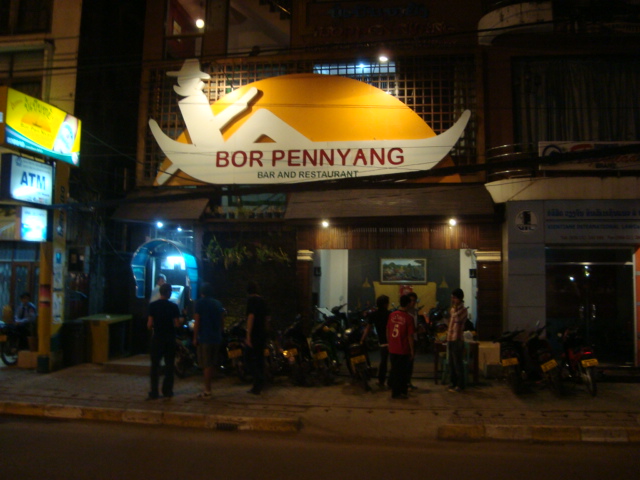
The 'No Problem' Bar in downtown Vientiane, one of the best in town
Bor Pennyang in Laotian language means, “no problem”. The saying is a reflection of the laid back Lao lifestyle. Expatriates who stay in Vientiane long term, tend to share the Laotians preference for quiet, stress free living. Like the Mekong, life here flows along slowly. 

Bor Pennyang also happens to be the name of one of the better restaurant bars in Vientiane, and it’s an expat favorite. I’m playing pool tonight, and luckily for me, playing pool here is free. Located on the top floor of a four story building, the necessity of climbing three flights of stairs keeps the lazy customers out. 

The establishment is open air, with a roof protecting patrons from the elements, but there are no walls. There are only railings, with catch nets beneath. The nets keep inebriated bar patrons from dropping their beer bottles onto unsuspecting pedestrians below. 
(I wonder how often that has happened.) When winds blow the monsoon rains inside, waitresses lower bamboo shades to keep the water out, rolling them up again when the skies clear. 

As far as a night spot goes, Bor Pennyang has the best night view of the Mekong River. Looking out over the railings I don’t  see Vientiane, I see… Thailand. Since the building is located on the river front thoroughfare, I’m getting an unobstructed view of the Mekong, with the riverbank homes of the ‘land of smiles’ beyond. It makes for a very romantic view when the Thai lights are lit up at night. For those who enjoy the nightlife, Bor Pennyang  is one of the few locales that make Vientiane worthwhile.

Looking down across the street onto the river front, the open grass lot atop the riverbank has been transformed. As night has fallen, enterprising cooks have hauled in gas stoves, coolers of food, and plastic tables and chairs. Extension cords have been strung up, with bare bulbs to light up the diners. Voila, an instant line of river front restaurants. 
Every night, instant restaurants pop up on the Mekong riverfront

The downtown riverfront is filled up every night with these mobile restaurants, popular with Laotians and visitors alike. I’ve enjoyed traditional Laotian dishes there, and they even have fresh seafood. One of the small restaurants keeps a huge bowl of live shrimp ready for cooking. With Laos landlocked, they must have been brought in from Thailand. 

Turning back from my view of the river front, I step up to the circular wooden bar, and order a cold Beer Lao. This is one of the few pub’s in the city that has the national beer on tap. I'm greeted by the manager, a friendly Aussie named Ian. He's the key to Bor Pennyang’s success; he runs a bar business that both locals and foreigners enjoy. A former chef, he has lived in Vientiane for years, enjoying the slow pace of life. Even among foreigners he stands out, with his odd choice of hairdo. Although balding, he still grows his grey hair long in the back, keeping it in a ponytail. Thankfully, he’s a much better bar manager than hairstylist. 

Tonight is a Friday night, and the crowd begins to roll in to play an early game of pool, or grab a late dinner. After a few games, I notice a Russian couple playing at the next table. Russians aren’t very common in Vientiane these days, there were far more of them here during the post-war years, when there the Soviets were in town working on infrastructure projects. 

“When I was young, the only foreigner I see was Russian,” I recall a Laotian woman telling me. “When I see them, I scared,” she said. “They have blue eyes.”

I take a break from pool, and strike up a conversation with these new Russians. They prove to be an interesting pair. Yuri and Olga are both funloving, outgoing, and young at heart. Yuri says he makes a living importing cars from the USA, shipping them to Russia. Olga is a part time interior designer, and mother to their two children. He’s 45 years old, fairly fit, and balding. She’s aged 29, thin, blonde and very attractive. Olga tells me that when Russians get married these days, age differences like theirs are very common. 

Stepping away from the pool tables, conversation shifts to their home in Moscow. I’m taken aback when out of the blue, Yuri mentions that Moscow has nude sunbathing, on the banks of the Volga River. I tell him that I didn’t know that was possible in Moscow. I didn’t think that it was hot enough there either. 
Interior of rooftop bar 'Bor Pennyang'

Yuri corrects me, “In Moscow, yes. In Siberia, no!”

I ask if he ever sunbathed nude. “Yes,” Yuri says in a matter of fact manner, “we are nudists.” 

While we are chatting, Olga is getting a lot of visual attention from others in the bar, since she’s wearing a very short skirt, and a tight shirt with no bra. Conservative Vientiane is no tourist beach town; she’s probably the only woman in the city showing so much skin in public. 

“She likes to go to strip clubs,” her husband tells me, confessing more personal information. As I continue chatting with Yuri, I eventually find out why the pair are so outgoing. 

They are both swingers. 

“We have alternative lifestyle.” Yuri explains. 

No kidding. After hearing that, I’m not surprised to learn that they are presently living in Pattaya, a beach town in Thailand with a seedy reputation. The only reason that they came to conservative Laos with their kids, was to make a visa run. This is their first trip to Vientiane, and they’re bored. They haven’t found any other couples in Laos who share their lifestyle, so they are disappointed with the city’s nightlife. 

It’s been an interesting conversation to be sure, but since I don’t share their lifestyle, I decide to move on to my next evening destination. I say goodbye to the Russian swingers, who continue their evening’s search for a like minded couple. 

Tuesday, September 3, 2013

TV AND FORBIDDEN FOREIGN MARRIAGE

Local TV seems locked in the 1970's
Taking some time to relax in my downtown hotel room, I stretch out on my twin bed that’s too small, and turn on the boxy old television. Flat screen TV’s aren’t so common in Laos these days. 

Surfing the channels on offer, local shows aren’t much to look at, since Lao TV is still government controlled. Like their communist neighbors in Vietnam and China, Laos has allowed economic liberalism, while maintaining tight control of public media. Production quality is low; some of the current shows on television look like they were made in the 1970’s. 

Fortunately for the viewers of Vientiane, TV’s here receive broadcasts from the other side of the Mekong. The highly developed media from the relatively free country of Thailand produces the most popular shows in Laos, especially the Thai soap operas. Since the Thai and Lao languages are very similar, most Laotians comprehend Thai TV shows quite well. These shows add to the ongoing love-hate relationship that Laos has with Thailand. 

I don’t speak Thai or Lao, so I’d like to go online, but my room doesn’t have wifi. There’s no hardwire internet connection either. Fortunately the hotel lobby has a computer for internet use. There are also a few internet cafés in town, filled with foreign backpackers doing email, with a few Laotian teenagers doing chat. There isn’t much internet censorship in Laos yet, for the most part it remains relatively open. Relatively few Laotians can even afford internet access, so it's not much of a threat to the current government. Not yet anyway. 

While the internet and Thai TV continue to get around the Laotian government censors, the local Lao newspapers don’t. Case in point is a copy of the local English language newspaper that I’ve bought, ‘The Vientiane Times’. 

I scan the front page, and a front page headline says, “Recognition for Skilled Workers on the Way.” Great reading, if you want to go to sleep. To a westerner like me, government controlled news is hardly news at all. 
Lane Xang Hotel in Vientiane, you foreigners with Laotian girlfriends, stay out!

I find one notable and story inside, with a misleading title: “Police ensure Lao women have good husbands.” While the title sounds ludicrous, the story actually refers to Laotian women and their foreign husbands, and to the ongoing problem of human trafficking. It’s a fact that arranged marriages are sometimes connected to human trafficking, a serious problem in Southeast Asia. Some women are pushed into sham marriages, and then forced into prostitution. Others have been pressed into jobs with slave labor conditions. 

The story goes on to mention that some foreigners with criminal backgrounds had been marrying Laotian women, solely so that they could stay in Laos indefinitely without visa problems. 

Foreigners with serious Lao girlfriends are not allowed to bring them into local hotels. This brings up the issue of senior westerners coming to Laos, and marrying young Lao ladies. These marriages are officially discouraged; clear discrimination. A local news story cites a case where the government is withholding official approval of a marriage between a 21 year old Laotian woman, and a foreign man in his 60’s. 

 “Police were suspicious about the marriage, believing the man would treat the young woman like a servant,” the newspaper says. Obviously that's a double standard. In this male dominated society, police believe it’s ok for Laotian men to treat their wives like servants, but not foreigners. 

The paper later quotes a Laotian Brigadier General as saying, “it is unbelievable that a man aged over 60 is unmarried.” 

Apparently this general has never heard of bachelorhood, or a western divorce! 

Friday, May 10, 2013

SURVIVAL IN NORTH VIETNAM'S WAR TUNNELS

Old Vietnamese soldier sits outside tunnel entrance
Deep in the dark war tunnels, below the village

I’m down in a dark tunnel. I've already been down in the Cu Chi tunnels, where Viet Cong guerillas had fought tough American 'tunnel rats' back during the war. But this place is different. I'm now in what used to be North Vietnam.

It’s very damp down here, and the air is humid. As I descend deeper inside, darkness envelops me. I round a corner, where a bare bulb hanging from the ceiling helps illuminate the way. In the dim light, I can make out cave walls that are a mixture of brownish soil and whitish chalk.

Fortunately, I don’t have to crawl around on my hands and knees this time, this passageway is reasonably spacious. But I'm forced to walk along bent over like a hunchback. This tunnel wasn’t made for tall Americans like me, but for shorter Vietnamese.

I’m beneath the village of Vinh Moc, and until the country became divided by the Demilitarized Zone (DMZ), this was just a quiet fishing and farming village in central Vietnam. When the country was split in two, that left Vinh Moc located just to the north of the DMZ in North Vietnam. For Vinh Moc’s villagers, the quiet coastal life that they had known was over. Overnight, they found themselves on the front line of Vietnam’s most devastating war.

Frieze depicts wartime Vinh Moc, both above and below ground
Much as the Gio Linh Firebase I had seen on the opposite side of the DMZ was a target of communist artillery, this village on the northern side was bombed even more intensely by US firepower. Since Vinh Moc was a coastal community held by the North Vietnamese Army, the NVA set up their heavy guns here, making the town a target of  US bombing from artillery, from the air, and even from the sea by heavy guns of the U.S. Navy. With this trio of destruction, the villagers of Vinh Moc soon found themselves living in one of the most heavily bombed villages in the war. Just about every building in the community was destroyed, including the village church.

As casualties mounted, many villagers fled to escape the shelling of the 1960’s, but some families stayed. With so many bombing attacks hitting the village so frequently, there was only one place where the villagers could find safety, and that was deep underground. Work quickly began on tunnels for shelter, and on trenches connecting houses to tunnel entrances.

Huge bomb crater from the war in Vinh Moc

As I walk stooped over through the dimly lit tunnels, my head bumps a crossbeam. Some stretches have wooden beams and supports lining the walls and ceiling, giving the appearance of an old gold mine. It’s an impressive network. These tunnels are solid, and far more spacious than those that I crawled through before in Cu Chi outside of Saigon. Those tunnels in the south were very narrow, built tight to discourage the taller and fatter Americans from entering. Since Vinh Moc lies within North Vietnam, they didn’t have to worry about American tunnel rats pursuing them down in these caves. These tunnels were built much taller and wider, to accommodate all of the village families.

Above ground many old bomb craters are still scattered around the tunnel entrances, but these tunnels were deep enough to protect them from incoming artillery. Multiple entrances allowed multiple means of escape. That way if a direct hit caused an entrance to cave in, the villagers were not left trapped inside.


The maternity room; 17 babies were born in the tunnels
There were three layers of tunnels, with the deepest going down to a very safe 23 meters. I’d like to see the lowest levels, but they have been closed off. Perhaps they are no longer maintained.

As I walk along, I encounter side rooms dug into tunnel walls. There are still beds inside, made of bamboo. These spaces were made to shelter individual families, who could sleep down here in safety. During long attacks, the villagers stayed down here for days at a time. For some villagers, there lives began down here.

“My father born in tunnel,” said Le, a local teenager who sells drinks outside. As the war dragged on, 17 of Vin Moc’s babies were born underground as the bombs fell above them on the surface. There was a makeshift hospital in one room, but conditions were far from sterile. Other infants born in these difficult and stressful circumstances didn’t survive.

There were rooms down here for cooking, for meetings, and storage for NVA supplies and ammunition. What they didn’t have room for, was an underground school.

Some entrances nearly reach the South China Sea coast

“No school (back then,)” Le told me. After the schoolhouse was destroyed, Le’s father grew up without an education. “Many men no have job now,” Le explained. The lack of schooling in their youth, made it difficult for Vinh Moc’s men to find a job in Vietnam’s economy of today. Le told me her father has to get by now with occasional work as a fisherman. 

I see daylight ahead, and follow it to a tunnel exit. As I walk out the opening, I have to duck under overhanging weeds. This entrance is surrounded by ferns and other overgrowth. After walking a few steps down the path, the brush opens up, and reveals a beach. I had no idea that the tunnels were located so close to the coast; the surf of the South China Sea is only steps in front of me. Then I turn around, and look back at the tunnel entrance. I can’t even see it! This entrance was well placed. Even with no war going on today, the entrance is still perfectly camouflaged by nature itself.

As I finish exploring, I leave the tunnel network, and find myself back in the village center.  I rub my back, pleased to be able to stand fully erect again.


Steps away from the tunnel entrance, it's nearly invisible
 Before I depart, I encounter a sight common in Vinh Moc during the war years. I happen upon a group of people wearing the military uniforms of the North Vietnamese Army. They are all older Vietnamese women, and most are wearing medals on their plain khaki clothing. I quickly realize that these ladies are all war veterans.

A sign on their bus translates as, “Association of Pioneer Youth Visiting The Old Battlefields.” These veteran women had a hazardous job. In their younger days as teenagers, these ‘volunteers’ had the difficult job of manually building and maintaining the Ho Chi Minh Trail.

As I look on, some foreign tourists approach to pose with the women for photos. The lady vets are all smiles. Many of them are grandmothers now, and they’re surprised at this kind of attention from foreigners. The contrast in size is obvious. Posing next to the taller Europeans, many of the Vietnamese ladies are not even five feet tall. It’s hard to imagine that this group of short, smiling older women are war vets. But they were there. They dug trenches, repaired the roads, and ran for cover from air raids. When jets destroyed the Ho Chi Minh Trail, they went right back out to work, to fix the roads all over again.


Lady war veterans from North Vietnam; they worked to build the Ho Chi Minh Trail
I remember the Godmother that I meet back in Saigon, who in her younger years wasn’t even 18 when as a young Viet Cong, she took on the US Army. She barely survived. I wonder how many of these ‘Pioneer Youth’ were killed or wounded as they carried out their dangerous duty.

Back in the 1960’s, American women were marching in the streets to protest for women’s rights. At the same time, many Vietnamese women here were marching off to war. Communists aren’t known for personal freedoms or liberty, but they did give their women a right that American women were mostly denied: the right to die in a war. The communists had female soldiers out in the line of fire, decades before the US military did.

Back in World War II, America had 'Rosie the Riveter', who donned coveralls, and went off to work to build planes, ships and tanks.

In Vietnam they had 'Diu the Digger', who put her hair up in a bun, marched off into the jungle, and helped build the Ho Chi Minh Trail.


Wednesday, March 27, 2013

MYSTIC DANCERS OF THE CHAMPA EMPIRE

There are times when 'beautiful' is an insufficient word. This is one of those times.

In front of me are three slender young ladies, dancing as I've never seen before. They are visions from a lost kingdom. Their shimmering costumes are symbolic of a forgotten people, from an era that time forgot.

The golden attired nymphs move with a grace and allure that is timeless. It's dancing unlike any other in the world; this performance is reminiscent of an ancient dance of worship. The only place I've seen anything similar to this, is from the poses of statues of royal dancers or goddesses that grace Hindu temples.


Yet, I'm not in India. I'm in My Son in Vietnam. This land is better known as a home to Buddhists or communists. But not well known to the outside world, is that Vietnam was once home to a kingdom of Hindus and Muslims. Going back hundreds of years, central Vietnam was once known as the Champa Empire.

The Chams controlled what today is central Vietnam, plus parts of Cambodia and Laos. Over time, their lands were gradually lost to wars with the Vietnamese and the Khmers, until their kingdom disappeared altogether. They live now only in dispersed communities, just another one of Vietnam's many minority ethnic groups.


But I'm enthralled by the lovely ladies dancing for visitors like me today, their cultural dancing is truly a wonderful sight. As I watch the display, handsome male dancers join the graceful ladies for more movement. As their performance closes, I exit the theater to enter the adjacent ruins of My Son.


Cham tower on a hill overlooking the coastal town of Nha Trang
I've seen some of the other Cham ruins that still survive today. In the town of Nha Trang by the coast, I once watched Hindus worship at an ancient Cham tower. These ruins I'm seeing today are further north, outside the historical town of Hoi An.

The ruins here were once decaying, slowly weathering as the surrounding jungle approached. Indeed, there are still grasses growing out of gaps in the brick work on the rooftops. But this greenery only adds to their ancient, naturistic appeal.


Ancient Hindu ruins of My Son
But it wasn't just old age and nature that were breaking down these old towers and religious sites.  As in the rest of Vietnam, the war came to My Son. Since these brick structures were in rural areas, they came under the control of the Viet Cong, who used their inner chambers to store weapons. When the US military found out, they bombed My Son.

Sadly, many of the ancient structures here were destroyed or heavily damaged. As I walk about the complex, there are still many old bomb craters to be seen beneath the trees. My Son was recently named a UNESCO World Heritage site, so some of the hard hit structures are being restored, though  work won't be completed for years.

Fortunately some of the structures here were left undamaged. So as I explore the complex, I can still feel a hint, see a glimmer, of the glory of the ancient Chams.
Cham dancers of My Son (with added mirror effect)

Tuesday, March 19, 2013

FRIENDLY LADIES OF THE HIGHLANDS

A traditional 'rong' house towers over a Bahnar neighborhood in Kon Tum

It’s a sunny day here in Kon Tum in Vietnam's highlands, so I decide to take a hike about town. Reaching the edge of town I enter a highland community, and find a neighborhood very different from the Vietnamese. Most homes I see are less affluent than the usual brick houses in Kon Tum. These homes are wooden, and built on stilts. A tall rong house in the center rises high above the humble residences surrounding it. The highlanders have a saying about rong houses. “The higher the roof, the stronger the village.”

Some children in uniforms chatter away as they make their way home from school on the crumbling road I'm taking. A highland woman shuffles along slowly, with a handmade basket backpack hanging over her shoulders. Despite the sunlight, women don’t wearing conical hats for shade like the Vietnamese do. Most of their heads are wrapped in scarves. Curious children peer out at me from stilt house windows. Everyone here is darker skinned, and their facial

Bahnar woman with traditional backpack
features are different then the coastal folk. I can’t help but think that they resemble indigenous people I once saw in Guatemala. These people aren’t ethnic Vietnamese at all.

“Hello!” I hear from a long haired local lady, as I walk by a house doorway. I return the greeting, and I’m surprised to hear that the young woman speaks English fairly well.

I introduce myself, and ask. “What kind of people live here?”

“This Bahnar people”, she answers. Another of the larger ethnic groups, the Bahnar are thought to be the original inhabitants of the highlands.


“My name Luu,” she says, and then she introduces her approaching confidant, “My friend Ba.” I’m not surprised that I’ve met these ladies so easily, Kon Tum has the reputation of being the friendliest town in the highlands. There are many Bahnar in town, and they are not as shy as the Vietnamese.

The pair invite me into the humble home, which belongs to Ba’s family. I learn Ba will be enter university soon. Luu’s house is in a village an hour away, and she’s studying to be a teacher.
With no furniture in the room we sit on the floor, and Ba offers me juice. As I look around, I notice some pictures on the wall. An old black and white photo of a young soldier with a US made helmet stands out.

“He my father,” Ba says. “He with American Army.” I’m not surprised that she said he was with the Americans, rather than with the South Vietnamese Army (ARVN). Most Bahnar militia were trained by American Green Berets, and fought with them side by side. Her father passed away a few years ago.

Beautiful old wooden church of the Bahnar Catholic community

Back during the war, their families didn’t live in town, they lived out in villages. Luu described to me how her mother hid from fighting when the North Vietnamese Army arrived. “My mother, when (the North) Vietnamese come, they go down”, and then she pantomimes that they went down into tunnels. “Then they go away, they come (back) out.”
 

A US Army veteran I know, Phillip, had resupplied Bahnar outposts by helicopter. “They were good fighters,” he had told me. Among the American’s, the Bahnars had a reputation as being more brave than the ARVN. Thousands of Bahnars were killed during that long war of attrition. 

Luu said that many years after the war ended, Bahnar soldiers were offered permanent residency by the US government. Some veterans in her village left, and are now in America. But others lack money for the expensive paperwork, and remain.
 

Ba says some GI’s married Bahnar women, and took them to the US. She said, “Bahnar very much like American. American very much like Bahnar.”

I wonder how much of that has to do with religion. Although the Bahnar were historically animists, many were converted to Catholicism by the French. Few Montagnards (hill tribe people) are Buddhist, further setting them apart from the Vietnamese. Not far from this neighborhood is a magnificent old wooden Catholic church, where Luu and Ba attend services. With it’s dark wood and gold painted trim, it looks like its straight out of medieval Europe.


Another friendly Bahnar walks in the front door, and he shakes my hand. It’s Ba’s brother. I ask Luu how many siblings she has.

“Have eight brothers and sisters,” she replies.

“Wow!” I exclaim, “that’s a big family.”


Curious Bahnar children watch me as I pass by their home
Then Luu asks me, “You like to go see my village?”

I would love to accept her hospitality and go, except for two problems. For one, I have to hit the road in a couple of hours to continue my journey. But the other reason is that foreigners are not allowed in certain hill tribe villages without official permission, or a government guide. I might get away with it, but I don’t want Luu or her village to get into any trouble after I’m gone.

Instead of driving to her village, we opt for a walk in the nearby countryside. Leaving the Bahnar neighborhood, we're soon walking in farmer's fields. It’s a hot afternoon, and the two ladies cover their heads with coats to protect them from the blazing sun. Motioning to a cornfield Luu says, “This my family field.” They also grow rice, and manioc. Like most Bahnar, they don’t work in the city, most highlanders still work traditional agriculture.

Walking further, we reach the banks of the Dakbla River. They’d like to cross and show me the other side, but there’s no bridge. 


“Want to go swimming?” Dang asks. They mean swim across the river with their clothes on. Since the river is deep and I’m carrying a cell phone and camera, I decline. So we head back to town.

Like most Bahnar women, both Luu and Ba are quite short, and they can’t get over how tall I am. With my long legs, I have to slow down my walking pace for them to keep up. Since highlanders are generally shorter than the already short Vietnamese, I must seem like a giant to them.

“Oo, you very handsome!" Luu says to me, and her and Ba giggle.

Luu asks if I’m married, and when I say I’m single, Luu says, “You marry me!” Then she giggles again, and flashes a lovely smile. This is my first marriage proposal in Vietnam. Of course there are many women in Vietnam who would gladly marry an American as a ticket out of poverty. But I’ve only just met Luu today, she’s just kidding… or is she?

Scenic scene of Bahnar farmland outside Kon Tum, with the Dakbla River beyond.

It’s getting late. It’s time for me to leave Kon Tum, and I find myself lingering. Unlike when I was in Saigon or at the beaches, these two sweet young ladies didn’t try to sell me anything, didn’t ask me for money, in fact they didn’t ask for anything at all. They invited me into their home, gave me some juice, and showed me around their community. These are friendly highland folk, who have showed me some much appreciated hospitality.

As I depart, Luu waves to me and says, “See you again. Miss you!”

I was so touched, I really wish I could see them again.


Thursday, February 21, 2013

LADY BAR OWNER IN VIETNAM

Bartenders spin flaming bottles in a Danang bar
Chau is an attractive, friendly Vietnamese woman, with a wide smile and a kind voice. She speaks English well, and at 30 years of age, she’s already the owner of her own business in downtown Danang.

“I have this bar two year,” she says proudly from behind her dimly lit bar. Tonight's a rare occasion when she’s wearing tight clothing, and it complements her womanly figure. This gets more than a few looks from her male customers. Some are Vietnamese, but most are western men. But unlike less reputable places, this isn’t a bar for working girls. In Chau’s bar, (name is withheld), she doesn’t allow prostitutes. “When they come in, I ask them to leave,” she says.


Chau isn’t from Danang, she’s from a village outside the city. She may be a businesswoman now, but capitalism wasn’t always popular with her family.

“My father was Viet Cong,” she confesses to me. “He no like Americans. He still hate Americans. Many VC, still hate Americans. But most of them are dead now.”

Back in the war years, Chau’s hometown was a Viet Cong stronghold. Her father’s side may have won the war, but his family paid a high price. “His two brothers died. His mother and father died,” Chau tells me. Her father was also wounded by a US bomb, and his old injuries bother him in his old age. For the first time, I’m hearing about a Vietnamese that still hates Americans. Given all that the war did to her father’s family, I’m not surprised. Fortunately his hatred didn’t spread to his chipper daughter, who seems to enjoy chatting with me. 


Chau says her father doesn’t understand her. “He ask me, ‘how can you talk to Americans’? I tell him, that (the war) was long time ago. That finished,” Chau says. “I don’t have a problem with Americans.”
Chau first came to know Americans as a tour guide, when she traveled extensively doing tours for returning US veterans. “Most of them nice. Some of them not so nice,” she says, giving her view of the vets. 

She traveled with them all over the region, from Danang, to the former De-Militarized Zone, and even to the infamous site of My Lai.

“What was it like with them there?” I asked.

“They cry,” she says. “They feel bad. They talk with lady there who tell them what happen. She tell (them) their story. Another lady was a child (then). They cry.” 


Chau's village endured fighting during the war
Chau also brought the veterans to an orphanage, where children continue to arrive today with deformities attributed to Agent Orange. The vets cried there too. Now that Chau owns her own bar, she doesn’t travel with vets anymore. But she’s still happy to translate for American medical teams that come to Danang, who treat the sick in poor communities for free.

Chau likes the American doctors, but there is another group she despises. “The old American men, they come back Vietnam. They marry young Vietnam lady. I don’t like,” she says with disdain. She allows these old men with young brides to come into her bar and drink, but that doesn’t mean that she approves. Nightlife is more relaxed in Danang than in Ho Chi Minh City, so she's had few problems with customers.


“Have you had many bar fights?” I ask, remembering the brawl I had witnessed in the former Saigon. 

“Only one time,” she answered. Predictably, the bar fight involved an American, although he didn’t start it. “It was old American man in the war.”

During an evening at Chau’s place, an American Vietnam veteran was talking with a twenty-something English teacher from England. They both had their share of drinks, when the subject of the war came up. Among other things, the burly young teacher told the veteran that he thought the Americans were baby killers. It went downhill from there.

“The English man, he know boxing,” Chau said. Being bigger, younger, and a trained fighter, the Englishman wasn’t afraid to back up his words with his fists. Chau kicked the brawling pair out, but not before a lot of blood was spilled in the bar. The American got the worst of it.  But that wasn’t the end of it. The American lives in Danang, and he got the last laugh. The Englishman had a well paid job at an international school, and the American found out which one.

“The American, he have Vietnam wife,” Chau told me. “They call the school where he work. Teacher fired.” Out of a job, the English 'boxer' was soon out of the country.

I ponder over this conflict. During my whole time in Vietnam this is the only fist fight I’ve heard of that involved a disagreement about the war, and no Vietnamese were even involved. The two pugilists were from two countries that are supposed to be allies.

Chau tells me later of a fight in a different bar, that ended tragically for her family. Some years back, one of Chau’s brothers was killed. He was just a university student then, out for a night with his friends when the fight broke out. He tried to break it up, and was stabbed fatally in the melee.

The new river front walkway in downtown Danang

The perpetrator was tried and sentenced to a long prison term, but he wasn’t behind bars for long. Less two years after her brother’s death, Chau’s family found out that the killer had already been released. He was long gone, and nowhere to be found. It turns out that the prisoner’s father was a powerful figure in the government. Chau’s father also worked in local government and was a war veteran, but that wasn’t enough power to guarantee justice for his murdered son. In the end, he didn’t have anywhere near the clout that the father of the killer did.

These days, Chau is doing very well. Her parents have retired, and with her pub thriving, she earns enough money to support them. She’s even saved enough to do some traveling. Unlike most Vietnamese, Chau has seen a lot of the outside world, and has traveled throughout Southeast Asia. She’s even flown to New Zealand and her favorite, Australia.

“I would like to go see America some day, but it very far,” she tells me.

I ask her if she would like to go work in America, but she doesn’t see the need. “Here I do what I want,” she says. “I’m free.”

I suppose it’s all very relative. Freedom of speech and freedom of the press don’t concern her. Chau enjoys the freedoms that she wants the most. She has the freedom to travel, and the freedom to run her own business. In her case, that’s all the freedom that she needs.