Showing posts with label killing fields. Show all posts

Sunday, April 10, 2016

SURVIVORS AND JUSTICE IN BATTAMBANG

Old French colonial buildings in Battambang
Sok has a shocking story of survival. He's lucky to be alive, like so many others that lived through the years of the Khmer Rouge genocide. 

But today, he's my guide and translator. Sok is 67 years old, and I tell him he looks much young for his age. He runs his fingers over his head, and tells me, “I paint my hair.”

He’s better dressed than your average Cambodian; wearing dark dress pants and a collared pink shirt. He looks like a teacher, except for the safari hat he wears for shade.

Years ago, Sok used to be a French teacher until Khmer Rouge guerrillas overran the country. He apologizes for his English; it’s not as good as his French. I tell him his English is better than many other translators I’ve had in Cambodia. Driving through the northwestern city of Battambang, I learn his story.

When the Khmer Rouge captured Battambang, his hometown, Sok wisely hid the fact that he was a French teacher. The Khmer Rouge hated colonial influences. I ask him what happened, the day the city fell to the Khmer Rouge. Sok says, “Khmer Rouge say all rich man, all teacher, go on bus. They say 'go to Phnom Penh to see (King) Sihanouk'. They go three, five kilometers on the road, and (they were all) killed.” Demonstrating, Sok makes a slash motion across his throat with his hand. During the course of the day, he uses this motion often, as he tells me how the Khmer Rouge executed many people.

Rice paddies here are among the richest in Cambodia
Escaping death that day, Sok and the city's population were forced to march into the countryside.

“In 1975, I work rice fields. I tell (Khmer Rouge) I from poor family in the country,” he explains. “If I tell them my history, they cut.” Then Sok makes the throat slashing gesture again. Sok was forced into slave labor on a farming commune. He says Battambang Province is big on agriculture, and very fertile with the best land for growing rice in the country. He says they used to load rice onto boats on the Stung Sangker River, sending it south all the way to Phnom Penh.

“It’s good soil here,” Sok says. He describes how they worked the fields all day, harvesting crops. The Khmer Rouge took it all. They took all food, and cooked it only for themselves. They gave the field workers nothing.

“There was very little food. Maybe no food,” he says of those awful years. “(My) three brother died from starvation.” Sok's sister died too.

I ask Sok how he managed to survive, while others died around him. “I eat everything,” he answers. “I eat leaf, small frog, insect. I eat like dog.”

Finally, the day came when the communists fled. “I free from Khmer Rouge when Vietnam Army and Khmer Army push Khmer Rouge to the Thailand border,” Sok recalls. “I free April 25, 1979. I very happy. Very happy,” he continues. “I cannot compare my happiness.”

Sok left the commune, walking for days in search of food. He passed many weak, malnourished seniors by the road on the way. “It was very difficult. I see many old people, sit under tree, no rice,” he recalls sadly of the dying elders he saw. Nearly starved himself, he could do nothing to help them.

Our tuk-tuk heads south on a Cambodian 'highway'
Eventually, he made his way back home. “I go to Battambang City,” he says. “Three months after, they need me to be a teacher.” He returned to his chosen profession. The Khmer Rouge had abolished currency, so there was no money for his salary. So he was paid with rice.

Sadly, his tough times didn't end after the Khmer Rouge years ended. In the 1980's his wife was killed by a drunk driver. He managed to raise his three children himself, and support their education. One son became a math teacher; he tragically died in a drowning accident. His other son became a banker. His daughter immigrated to Australia.

As I listen to Sok, our tuk-tuk (motorcycle-trike-taxi) continues through Battambang, Cambodia’s second largest city. Crossing the Old Iron Bridge, we head through the town center. Looking through a wrought iron fence, I spot large old yellow buildings. “Before in 1904, the governor stay there,” Sok says, pointing to a well preserved colonial mansion. It still houses government offices today. Sok is old enough to remember the colonial years; he’s a great source on local history. We pass two fabulous looking French mansions, and I ask who lived there during colonial times.

“Rich French, or rich Khmers," Sok says. Back in colonial times, Khmer elite wanted to emulate the French. But not all of Battambang's old French buildings are preserved, as many were torn down in the name of progress. We pass a downtown construction site. “Years ago, that was prison,” he says. “Now they build market.”

Ieng Sary on trial for crimes against humanity
We head west out of Battambang, and the road turns rural. This road is safe enough, but many nearby villages have yet to be cleared of landmines and old munitions. Shortly before my visit, a local woman and her teenage son were killed outside Battambang when their oxcart rolled over an anti-tank mine. The scourge of landmines still claims innocent lives here. 

Sok describes the journey ahead. “Up there, road not like this,” he says. “Bad road.” True to his word, soon our tuk-tuk is off the blacktop, and on a It's a slow, dusty dirt highway. Motorbikes, tuk-tuks, and trucks loaded with cargo pass in both directions.

“This road to Pailin,” Sok informs me, as the paved road ends and we continue on aj reddish dirt road full of potholes. When the Khmer Rouge fled from Battambang, they weren't completely defeated. Pailin became one of their remote hideouts by the Thai border. By the 1990's, cold war support for the Khmer Rouge disappeared, so they turned to the black market for money.

“There many gemstone and ruby (mines). They cut down tree, they dig gemstone. Now, all gone,” Sok says. The Khmer Rouge sold lumber and gems from Pailin to Thailand, with the help of unscrupulous Thai generals. This black market economy kept the guerrillas equipped well enough to fight on for years.

“Ieng Sary, Khieu Samphan, Nuon Chea had house in Pailin,” Sok says. These former Khmer Rouge politburo members, pushed on in their losing war from their border hideout.
A Buddhist memorial for those murdered at the caves
With the war dragging on, in 1996 Ieng Sary and 3000 of his fighters finally defected from the Khmer Rouge, making their own separate peace with the Cambodian government. It was a giant leap towards ending the war. That separate peace didn’t keep them from being arrested later though. All three of these communist radicals ended up in a Phnom Penh prison, on trial for genocide at the Khmer Rouge Tribunal.

Even though Ieng Sary went to prison and died during his trial, his family still has some power in Pailin. Sadly, his son Ieng Vuth is now deputy governor there. They still have influence in Battambang too. “Nuon Chea family have house in Battambang,” Sok says. “He from rich family.”

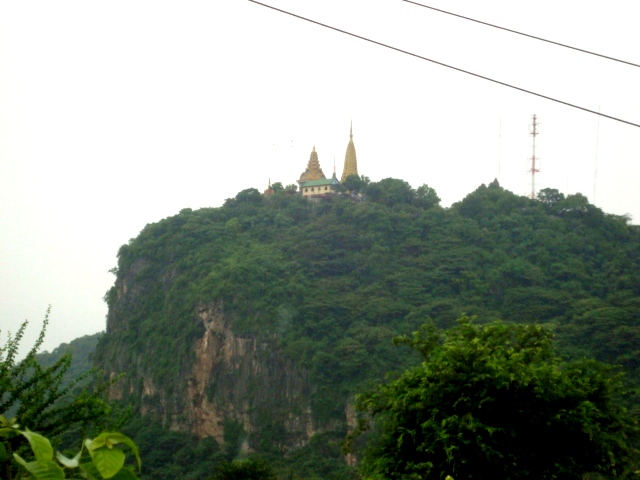
Our tuk tuk passes a tree covered hill with a Buddhist pagoda and stupa visible at the top. This is Phnom Sameau. I'd like to go up for a look, but Sok stops me. What's up there is a very sad memorial. “This killing field too,” Sok says somberly. “They have one cave for adult, have one cave for the children. (Khmer Rouge) kill baby with rock. The other cave for the parents. I don’t like see that."

What Sok is trying to tell Me, is that he doesn’t want to go to that horrific place again. I don't blame him. I’ve already seen too many cracked skulls and human bones at other killing fields during my stay in Cambodia, so I agree to travel on. We continue in our tuk tuk, heading down the bumpy dirt road. Next stop: the scenic, and tragic site of Kamping Poi.  

Friday, November 7, 2014

KILLING FIELD

Leg bone and clothing of Khmer Rouge victims lie exposed
I'm out in the Cambodian countryside, walking down a well worn dirt path. Looking down, I spot what looks like a tree root protruding from the dirt. It catches my eye, because unlike dark tree roots, it’s white. That’s when I realize, I'm not looking at a tree root at all.

It’s a bone, a human leg bone!

Where I’m standing, is in the middle of a killing field. From 1975 – 1978, there were 17,000 people murdered here by the Khmer Rouge. Most were innocent civilians.

Everyone has heard of the 'killing fields' due to the movie of the same name, and I'm visiting one for the first time. This killing field is known as Choeng Ek, located eight miles south of Phnom Penh. Here is where the guards of Tuol Sleng prison sent all of their victims  to be executed and buried.

As I walk further along the path, I see dirty pieces of clothing of every color, lying all over the ground. This isn’t discarded garbage, this was clothing of the victims buried here. Like the bones I see, pieces of clothing have gradually been uncovered and surfaced over the years from excavations and erosion. Much of it has been left in place. This is one giant crime scene.


Buddhist monks walk by excavated mass graves
Four Buddhist monks pass by on the path, while I look at burial pits to either side of me. Walking between the pits, even more parts of bones are visible protruding from the earth. Here a broken leg bone is sticking out. There is part of a skull. This killing field is made up of numerous mass graves. Pit after pit after pit, the shocking total is 129 mass graves in all.  

To bear witness to the atrocities committed here, signs were posted on the site. Those beneath two nearby thatched roof enclosures, need no further explanation.

“MASS GRAVE OF 166 VICTIMS WITHOUT HEADS”

“MASS GRAVE OF 450 VICTIMS”

This killing field isn’t exactly a field, as some trees are scattered throughout. I come to a large tree, with a stack of leg and arm bones piled up at its base. Apparently, human bones are occasionally gathered up, and placed into piles at locations around the site. A sign next to the tree says, “MAGIC TREE…THE TREE WAS USED AS A TOOL TO HANG A LOUDSPEAKER WHICH MAKE SOUND LOUDER TO AVOID THE MOANB OF VICTIMS WHILE THEY WERE BEING EXECUTED”. Just how did they get ‘Magic Tree’, out of something so horrible?


Children were killed here. Other bones at right.
The Khmer Rouge didn’t have the money, or the know how to make gas chambers and crematoriums like the Nazis did. So they brought their victims here, to what used to be an old cemetery. The Khmer Rouge wanted to save money on bullets, so few were shot here. Most of their victims here were beaten to death, or stabbed. Their tools of death included steel rods, bamboo poles, axes, hoes, shovels, and knives.

Another large, leaning tree, with another pile of bones at it’s base, has a sign that is even more disturbing. “KILLING TREE AGAINST WHICH EXECUTIONERS BEAT CHILDREN”.

In the first year of the genocide, it was mostly the civilians with ‘soft hands’ that were executed here. That meant that the victims were non-farmers, such as teachers, businessmen, white collar workers, and the educated class. There are a few westerners buried here as well, and foreigners that were married to Cambodians.

By the final year of killing here, there were no more enemies from the old regime left to execute. By that time, the Khmer Rouge were killing their own. Their paranoia and violence had been turned on each other. In a Cambodian version of the Red Terror, communists turned on communists, making false accusations to turn in political rivals. This is when the more Vietnamese oriented Eastern Zone of Cambodia became the number one target of the Khmer Rouge. Many cadres and soldiers from that region ended up buried here. The current Prime Minister Hun Sen, was a Khmer Rouge cadre from that area. The only reason he wasn't killed by his comrades, was because he managed to escape and flee to Vietnam.

Another twisted modus operandi of the Khmer Rouge, was their extensive use of child soldiers. That method was used here, as many of the executioners at Choeng Ek were only teenagers! As Pol Pot sought to 'purify' Cambodia, he had many executioners that were between 13 to 19 years old. 
Photos of Tuol Sleng victims buried at Choeng Ek. Those killed here include women and children.

On some days, more than 300 people were murdered at this site. Killing here was like a factory, and most victims were killed by hand. The executioners killed not just men, but also women and children. The mental and emotional trauma of murdering so many people by hand was more than many of the executioners could handle. Over time, many of them could just not deal with the horror of their actions. Some went crazy, rebelled, or deserted, only to be caught and returned. In an ironic end for them, those executioners who tried to escape, were brought back to be killed in this very place, where they themselves had killed others. (This had also happened to some of torturers at Tuol Sleng prison.) Still others were faithful communists doing their duty to the end, but were betrayed by other cadres, falsely accused, and executed.  

After the fall of the Khmer Rouge, the Vietnamese led government began excavations here in 1980. Of the 129 mass graves here, 86 were excavated. The diggers found heads were often buried separately, so they were unable to match heads to their original bodies. The pits were dug deep, corpses were usually crammed together, with bodies stacked high. They dug up more than 8,900 corpses, before finally halting the excavations. I’m aware that as I tread lightly around the paths of this killing field, directly beneath my feet are the remains of thousands of more victims, still interred where they were originally buried.
Memorial stupa, with remains inside

As time has passed, some signs of life have returned to this somber place. Birds are chirping in the trees, and an occasional butterfly floats by. Free range chickens peck at the dirt. Goats and cows chew on grass beyond the border fence. Since they didn't excavate all of the mass graves, the cows are probably grazing right on top of them. A tragic fact, is that this is only one of the many killing fields across in Cambodia. A survey done after the war, found that there are at least 389 mass graves across the country.

Choeng Ek has few surviving buildings. The old Khmer Rouge office, detention building, and sheds were torn down by scavengers long ago. But there is one tall building; a memorial stupa built in 1988.

I approach the structure apprehensively, knowing what's inside. (I saw a similar stupa for Vietnamese massacred by the Khmer Rouge, across the border in Vietnam.) From a distance, it looks only like a whitish tower with windows. The familiar sloping Khmer rooftop with heads of snake-like nagas point up from the corners. As I get closer, I see what is behind the windows. Skulls. Layers and layers of human skulls, with shelves reaching higher and higher. There have to be thousands of human skulls here.

Surprisingly, the door isn't locked. My guide opens it, and gestures me to enter. I slowly step inside. Solo flute music floats down from somewhere. The stupa has 17 levels to symbolize April 17th, the day that Khmer Rouge rule began in 1975. I walk around the interior looking at them, level after level, skull after skull. They all stare right back at me, with their dark empty eyes. I remember all those enlarged photos of the faces of condemned prisoners back in the Tuol Sleng prison; they ended up executed here. I look at all of these skulls lined up together, staring back at me. These aren’t  just pictures on a wall any more. These are the genuine faces of death. The question comes to me, that comes to all visitors who see this. Why? Why? It’s a question no civilized person can answer. It’s answered only in the twisted logic, the barbarity, the insanity that made up the murderous mindset of the Khmer Rouge communists.
Inside the stupa, are shelves stacked with skulls of Khmer Rouge victims

Exiting the tower, on steps next to the stupa, I encounter a steel rod, with leg irons looped through it. If prisoners arriving on Chinese trucks got here too late at night for executions, these leg irons were put over their ankles. The condemned were all forced to lie in a row, shackled to the same steel rod. There are enough leg irons here to shackle six people together. Some of the leg irons here look too small to fit around an adult’s ankle. My guide says that in that case, the guards would break the prisoner’s ankle, to make it fit.

Choeng Ek has its greatest number of annual visitors on May 20th, the local Memorial Day, when many Khmers who lost relatives here come to remember them. My guide says he's been here then, and that many seniors cry.

One of the signs I read as I’m about to leave, gives the best description I’ve seen yet of the Khmer Rouge leaders.

“THE METHOD OF MASSACRE WHICH THE CLIQUE OF POL POT CRIMINALS WAS CARRIED UPON THE INNOCENT PEOPLE OF KAMPUCHEA (CAMBODIA) CANNOT BE DESCRIBED FULLY AND CLEARLY IN WORDS BECAUSE THE INVENTION OF THIS KILLING METHOD WAS STRANGELY CRUEL SO IT IS DIFFICULT OR US TO DETERMINE WHO THEY ARE FOR : THEY HAVE THE HUMAN FORM BUT THEIR HEARTS ARE DEMON’S HEARTS, THEY HAVE GOT THE KHMER FACE BUT THEIR ACTIVITIES ARE PURELY REACTIONARY. THEY WANTED TO TRANSFORM CAMPUCHEAN PEOPLE INTO A GROUP OF PERSONS WITHOUT REASON OR A GROUP WHO KNEW AND UNDERSTOOD NOTHING, WHO ALWAYS BENT THEIR HEADS TO CARRY OUT ANKAR’S ORDERS BLINDLY THEY HAD EDUCATED AND TRANSFORMED YOUNG PEOPLE AND THE ADOLESCENT WHOSE HEARTS ARE PURE, GENTLE AND MODEST INTO ODIOUS EXECUTIONERS WHO DARED TO KILL THE INNOCENT AND EVEN THEIR OWN PARENTS, RELATIVES OR FRIENDS.”

Some executioners survived those years, and remain free to this day. They have never been arrested for their crimes here at this killing field. I asked my guide what he thought about the Khmer Rouge who are alive today, and he told me, “We forgive them, but we never forget.”

Friday, October 31, 2014

WATCHING WAR CRIMES TRIAL

Courtroom building for the trials in Phnom Penh, built with foreign aid
When people think of Cambodian history, a few words usually come to mind: “Killing Fields” and “Khmer Rouge” top the list. After decades of impunity, the time has finally come for the ex-leaders of the Khmer Rouge to answer for their genocidal crimes.

Today I'm see a truly historical event. I'll be watching a trial for the most serious crime of all: "Crimes against humanity".

I'm attending this historical trial with my friend Sue, another American living in Cambodia. We arrive by tuk-tuk on the edge of Phnom Penh, and enter the ‘Extraordinary Chambers in the Courts of Cambodia’, (ECCC) an impressive judicial complex built solely for these trials. A large new yellow building with a Khmer style roof holds the courtroom. This complex also has a jail for those accused, so it's surrounded by a fence topped with barbed wire.

We enter through metal detectors; cell phones or cameras aren't allowed. (Darn!) Walking in, I find the room very wide, with blue movie theater style seats for those attending. It looks more like an auditorium than courtroom. Attendance is low; I count only about 115 people, mostly foreigners. Many more Cambodians attended in the beginning. But these trials are a long, slow process, and fewer attend these days.

The audience is separated from the proceedings by glass. I wonder if it makes those inside feel like zoo animals. That’s not far off, considering the crimes committed by those on trial. The glass is very thick; I wonder if it’s bulletproof. There are many Cambodians that would like to kill the defendants themselves, along with their lawyers.

Prime Minister Hun Sen is ex-Khmer Rouge! (photo: Wikipedia)
I grab a booklet titled, “An Introduction to The Khmer Rouge Trials”. The preface is given by Hun Sen, Cambodia's Prime Minister. He says,“During that time, over three million of our people lost their lives. They were our parents, our children, our relatives, our colleagues and our friends. Those of us who survived have lived for a quarter of a century bearing pain and grief for those we lost and being haunted by the nightmare of our own experiences.”

What Hun Sen fails to mention, is that during the genocide, he was a Khmer Rouge commander! His former membership in the Khmer Rouge is believed to be one reason why these trials were delayed, for years. It hasn't been proved that Hun Sen took part in war crimes during the Pol Pot era, but it hasn't been disproved either.  

The only reason these trials came about, was through international pressure. Hun Sen’s government couldn't hold fair trials on their own, and he also refused to allow the trials to be held at the International Criminal Court in the Hague, where it would have cost less. The Cambodian government demanded the trials held here. Cynics say that this was so the Cambodian government could make money off the trials. To ensure fairness, the international community demanded that a few foreign judges be included. As a result, the presiding justices are a mix of Khmer, and foreign judges.

On entering, I’m handed a headset and receiver to listen to the translations. Flags of the United Nations and Cambodia hang flat on the wall, with the ECCC seal between them. Looking at the participants, all lawyers and officials are wearing purple or black robes. Off to the right, seated alone, is an older Cambodian. I quickly recognize him. It's hard to believe it, but there he is.

Ex-prison warden Duch(photo:Wikipedia)
Duch!

I almost gasp. Duch was the warden of S-21, also known as Tuol Sleng, the former prison and torture center that I had visited. This man is responsible for the murder of 17,000 Cambodians, and he's seated less than 30 feet away from me!

I'm surprised to see that he’s so short. For a man who was one of the 20th century's biggest terrors, he’s really rather small. He wears a white, short sleeved dress shirt, and he’s a little chubby. Unlike his former captives, he’s not going hungry in prison. He's been getting fat on ECCC prison food.

Duch is not his real name. Like most wartime Khmer Rouge cadres, he changed his name when he joined the radical movement. His real name is Kaing Gueck Eav, born in 1945 in Kampong Thom Province. A gifted math student, he once won 2nd place in a national mathematics contest. He later became a math teacher, joining the Communist Party in 1970. In the 1980’s he left the Khmer Rouge and disappeared. A western journalist found him in the 1990’s, and he was finally arrested in 1999.

As Pol Pot is already dead, four other top Khmer Rouge leaders will be tried later, after Duch. These include Nuon Chea, former head of the National Assembly, Ieng Sary, former Minister of Foreign Affairs, his wife Ieng Thirith, former Minister of Social Affairs, and Khieu Samphan, former Head of State. Four of the five are charged with war crimes, and all are charged with crimes against humanity. 
Photos at S-21 prison of some of the women and girls Duch ordered executed

At 9am, there’s a loud electronic beep, and everyone stands. Seven judges file in, all wearing red robes. Two Cambodian guards enter, sitting on either side of the accused. And the proceedings begin. Lawyers do most of the talking, speaking on the slow side to make it easier for translators. Translations are available in Khmer, English and French. I'm impressed by the translations, though it's a very slow process. No wonder these trials are going to take years.

Today the lawyers are questioning a witness that spoke about refugees that fled the Khmer Rouge, seeking safe haven in Vietnam. Apparently, the Vietnamese government had forcibly repatriated some refugees back to Cambodia. His testimony is needed, because after those refugees were forcibly returned the Khmer Rouge executed them.

As testimony proceeds, Duch agrees with the witness's recollections. Wearing glasses, he looks much like the teacher he was before he joined the Khmer Rouge. As the former prison warden speaks, he waves his hands for emphasis, speaking of the “life and death conflict” between Vietnamese and Cambodian Communists.

Duch said, “I didn’t think of Pol Pot as a patriot. He had blood on his hands.” And Duch didn't? I thought that was an odd thing for him to say, since he'd signed thousands of death warrants with his own hand.

Later that day, he seemed to correct himself. “My hands were stained with the blood of S-21,” he said. Duch doesn’t deny his part in the genocide. A unique part of Duch's story, is that in the 1990's he converted to Christianity. His conversion seems to have played a role in his confession. He's the only defendant in these trials that is pleading guilty.
Duch speaks at his trial for crimes against humanity (photo: Wikipedia)

While we watch the trial, Sue recognizes Vann Nath, a Cambodian sitting behind the prosecutor. He's one of the very few survivors of S-21. His testimony against Duch will be strong evidence. As I watch, Duch speaks animatedly with his hands. I notice something else: he’s missing a finger on one hand. I wonder, did having a maimed hand, make Duch more brutal?

Just about everyone speaks calmly during the trial, until a Cambodian lawyer speaks up. He questions Duch heatedly, asking about Cambodians deported from Vietnam. It's stated that Vietnamese officials exchanged buckets of salt for refugees, before they were executed. So Khmer refugees were literally not worth their weight in salt to the Vietnamese government.

It's shocking to learn terminology that the Khmer Rouge used in those violent days. Lawyers and witnesses discuss a Khmer Rouge meeting, where they spoke of ‘smashing’ people in the army. Of course ‘smash’ meant 'kill'. Then Duch speaks up - he was at that meeting, and agrees to fill us in. It's chilling testimony; it's as though I'm listening to a top Nazi talk about the meetings for the final solution. They spoke of, “getting rid of enemies and traitors”. Duch doesn't sugar coat his part in this either. Regarding one detainee, Duch says, “I ordered people to beat him, and get a confession.”

As the day's proceedings close, the judges exit the court room. As they do, Duch gives each judge a Buddhist bow. How times have changed; he could have been executed for doing that back during the Khmer Rouge days.

Months later, Duch's trial finally ends, and he's sentenced to 35 years in prison. Given that he had already been in jail for so long, he would be able to walk free after 18 years. Duch appealed his sentence, saying that he was only a ‘junior officer’ following orders. His appeal outraged victims, and the prosecution, who said the sentence was too lenient. After hearing the appeal, the judges agreed with the victims. Duch was re-sentenced, to serve the rest of his life in prison.