Showing posts with label Mekong River. Show all posts

Wednesday, September 27, 2017

DRAGON BOATS BID ME FAREWELL

Thousands of Khmers crowd the riverfront for the dragon boat races
I’m leaving Cambodia soon, and a huge crowd has gathered. A mass of humanity stretches for several blocks. It’s unlike anything I’ve ever seen in Southeast Asia.

But this isn’t a riot. And it’s not a political rally. Thousands and thousands of Khmers, many with their families, have come to the Phnom Penh riverside to watch the dragon boat races.

Over 300 colorful dragon boats, resembling long outrigger canoes, from all over the country will race and compete for glory and honor on the river. Farmers from far flung provinces have just completed harvesting their fields, and traveled all the way here to celebrate or participate.

2 - 3 dozen men crowd into each dragon boat, all wearing matching colored t-shirts. A flag bearing the number of their rowing team flies off the back of each, flapping in the wind as each strong stroke by the crew drives them towards the finish line.

The dragon boat races are part of the annual Water Festival in Phnom Penh
Dragon boats have a long history in Cambodia. The event commemorates a legendary naval battle during the reign of King Jayavarman VII. This Khmer King that reigned over Angkor Wat led them to victory on the waters against the neighboring Cham empire.

Taking place over 3 days in November, the dragon boat races are part of the annual Water Festival, marking the time when the Mekong River downriver swells, and the Tonle Sap River that meets it reverses its course. Upriver becomes downriver.

Like everything else that was popular, fun and traditional in Cambodia, this festival was banned during the Khmer Rouge communist years. It was revived in 1990, and the festival and races have grown exponentially ever since.

I attended a wedding in Phnom Penh before, and that was also a joyous occasion. But this huge festival gives me a different feeling.

More than 300 dragon boats take part in the races on the Tonle Sap River
As I watch families enjoy the festival, I get a vibe that I have never felt in Cambodia before.

Mass happiness.

In my six months here in Cambodia, I had spent much of my time traveling through the old war zones, speaking to survivors. These people had survived oppression under the French, the civil war with the Lon Nol dictatorship, war against the Vietnamese, and worst of all, the Khmer Rouge genocide.

Talking to these resilient survivors about those horrible days was not cheerful work.

But here at the dragon boat races, I sense the happiness that the people of Cambodia truly deserve. This is their festival. Done by them, for them. It’s a purely Khmer tradition that they can all enjoy.

That night, I return to the riverside, and see another unexpected sight. Elaborately lighted boats. Decorated with thousands of what westerners would call ‘Christmas tree lights’, thousands of bulbs form huge floating figures, such as nagas and other Buddhist icons. Impressive.

Lighted boats illuminate the river at night during the Water Festival
To close the event, the night sky lights up with fireworks over the lighted boats and barges.

As I leave Cambodia, I’m glad that this festival is my last experience in this fascinating country. 

The Khmer people I’ve met during my time here have endured the worst, but this country is on the upturn.

There are problems, to be sure. But they are at peace.

Their darkest days are behind them. I hope so. I pray so.

I can feel it. There is hope for the future here.


Thursday, April 24, 2014

UP THE MEKONG RIVER TO CAMBODIA

I leave Vietnam from their oddly designed Mekong River immigration post
As our boat chugs up the Mekong River against the dark water’s strong current, I look to the riverbank. Up on a flagpole, the familiar red flag of Vietnam flaps in the wind. Steps away, a red and white fence marks the border. Our small boat boat passes the fence, where another banner waves above a humble border post. The flag is striped blue and red, with an image of the ancient Angkor Wat temple in the center. 

I’ve just left Vietnam, and crossed into the Kingdom of Cambodia. 

I’m traveling with a mixed boatload of travelers, hailing from China, Finland, Korea and Australia. As usual, I’m the only American and we’ve just left Vietnamese immigration. We could have just walked across the border, but this is all part of a Mekong journey taking me to Phnom Penh, Cambodia’s capital. Our boat docks, and walking up the riverbank, we pass beneath a large sign: “KAAMSAMNAR-KOHROKAR INTERNATIONAL BORDER CHECK-POINT POLICE STATION”. That’s a mouthful. 


Crossing post with faded paint marks the riverside land border
Compared to the Vietnamese side, immigration here is a small operation. Leaving Vietnam, their new immigration office was strangely designed like some kind of new age ship. It was even air conditioned. 

But not on this side. Cambodia doesn’t have money for that extravagance, so we queue in the hot sun. There are few immigration officers in this small office, so the line is slow moving. Most visitors travel to Cambodia by road or air, so this Mekong border crossing has fewer travelers. 

The first major difference I note, is their priorities. They don't have much money for a big immigration office, but they do have money for their religion. An impressive Buddhist shrine and large spirit house are at the entrance. Both look stunning with gold paint and red trim, outshining the simple government buildings that surround it. Cambodia is no longer a radical communist, atheist country. Buddhism has returned.


Buddhist shrine and spirit house by the border post

After sweating in the queue for awhile, I finally pass into the shade and get my passport stamped. We head back to the river, and end up with a larger boat, though it’s not much of an upgrade. We are joined by 10 more Spanish and English passengers, so it won’t be a very roomy journey. Although our new river boat has a toilet in the back, it’s not quite up to environmental standards. The bathroom is the size of a closet, and the hole where you sit drops straight into the river. Adequate sanitation is scarce here; lots of raw sewage empties into the Mekong.

As we depart, one of the Khmers (Cambodians) on board starts calling out to the passengers for his side business. “Change money… Change money for Cambodia riel.” I decline, due to Cambodia’s unusual currency system. Although the official currency is the riel, the US dollar is widely accepted. The highest riel bill commonly found in circulation is the 10,000 riel note, worth only about US $2.50. Larger purchases are usually done in US dollars. Even Cambodian bank ATMs give out cash in dollars. 


Queuing for Cambodian visa and passport stamps
Settling in for our long river cruise, I immediately notice a major change in the river from the opposite side of the border. Back in Vietnam, the Mekong is a delta with many branches. But on the Cambodian side, this is just one huge river, more than a mile wide. 

River traffic is reduced too. On Vietnam's side, there are many more boats, fishermen, and villages. That is partly due to the fact that Vietnam’s population is more than six times that of Cambodia, so the river gets more use there.

With an open river ahead of us, the Cambodian side is definitely more scenic, rustic, and romantic. Here there's far less evidence of man and modernity. On this stretch of the Mekong, there are few coastal towns, Khmers on the river live mostly in small villages with plenty of distance between them. Palm trees lining the riverbank are far larger, and numerous. There’s not as much logging in this quieter, less hectic corner of Southeast Asia. 

I find the hum of the motor rather relaxing. The hot sun is replaced by clouds, and the boat’s motion gives us a cool breeze as we head deeper into Cambodia. Our long blue boat isn't big on amenities; rather than individual seats, passengers sit on wooden benches that run the length of the boat. The ceiling is strangely decorated with artificial flowers. A woman working the boat makes the rounds with a basket, selling beer and soda. Nobody buys beer, since everyone is hot and dehydrated from the tropical heat. 


Khmer fisherman on Mekong River
As we continue, the river craft begins to list to the port side, and our boat slows down. The Khmer pilot comes aft to the passengers, making hand motions to a portly Spaniard. I chuckle, realizing what he’s trying to say. If he could have spoken English, he would have said, “Would the heavyset Spanish gentleman please move back to the other side of the boat?”

Once the Spaniard gets his meaning, he says, “I didn’t know I was that heavy.” There’s laughter, as he changes sides, the boat is righted, and we’re off again. 

Looking upriver, I see mist ahead of us. Rain. We’re about to get poured on. Soon we’re in it, and the crew scrambles around the riverboat, bringing bags of rice down from the rooftop. Then they quickly lower the cabin’s side flaps, hoping to keep us dry. 

The rain grows heavier, and I hope the downpour won’t last. As we shelter from the deluge, I ponder the Mekong’s stormy past. On this slow boat up the Mekong River into Cambodia, I'm reminded of Joseph Conrad’s river journey in ‘Heart of Darkness’, and the Vietnam War era movie "Apocalypse Now" that was based on his book. Much like the movie and book, there was a time when the journey here led to madness. During the war years, this was the world's most dangerous river. It started with the communist fighters of the Khmer Rouge. 


Our crowded boat heads upriver into Cambodia
I'd already encountered former communist fighters in Vietnam, but as I'd also seen in Ba Chuc, the Viet Cong had nothing on the Khmer Rouge when it came to murderous brutality. Some of that violence was seen here. This stretch of the Mekong River was a lifeline for the US backed government of Cambodia during the war; in the early 1970’s the Khmer Republic received most of its supplies up this Mekong route. But as the communist Khmer Rouge gained in strength, they began targeting river convoys here with a fury. Many supply ships, escort boats, and lives were lost on this river. Much of that war refuse remains; marine wreckage and a great deal of unexploded ordinance still litter the river bottom. out of sight beneath the darkened waters.

Khmer Rouge attacks here brought heavy retaliation from the US military, using B-52 bombers. When the Mekong’s river banks were seen later from the air, a US embassy officer remarked that the countryside, “looked like the valleys of the moon,” from all the bomb craters. Just like in Vietnam, B-52’s weren’t the answer to stop guerrilla warfare. In time, the Khmer Rouge eventually cut off all resupply convoys, blocking river access to Vietnam and the coast. When that finally happened, the days of the Cambodian government were numbered. 


Some river boats look overloaded, low in the water
Before long we motor ahead out of the rain, the flaps go up, and our lovely river views are restored. River traffic picks up, and we pass wooden boats carrying sand, gravel and bricks. It’s good to see that military cargos have been replaced by construction materials. These cargos are meant to build, not destroy. Some overloaded boats look so low in the water, that you’d swear that they’re sinking. At night, some don’t even use running lights. They appear as long, dark silhouettes in the water; some have been sunk after late night collisions.

My fellow travelers aren’t a talkative lot, except for the Spaniard, who asks aloud, “Is this country communist also?”

An Englishman corrects him, “No, it’s a kingdom”.  

This 'kingdom' is one of the poorest countries in Asia, as poverty is widespread in Cambodia. There are few signs of modernity, we see only a rare cell phone tower, and a pair of new Buddhist temples. A farmer with an ox cart walking the riverbank reminds me that most poor Khmers get by as farmers. Many villages we pass are all thatched roof homes, lacking electricity. My journey is during the dry season, but in the rainy season, much of the shore in view will be underwater. I see no bridges over the river either; Cambodia remains seriously underdeveloped.

As the hours pass, I find myself yawning. There are too many passengers on our boat’s benches for anyone to lay down. Still, some are already asleep. With the motor's hum acting as a lullabye, I give in, and close my eyes. Sleep finally comes. 

Soon, I arrive in Phnom Penh.  

Thursday, November 7, 2013

MEKONG RIVERFRONT AND OLD TOWN NIGHT MARKET

Laotian paddles traditional boat on Mekong River at Luang Prabang

This afternoon I'm strolling through the historical neighborhood of Luang Prabang, in the old capital of Laos. Walking downhill, I arrive at the famed Mekong River. Having been on it before, it's as though I’m reunited with an old friend. It doesn’t disappoint; I’m treated to another fantastic view. The majestic Mekong flows before me, and beyond it are ancient forest covered mountains. Since the sun has returned the colors are bright, and the intense green colors of the jungle blanketed hills really stand out. 

There are no tourists around this serene scene, so I find a walkway down from Khem Khong Street to the riverbank. There are no speedboats here, like everything else in Laos, movement on the river is slow. There’s no bridge either, any one crossing uses their own small boats, or takes the ferry. With the ferries docked, river traffic is light. The only sound is the putt-putt of one longtail boat chugging upriver.


Buddhist monk by Mekong River, opposite Luang Prabang. This side of river was once part of Thailand.
Far downriver is Vientiane,  but unlike in the south, the Mekong is not an international border here. The bank on the far side here is now Laotian territory, but it wasn’t always this way. There was a time when the land west of the Mekong was part of Thailand. That back and forth change of frontiers led to border battles further west in the 1980’s. But all is calm now; the far bank is now home to quiet ethnic minority villages.

I head further down the Khem Kong river road, behind the royal palace. This was once the royal pier, a miniature port where the world’s dignitaries arrived by boat for official visits with the king. Back before there was a decent road between here and Vientiane, the Mekong was the main highway of Laos. 
Long houseboats lined up on the riverbank
With the rise of roads in Laos, river traffic has dropped, but there are still some boats that carry passengers up and down the Mekong. This area has become a passenger port for journeys on the river. A whiteboard outside the booking house promotes a two day boat trip to Huay Xai, a town upriver bordering Thailand. It claims that the trip is by ‘VIP boat’. I let out a chuckle, since I spoke with some travelers that dispute that classification. They arrived in Luang Prabang on that same river route, and the boat they traveled in was far smaller than they expected.

“It was so crowded, full of cargo and passengers, there was little room to spare,” a young lady complained. “We only slept a little, and that was in hammocks.” Well, when those backpackers travel, they like the true local experience. They certainly got one. 

I look down towards the river bank now, and there some passenger boats, but they are outnumbered by much larger craft. There are more than 20 blue houseboats, all lined up on the bank, one right after 
A family lives on this houseboat
another. This part of the shoreline has been transformed into a floating residential area. I’ve never seen houseboats like this before, long and narrow, most are more than 80 feet in length. This makes for affordable housing, in an exclusive neighborhood. These boats are docked next to the most expensive land in northern Laos, and their rent to dock here is  probably quite low. Some of these families seem to do well; a number of the rooftops are adorned with solar panels and satellite dishes. 

Still, this isn’t a very sanitary lifestyle. I see a few children playing about, and laundry is drying in the windows. The laundry water and the bath water both come from the river. Unfortunately the river is also the neighborhood toilet. 

Leaving the river I go to check out more of the town’s commerce, so I walk up the hill into the heart of this historic town. I notice Laotians walking into a market resembling a barn, and I follow them in. Inside is a market not for tourists, but for local folk. Booth after booth is selling cheap clothes, costume jewelry and pirated DVDs. 


Old basketball court is now a market
The ceiling is unusually high for a local market, and looking up, I notice familiar hoops hanging from each end. This barn-like building wasn’t originally a market at all, it was a basketball court. Given that basketball is an American game, I wonder if these old backboards were installed when pilots of the CIA's Air America used to be here during the war. Since most Laotians are fairly short, they don’t have much use for a game favoring tall people. At least they’re putting the building to good use with the market. Not to miss a place to display their merchandise, one vendor has hung her colorful t-shirts from the far hoop. 

Leaving the market, I turn onto the main street of the town’s old part, Sisavangvong. Passing the palace I visited earlier, I reach the best preserved section of town. There are French shophouses, cafés, popular restaurants, and stores selling works of local artisans. And yet, there is a distinct, un-Laotian feel to this street. Also occupying these old buildings are travel companies and internet cafés. The foreigners have invaded.  

Looking around, I see Laotians on Sisavangvong have been outnumbered by white foreigner tourists. Walking down the busy street, I hear German, French, Swedish, and various English accents. In 1995 Luang Prabang was declared a UNESCO World Heritage site, which helped to preserve the old French colonial houses. After the war Laos was a forbidden land for foreigners, but they have come back to Luang Prabang in droves. 

Passing one tour company, I pause to read the elaborate placard out front. It advertises elephant rides in the countryside, a favorite of foreign visitors. Ride an elephant for a couple hours, or all day. For those who want to spend even more time with the great Asian elephants, they advertise a mahout school for $140. In learning the mahouts ways, you are taught the basics to be an elephant driver, or handler. The introductory course takes three days. 
Local vendors set up for Night Market in Old Town Luang Prabang
Or if you prefer an old fashioned jungle trek like the colonial explorers used to do, you can take a four day elephant caravan into the Hongsa Forest. That will only set you back $800 a head. 

Walking on, another elephant tour company advertises this: “Three days trek to visit old opium fields”. 'Old' opium fields? Really? Are they saying that there aren’t any more new ones? 

I head back to the guest house to rest, but there's more coming in the evening. Sisavangvong is known for its night market, and I return later to check it out. 

This is actually my second time to the night market; I had seen it five years before. It was a unique night market back then, the street was closed to traffic, and each vendor had their wares laying out in the open on the roadside. There were no tables, their goods were laid out on the ground on top of colorful woven blankets. Each lady vendor had only a small light bulb to brighten their merchandise beneath the moonlight. 
Lady vendor smiles at customers in Luang Prabang Night Market
Many ethnic minority women came in from the countryside to sell their goods, some of them working with a baby still strapped on their back. There was a wide selection of Buddhist statues, incense and silver jewelry of traditional designs. The best wares were the hand woven fabrics and traditional clothing. These weren’t just cheap tourist souvenirs, this was real craftsmanship. Almost everything you could see was made by hand.

In the years since my last visit, I return to the night market to find it has expanded exponentially! There are now so many vendors here that they don’t just line the roadsides, they are crowded together out in the street. It'ss no longer open to the skies either, most vendors have erected pop-ups for the rainy season. They're all packed so tightly together on the road, that there isn’t much space to walk through. To make my way down the street through the pop-ups, I'm forced to duck up and down repeatedly like a target in an arcade game! 

2005: The Night Market before it became swamped with tourists


Having Luang Prabang declared a world heritage site has been a mixed blessing here. The old buildings have been preserved, that’s true, and business is booming. 

But I fear Luang Prabang’s old district has become a victim of its own success; its romantic allure is fading. The high season now has mobs of tourists here, with most businesses catering solely to foreigners. 

This historic street is losing the old world charm that made Luang Prabang a world heritage site in the first place. 


Wednesday, October 30, 2013

RAINING ON THE RED PRINCE

I'll have a Coca- cola to go... in a bag??
A double rainbow, what a rare sight. Having just left my guesthouse, I’ve stepped out into the quiet afternoon streets of Luang Prabang, Laos. I’ve seen the colorful phenomena of twin arches only a few times in my life. I feel a good day ahead of me; I turn and head towards the Mekong River. 

On my way, the precipitation that brought the rainbows returns, and the clouds loosen into a steady rain. I quicken my steps, and take shelter in a small roadside drink stand. It’s not much; tables and benches are made of scrap lumber. But it’s dry inside, and with the rain turning into a deluge, I stay for a while. I’m not that worried about the downpour; most monsoon showers don’t last very long. Besides, I prefer the rainy season here in Luang Prabang. In the dry season, the air here is terrible. Since local farmers still practice slash and burn agriculture, the air becomes filled with acrid smoke from burnt brush, with the skies always hazy. I’ll take the rainy season, thank you. 

The lady vendor in this drink stand doesn’t speak English, but I make do with hand motions and order a soda. Reaching into an ice cooler, she removes a glass bottle of cola. But instead of handing it to me, she opens it and pours the contents into a clear plastic bag! After inserting a straw, she seals the bag's top with a rubber band. 

I had forgotten about this little ritual. This is the usual Southeast Asian manner of dispensing a soda to go. By doing it this way, she keeps the glass bottle to return for deposit. 

A tribute to the 'Red Prince' on his 100th birthday... but where are the crowds??
Soon the rain relents, and I resume my walk along Luang Prabang’s red brick sidewalks. Despite wet streets, this is a great place for a stroll. The scenic town has well preserved French villas, friendly folks, and a laid back lifestyle. As the former capital, it retains some of the old allure that the rest of Southeast Asia has lost.

While wandering the streets, I chance upon a statue and park dedicated to President Souphanouvong, a.k.a. the 'Red Prince'. It’s a new looking park, and it appears that I’ve just missed some kind of public event. There are fresh flowers and colorful ribbons strung about everywhere. Perhaps the rain chased everyone away. 

An impressive display of old photographs depicts Souphanouvong’s career as a communist. A new billboard bears the likeness of the former Prez, and lists his birthday, which is today. He died years ago but by coincidence, I found his memorial park on what would have been the Red Prince’s 100th birthday.
The ex - President, with frozen applause

That explains all the decorations. I have arrived here just after an official government ceremony commemorating his birth. I look up at his brown likeness, and it’s an odd pose for a statue. The Red Prince seems to be frozen in the midst of applauding. Yet he applauds alone. On his centennial anniversary, I am now the only person in the entire memorial park. If his well wishers left due to the rain, nobody has returned. 

Government officials were here for the ceremony, but with their departure, there are no other Laotians here paying tribute to his memory, fans or otherwise.

I saw far more people visiting the royal palace of his cousin, the king, that Souphanouvong had helped his communist comrades to depose. 

Apparently people have a lot more interest in old kings, than they do in old communists. 

Thursday, September 12, 2013

'FRIENDSHIP BRIDGE' CONNECTS OLD ENEMIES

'Friendship Bridge' crossing the Mekong River, from Laos to Thailand
“You! You –You –You !”

I hear this sharp and repetitious voice calling out to me from behind. Wondering what all the fuss is about, I turn to see a uniformed soldier quickly approaching. 

Uh – oh. 

Fortunately, he’s unarmed, but the look on his youthful face tells me that he means business. I realize now that I’ve somehow wandered into a restricted area. Oops.

I’m in the village of Tha Na Leng, a half hour from Vientiane. I hadn’t walked into a secret military base, or a government compound. The restricted area that I had walked into, was simply beneath a bridge. But this is not your average bridge. 

It’s not my fault really; there was no sign posted warning me not to enter this grassy area by the Mekong River. Well, I didn't see any ‘No Trespassing’ signs in English anyway. There was a hand written Laotian sign back at the gate where I entered, but that could have said ‘Joe’s Restaurant’ for all I knew. The gate was wide open, with no guards in sight.

Since this young soldier’s English is limited, he merely points back towards the gate. I get his meaning, and he escorts me back out to the road.  Having been turned away from my original vantage point, I walk go looking for another bridge view. I find a path through an overgrown lot, and soon I’m back at the Mekong's edge. Further upriver, my view of the bridge here is even better. 

Flapping in the wind above the bridge, is the flag of Laos. Flying above on the far side, is the flag of Thailand. This is the ‘Friendship Bridge’. Stretching far across the Mekong, this is the busiest and most important border crossing that connects these two Asian countries. 
Oops, sorry soldier, I didn't know I'm not supposed to be down here... 

The relationship that Laos has had with Thailand is a complicated one. On the one hand, Laotians remember that Thailand destroyed Vientiane in the 19th century, and dominated Laos for years afterwards. Laotians still distrust the Thais to this day. On the other hand, Thailand is the largest foreign investor in Laos, and one of its biggest trading partners. That’s easy to see here, simply by watching the freight trucks that drive back and forth across this bridge. 

As far as bridges go, the Friendship Bridge is impressive in both length and height. It’s not just that the Mekong is a half a mile wide here; beyond that the bridge stretches even further. Beginning over in Thailand, the bridge slopes upwards, enabling it to reach high over the mighty river. Though this is the rainy season and the river is high, the gap still leaves plenty of room beneath for large riverboats, though I don’t see any. When the bridge reaches the Laos side, it descends gradually onto a ramp leading to customs and immigration.

Built with the help of foreign donors, the Friendship Bridge opened in 1994, and it’s symbolic of the improving relations, and increasing trade between Laos and Thailand. Good relations increased further, and Laos entered ASEAN in 1997, bringing it into a more open relationship with it’s regional neighbors. 

As I look at the steel structure, I can make out four people high above crossing the bridge on foot from Nong Kai, the city on the Thai side. That’s a very long walk for a border crossing. From one immigration point to the other, the whole crossing is close to two miles. Crossing the Mekong here nowadays is a safe affair, but for Laotians it was not always so easy. Back in the days after the communist takeover in the 1970’s, crossing the Mekong from Laos to Thailand was very dangerous indeed. 

When Laos turned communist in 1975, this border with Thailand became a new cold war dividing line. On the Laotian side, the communists could not afford to build their own Berlin Wall like the East Germans did, so they relied on the natural border of the Mekong. This became part of what was called, 'The Bamboo Wall’. 

After the communist takeover, private businesses were closed, property was confiscated, and freedoms declined. Most Laotians with money or education fled the country. This included thousands of businessmen, landowners, teachers, and government workers. The iron fisted policies of the communism created a brain drain. A great deal of wealth left with these migrants, and the economy collapsed. In those years, 10% of all Laotians fled as refugees. With so many departing Laos, numerous refugee camps sprang up across the river in Thailand. Back in the late 70’s and 80’s, the refugee camp across from here in Nong Kai was one of the largest. Pathet Lao patrol boats cruised the Mekong, searching for refugees attempting to escape. Many made it safely across to Nong Kai, while others weren’t so lucky. 
Immigration arrivals and departures are processed here on the Laotian side. Shopping anyone??

I recall the words that a refugee named Truong said to me in America back in the 1980’s. “If you go to Laos,” he said bluntly, “they shoot you.” Truong was a Hmong refugee, resettled in America. He’d spent years in Nong Kai, after escaping across the Mekong. More than a few refugees had been shot, and died on the river as they attempted to escape the communists back in those difficult years.

Most Laotian refugees in Thailand have since found asylum in third countries. While most conflict ended, some refugee problems continue. In recent years small groups of Hmong have been forcibly returned to Laos against their will. There are still an undetermined number of refugees in Thailand today. Since Thailand already had its own Hmong minority before the war, exact numbers are difficult to tabulate. More than 100 Hmong are being held in a Nong Kai detention center, while a few thousand more still live in refugee camps. Other undocumented refugees are still in hiding in Thailand, living under the radar. 

Here at Friendship Bridge, Laotians heading over to live in Thailand these days are mainly economic migrants. With more prosperity in Thailand, plenty of poor Laotians move there to work, both legally and illegally. Crossing for these migrants is now peaceful and orderly, and the military and police presence is greatly reduced. Looking around, I don’t see any patrols, armed police are few, and even the soldier I encountered earlier was armed only with a radio. Most conflict today, is over smuggling. Some contraband is hidden in cargo crossing the Friendship Bridge. With such a long unguarded riverbank, other goods are brought across by boat. But this is not without hazards. There are still reports of Laotian militia firing at boats on the Mekong after dark. 

Across on the Thai side, I see an old abandoned riverboat beached on the riverbank. Except for that old boat, everything else on the Thai side looks newer, and far more prosperous than in Laos. Thai houses are larger, more modern, and more numerous. The difference in numbers isn’t surprising, since the population of Thailand is nearly 10 times that of Laos. 

Here on the Laotian side, is another imposing feature. Just upriver from me, enormous red and white power transmission towers rise high into the sky. You wouldn’t expect these in a country where many villages still don’t have electricity. These must be the tallest electrical towers in all of Laos. They reach from one side of the Mekong all the way across to the other. These lines provide one of the country’s top exports: hydroelectric power. Sent through these lines to power hungry Thailand, Laotian hydropower is fueling factories in the Thai northeast. These days, Laos is sending electric power to Nong Kai, rather than refugees. 

I’ll see more of the country’s controversial hydroelectric dams, and more on the plight of Hmong refugees, as I continue my journey north. 

Friday, September 6, 2013

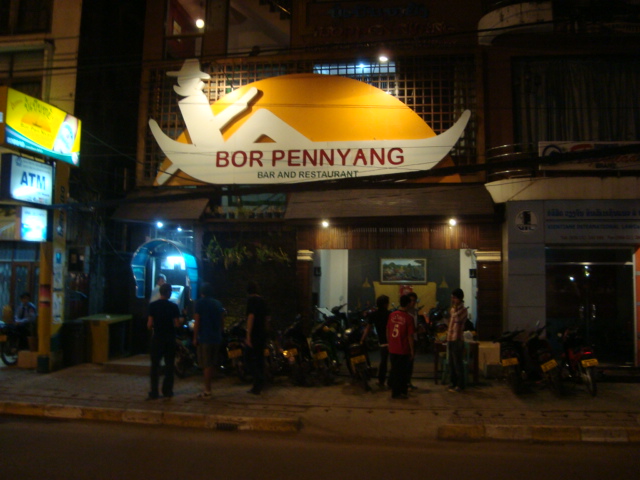
THE 'NO PROBLEM' BAR IN LAOS

The 'No Problem' Bar in downtown Vientiane, one of the best in town
Bor Pennyang in Laotian language means, “no problem”. The saying is a reflection of the laid back Lao lifestyle. Expatriates who stay in Vientiane long term, tend to share the Laotians preference for quiet, stress free living. Like the Mekong, life here flows along slowly. 

Bor Pennyang also happens to be the name of one of the better restaurant bars in Vientiane, and it’s an expat favorite. I’m playing pool tonight, and luckily for me, playing pool here is free. Located on the top floor of a four story building, the necessity of climbing three flights of stairs keeps the lazy customers out. 

The establishment is open air, with a roof protecting patrons from the elements, but there are no walls. There are only railings, with catch nets beneath. The nets keep inebriated bar patrons from dropping their beer bottles onto unsuspecting pedestrians below. 
(I wonder how often that has happened.) When winds blow the monsoon rains inside, waitresses lower bamboo shades to keep the water out, rolling them up again when the skies clear. 

As far as a night spot goes, Bor Pennyang has the best night view of the Mekong River. Looking out over the railings I don’t  see Vientiane, I see… Thailand. Since the building is located on the river front thoroughfare, I’m getting an unobstructed view of the Mekong, with the riverbank homes of the ‘land of smiles’ beyond. It makes for a very romantic view when the Thai lights are lit up at night. For those who enjoy the nightlife, Bor Pennyang  is one of the few locales that make Vientiane worthwhile.

Looking down across the street onto the river front, the open grass lot atop the riverbank has been transformed. As night has fallen, enterprising cooks have hauled in gas stoves, coolers of food, and plastic tables and chairs. Extension cords have been strung up, with bare bulbs to light up the diners. Voila, an instant line of river front restaurants. 
Every night, instant restaurants pop up on the Mekong riverfront

The downtown riverfront is filled up every night with these mobile restaurants, popular with Laotians and visitors alike. I’ve enjoyed traditional Laotian dishes there, and they even have fresh seafood. One of the small restaurants keeps a huge bowl of live shrimp ready for cooking. With Laos landlocked, they must have been brought in from Thailand. 

Turning back from my view of the river front, I step up to the circular wooden bar, and order a cold Beer Lao. This is one of the few pub’s in the city that has the national beer on tap. I'm greeted by the manager, a friendly Aussie named Ian. He's the key to Bor Pennyang’s success; he runs a bar business that both locals and foreigners enjoy. A former chef, he has lived in Vientiane for years, enjoying the slow pace of life. Even among foreigners he stands out, with his odd choice of hairdo. Although balding, he still grows his grey hair long in the back, keeping it in a ponytail. Thankfully, he’s a much better bar manager than hairstylist. 

Tonight is a Friday night, and the crowd begins to roll in to play an early game of pool, or grab a late dinner. After a few games, I notice a Russian couple playing at the next table. Russians aren’t very common in Vientiane these days, there were far more of them here during the post-war years, when there the Soviets were in town working on infrastructure projects. 

“When I was young, the only foreigner I see was Russian,” I recall a Laotian woman telling me. “When I see them, I scared,” she said. “They have blue eyes.”

I take a break from pool, and strike up a conversation with these new Russians. They prove to be an interesting pair. Yuri and Olga are both funloving, outgoing, and young at heart. Yuri says he makes a living importing cars from the USA, shipping them to Russia. Olga is a part time interior designer, and mother to their two children. He’s 45 years old, fairly fit, and balding. She’s aged 29, thin, blonde and very attractive. Olga tells me that when Russians get married these days, age differences like theirs are very common. 

Stepping away from the pool tables, conversation shifts to their home in Moscow. I’m taken aback when out of the blue, Yuri mentions that Moscow has nude sunbathing, on the banks of the Volga River. I tell him that I didn’t know that was possible in Moscow. I didn’t think that it was hot enough there either. 
Interior of rooftop bar 'Bor Pennyang'

Yuri corrects me, “In Moscow, yes. In Siberia, no!”

I ask if he ever sunbathed nude. “Yes,” Yuri says in a matter of fact manner, “we are nudists.” 

While we are chatting, Olga is getting a lot of visual attention from others in the bar, since she’s wearing a very short skirt, and a tight shirt with no bra. Conservative Vientiane is no tourist beach town; she’s probably the only woman in the city showing so much skin in public. 

“She likes to go to strip clubs,” her husband tells me, confessing more personal information. As I continue chatting with Yuri, I eventually find out why the pair are so outgoing. 

They are both swingers. 

“We have alternative lifestyle.” Yuri explains. 

No kidding. After hearing that, I’m not surprised to learn that they are presently living in Pattaya, a beach town in Thailand with a seedy reputation. The only reason that they came to conservative Laos with their kids, was to make a visa run. This is their first trip to Vientiane, and they’re bored. They haven’t found any other couples in Laos who share their lifestyle, so they are disappointed with the city’s nightlife. 

It’s been an interesting conversation to be sure, but since I don’t share their lifestyle, I decide to move on to my next evening destination. I say goodbye to the Russian swingers, who continue their evening’s search for a like minded couple. 

Monday, August 12, 2013

MEKONG RIVER AND THE FAILED PEACE

Late afternoon overlooking the Mekong River
It’s late afternoon, and I’ve taken a seat on a wooden platform, high on the riverbank. The river’s waters are calm, and the slow but steady current flows by silently. The sun drops behind a cloud upriver, as it continues its descent toward distant trees.

A few Laotian couples are also present along the riverside, taking in the romantic view, sitting in pairs atop their parked motorbikes. There are no deep kisses in public here; Laotians are too conservative for that. The young lovers cuddle together, talking quietly in the late afternoon.

Soon the sun peeks out from beneath a grey cloud, and heads for the horizon. Before it does, it casts its warm yellow glow across the serene scene. Sunset on the Mekong.


I have a view of the river that's almost horizon to horizon. As always, the Mekong River is impressive. Yet here river traffic is light, with few boats to be seen. I remember the busy floating market I'd seen down in the Mekong Delta
A longboat heads upstream on the Mekong River
in Vietnam, but here there are only three small boats, each with a lone fisherman aboard. The only others out are four fishermen wading the shallows.

As one of the world’s great rivers, the mighty Mekong seems vastly underused, at least here in Vientiane. When the French colonists took over Laos, their explorers marveled at the size of the Mekong, raving at its potential for commerce. Their surveyors believed they had found a new trading route north into China, where the great river originates. That potential was never realized.

Leaving my river side perch, I walk along Quai Fa Ngum, the city’s river front road. A couple blocks on, I come across an imposing, new red roof building constructed with familiar Asian architecture. In a landscaped planter out front, red flowers are carefully arranged to spell, “MRC". These are the offices of the Mekong River Commission.

Formed by Laos, Cambodia, Thailand and Vietnam, the commission was founded in 1995. According to the MRC, they are
Headquarters of Mekong River Commission in Vientiane
working, “for sustainable development”, with a vision for, “an economically prosperous, socially just and environmentally sound Mekong River Basin”. This vision has little resemblance to the current reality in Southeast Asia, especially related to the environment.


With growing populations, these countries that line the Mekong’s river banks need more and more of the great river’s water for agriculture and hydropower. There are 11 proposed dams in the area, an ongoing threat to the environment and wildlife. Given the levels of corruption in Southeast Asia, the future of the Mekong is anybody’s guess. 


World Wildlife Fund reports Irrawaddy Dolphins are at risk of being eliminated from the Mekong River. Less than 80 of these rare animals are left here. The dolphins' immune systems seem to be suffering from river contaminants. I once asked an Australian environmentalist about their chances of survival on the river. “It doesn’t look good,” he said. “The river is just too polluted.”
Decaying ex-offices of International Commission for Supervision and Control (ICSC)

A block past the MRC, the pavement turns to dirt and I find the remnants of another Laotian commission in an abandoned three story building. Back in the day, this was one of the more modern office buildings in town. Now it’s just a crumbling shell, overgrown with weeds. Despite its decrepit present condition, this was once a place of great political importance in Laos.

These were the offices of the International Commission for Supervision and Control. (ICSC) Born out of the 1954 Geneva Agreement that ended the French war in Vietnam, the ICSC was supposed to monitor and verify terms to end the conflict in Laos as well, and keep the country neutral. It was hoped this independent commission would aid with the integration of Pathet Lao rebels into the Royal Laotian Government. 

Since the conflict dragged on for two decades, what was supposed to be a short mission for the ICSC dragged on as well. Like most of the peace attempts in Southeast Asia at the time, there were good intentions, but the ICSC was over politicized, with little means of enforcement. Made up of teams from Canada, India and Poland, their monitors were rarely allowed into rebel areas to verify if the Pathet Lao were following the treaty’s terms. Often, they weren’t. As for dealing with their opposites in Vientiane, the ICSC had to deal with multiple changes in government, due to frequent coups. 

In the end, Laos was unfortunately just a pawn, and it was outside forces that determined the end of the war in Laos. When the Paris Peace Accords ended America’s war in Vietnam in 1973, a cease fire in Laos was signed less than a month later under pressure. After more agreements, communists became part of a coalition government. Soon, Vientiane’s residents woke to the bizarre sight of Pathet Lao troops patrolling the streets jointly with police of the Royal Laotian Government. (RLG)

Pathet Lao Politburo meeting to seize power in 1975 (museum photo)
What should've been a power sharing agreement between the two opposing groups was soon subverted by the Pathet Lao. No longer stuck in the jungle, the communists gradually took over the central government by orchestrating riots and demonstrations. Subverting the government from within, they gradually forced RLG ministers out of their jobs Most fled to exile.

On November 28th of 1975, Prime Minister Souvanna Phouma finally resigned. By then the Pathet Lao had already declared to the populace that Vientiane had been ‘liberated’. The reality was that individual liberties were ending. With their takeover complete and the war over, Laos became the final domino to fall in Southeast Asia.

With the conflict finished the teams of foreign monitors left for home, and the ICSC closed its doors. I look at this hollow derelict, and familiar yellow colonial paint is faded and peeling. Left to the elements and the homeless, even the doors and windows have been looted. Green grass grows on the top balcony. 


Seeing movement near the back, I notice this building isn’t totally empty. Just outside, four construction workers are taking bucket showers in their underwear. Peering up through the windows, I see more signs of life. Laborers are hauling building materials inside. It seems that this old derelict is being reborn, as they prepare to renovate.

Heading back the way I came, I pass the Mekong River Commission on my way home. These ‘Commissions’ didn’t seem to have a very successful record in Laos. The ICSC’s mission failed, and so did the chances for democracy Laos.

I sincerely hope that the Mekong River Commission is far more successful.