Showing posts with label Hindu. Show all posts

Monday, April 17, 2017

TEMPLE OF THE LAST HOLDOUT

The roof collapsed on this old temple building in Preah Vihear
I’m at the ancient Preah Vihear temple site, where Thai troops have recently had gun battles with Cambodia soldiers over control of the temple. There’s no shooting today. So far.

It’s a long climb up the ancient stone block steps, and eventually I reach the top. To Khmer worshipers of old, perhaps this was a metaphorical climb towards heaven.
With sore legs after the climb, I reach the top, The old temple sits on a stone platform, and it’s somewhat ruined. The roof has totally collapsed, leaving immense stone pillars and beams. Some stones are jacked up by strong wooden supports, to keep them from collapsing further. 

The style is obviously the same as the temples at Angkor Wat. It makes me wonder why the Thais would want to fight for this temple, when it was so obviously built for a Khmer king.

As I look around, a Cambodian policeman walks up. I discover that he speaks a fair amount of English; his name is Kuhn. He says there’s no fighting here today, (at least not yet,) so he offers to show me around the temple.

Barbed wire blocks the border to Thailand
From high up on here the hill, I can see well over the line of control onto the Thai side of the border. On the horizon is a vast green plain, eastern Thailand. On a nearby hill, I can make out a couple of Thai civilians walking down a modern paved road that ends at the closed border. No wonder so many Thais used to come here before, they didn’t have to endure the long trip on a nasty dirt road I just traveled. They could take nice air conditioned buses all the way here, walk across the border, visit the temple, walk back to the bus, and be way back in Thailand before dinner. But not anymore, the border is closed due to the recent fighting.

There are few buildings visible on the Thai side, it’s mostly trees and brush.
Kuhn points to a prominent white government border building flying the Thai flag. “Ta Mok’s house was there,” he tells me. This is the third house I’ve seen that belonged to the murderous Khmer Rouge war chief. I wonder how many more houses he had.

From this high vantage point, I can look down on the Cambodian Army’s dugouts and bunkers. Trenches cross over the hill, and out of sight. I don’t see any such fortifications on the Thai side, but they are over there somewhere, well camouflaged.

Kuhn takes me behind the temple, onto a long, wide walkway reaching up the hill. It’s made entirely of heavy stone blocks, and has many more stones than the temple I just saw. It must have been a monumental effort to haul these blocks up the mountains, all those centuries ago.

View of conflict zone. On left: Thailand. On right: path for Cambodia soldiers along trench line.
Continuing up the hill, we reach another temple building, bigger than the first. I discover that Preah Vihear isn’t one temple building, but several, with adjacent shrines and a pool. This place is bigger than I thought.

I explore two more temple buildings, one has elaborate carvings and a collapsed roof above. The other is a stone Khmer style tower. Curiously, a large green tree is growing out of the roof.

Kuhn points out his temporary house off to the side, not 100m from the temples. Between the trees are some lean-tos, and flimsy buildings. “I live there with my wife and daughter,” he tells me.

For years, nobody could live on that land, as it’s a former minefield.

Heavy stone blocks make a path connecting the temples
Back in the 1980’s when the Vietnamese communists occupied Cambodia, many Khmer Rouge fighters were crossing back and forth from sanctuary in Thailand, so the Vietnamese laid more than 2 MILLION landmines along the Cambodian border, known as the K5 belt, where they continue to kill and maim today.

Many of the minefields close to the temples have been cleared, but with the current border conflict, I wonder if they are laying more mines elsewhere. One step forward, two steps back…

Along the wall of this old temple complex, is a tunnel opening. It opens into a large military shelter; an artillery casing sits at the entrance. Close by is another bunker for the soldiers, and parts of the wall were made from ancient stones they took from the temple. Preservationists would be horrified. These were originally built by the Khmer Rouge; this religious site that was sacred to both Hindus and Buddhists, became a military base for communist atheists.

A tree grows atop a temple tower
Some of the walls on the last temple building are peppered with bullet holes. This was the last holdout of the Khmer Rouge. Even after the communists laid down their weapons near Anlong Veng, hardliners still held out here. The Cambodian Army perhaps could have beaten them here, but they were restrained, as they didn’t want to destroy the temple. They could have used heavy artillery, but they didn’t; one artillery barrage could have irreparably destroyed the entire temple complex. The last communist holdouts finally agreed to peace with the Cambodian government in 1998.

Looking from up high to the east, I can see far along the Dangkrek mountain chain. Not far away in that direction, the opposite side of the border changes from Thailand, to Laos.

I enter the last highest temple building near the cliff: the Central Sanctuary.

Within are Angkor era carvings and architecture, familiar to me by now. There’s an inner courtyard, with some collapses surrounding walls, and others still intact. Impressive hallways and arched ceilings are made entirely of stone. I wonder how many of the ceilings have collapsed over the years from age, or from the violence of men.

While some stones have collapsed, other temple walls are still standing strong
In the courtyard’s center is the innermost shrine. Much of it is still intact. The intricate decorative carvings have survived, though the colors and paint have faded from time, leaving faded grey and white stone underneath. Ducking inside, I see a Buddhist statue through the shadows. Some old offerings from rare pilgrims are left at its feet.

Walking out behind the last temple, a dirt path leads to bare bedrock on the edge of a cliff, it’s well over 1,500 feet down. There are no trees blocking my view. In front of me is the most amazing view in Cambodia. Far beneath me is a vast carpet of a greenery, a flat plain that stretches to the horizon. Only a couple of dirt roads cut across the green scene. 


From atop the cliff I get a fantastic scenic view of Cambodia
Small dots clumped together by a crossroads are the village houses of Kor Muy, where my driver Shanghai awaits me.

I’m in awe of this view. No wonder the Thais are fighting them for it.

I bid goodbye to Kuhn, and mount a motorbike taxi for the trip down the mountain. On the way down, we pass a convoy of government officials on their way up, with journalists in tow, carrying cameras and camcorders.

Soon I’m down the mountain, and the motorbike driver drops me in Kor Muy. Word is going around the village that while I was up by the temple, there was another border incursion by Thai soldiers. The conflict here isn’t over yet.

I find Shanghai, and we head back to his muddy car. He fills his old Toyota Corolla’s radiator with water, and we start the long drive back to Anlong Veng.

Landmine warning sign. Stay on the path, or your next step might be your last.
After the long journey, I’m back at my hotel, and I flip on the news. CNN is reporting, “Tensions along the Cambodia – Thailand border”. They are saying that 100 Thai troops crossed ‘briefly’ into Cambodian territory. The Thai government says that the situation is 'calm', and denies the border breach.

It’s calm all right, as this time there wasn’t any shooting. Fortunately.

Two weeks after I leave Preah Vihear, fighting erupted again near the temple. When the shooting stopped, 2 Thai soldiers were dead, and 9 were wounded. 12 Cambodian soldiers were injured.

As Cambodia is a country still recovering from several wars, I really hope that the Thais will finally leave them in peace.

*NOTE* - The events described above took place in 2009. Violent conflict between Cambodian and Thai soldiers in the region surrounding the temple has continued to occur sporadically in the years since then.



Sunday, September 27, 2015

TOMB RAIDER TREES

This monster tree knocked down a wall!
When it comes to ancient Asian temples, everyone has seen that romantic image of an overgrown temple ruin in the jungle, as put forth by Hollywood movies. Massive carved stone heads are surrounded by immense stone pillars. Abandoned centuries ago, green vines cover the stone walls, while trees grow out of collapsed ceilings.

For once, Hollywood was right. That place does exist, and I'm looking at it now. It’s found here in Cambodia, in the Khmer temples of Angkor.

Part of the amazement of experiencing these temples in person, is seeing the variety of condition these many temples are in. Some like Angkor Wat are fairly well preserved. 

Others lie completely collapsed and destroyed. Several have been completely overgrown with jungle growth. Others seem to be a combination of all of the above.

But perhaps none quite captures the human imagination, as the temple of Ta Prohm.

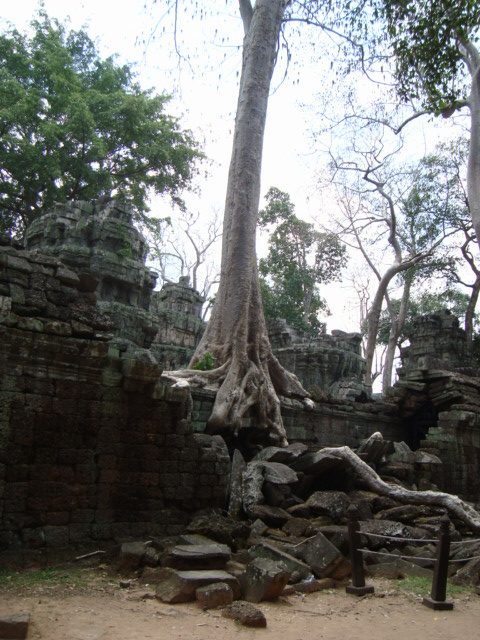
Part temple, part ruin, part nature, as I approach Ta Prohm, the first sight that grabs my attention, is what can only be described as a great tree of destruction.


Is it a giant snake?? No, it's tree roots!
This massive tree sits on top of a wall, and towers high above it. Meanwhile, the tree’s roots look like the tentacles of a giant squid, as though formed from Jules Verne’s imagination. The roots appear to have pushed over this strong stone wall, with no more effort than it takes for a child to push over a wall of toy blocks. A gaping section of the wall, is now only a pile of stone bricks. A root of the great tree has creeped across them, burying itself in the earth beyond these measly human cut stones. The tree’s light bark contrasts with the blackened stones that have tumbled down below.

If you have read J.R.R. Tolkien, this tree could have been an ent from Lord of the Rings. It’s as though a mythical tree hopped up on the wall one night, and reasserted the power of mother nature, bringing back the jungle to cover the vanity of man. 

'Tomb Raider Tree' made famous by Angelina Jolie
Along another part of the wall, a colossal tree has grown up on both sides of the wall, towering over the tons of stone below it. This one gives the impression that it is supporting the wall, and holding it in place.

Others great trees have their roots flowing down over the walls smoothly, reaching downward like running water. They resemble a waterfall, frozen into tree roots. Still another has grown lengthwise over stone blocks, appearing as a giant serpent.

Movie buffs may recognize one stone gripping temple tree, from a scene in the film, ‘Tomb Raider’. I once chatted with a Khmer policeman, who had worked with the production crew while the film was in production here. “I see Angelina Jolie,” he told me perkily. “She beautiful!”

As a melding of temple and nature, Ta Prohm truly is a place of wonder and romance. I wonder if this exotic locale had any influence on Angelina Jolie. Cambodia certainly made some impression on the famous actress; she adopted a Khmer orphan to be her own son.

There used to be far more jungle growth covering Ta Prohm temple, but most of it was removed during restoration. When they got to these impressive trees however, they noted that removing them would damage the walls and monuments even further. Leaving the great trees where they are leaves a visual balance; it shows that Angkor is not just about temples, it is also jungle.

Restoration laborer, hard at work
Closer examination on some walls and reveals perfectly round holes dotting stone building blocks. These are not bullet holes as I saw at Angkor Wat; these are all holes left over from the days of original construction. Ancient Khmer construction methods had these blocks moved by sticking wooden rods into these holes for easier lifting.

I come to one of the temple's stone archways, and it’s blocked off. A sign reads, “NO ENTRY, WORK AREA”. Looking in near the sign, I find a workman lying asleep on a dislodged block. So much for working. That’s one thing I’ve noticed about Khmer men, they can sleep soundly on almost any surface. Whether it’s grass, concrete, a motorbike seat, or a stone block, you can find them snoozing almost anywhere.

Besides Ta Prohm, restorations are in progress in several other temples around the Angkor complex. As Cambodia is such a poor country, most of the funding comes from foreign sources. India is providing financial aid to restore one temple. That's not surprising, since India is the home of the Hindu religion. When these temples were first built, the Khmers were Hindu, before later turning Buddhist. The Japanese and German governments fund repairs on other temples. There are so many hundreds of temples around Angkor, that all of them will never be restored in our lifetime.

I know an American Vietnam War veteran, who spent time in Cambodia in recent years. He decided he would personally visit every single ancient Khmer temple in the Siem Reap region. 

It took him six weeks to see them all!!

The towers and trees of Ta Prohm


Wednesday, March 27, 2013

MYSTIC DANCERS OF THE CHAMPA EMPIRE

There are times when 'beautiful' is an insufficient word. This is one of those times.

In front of me are three slender young ladies, dancing as I've never seen before. They are visions from a lost kingdom. Their shimmering costumes are symbolic of a forgotten people, from an era that time forgot.

The golden attired nymphs move with a grace and allure that is timeless. It's dancing unlike any other in the world; this performance is reminiscent of an ancient dance of worship. The only place I've seen anything similar to this, is from the poses of statues of royal dancers or goddesses that grace Hindu temples.


Yet, I'm not in India. I'm in My Son in Vietnam. This land is better known as a home to Buddhists or communists. But not well known to the outside world, is that Vietnam was once home to a kingdom of Hindus and Muslims. Going back hundreds of years, central Vietnam was once known as the Champa Empire.

The Chams controlled what today is central Vietnam, plus parts of Cambodia and Laos. Over time, their lands were gradually lost to wars with the Vietnamese and the Khmers, until their kingdom disappeared altogether. They live now only in dispersed communities, just another one of Vietnam's many minority ethnic groups.


But I'm enthralled by the lovely ladies dancing for visitors like me today, their cultural dancing is truly a wonderful sight. As I watch the display, handsome male dancers join the graceful ladies for more movement. As their performance closes, I exit the theater to enter the adjacent ruins of My Son.


Cham tower on a hill overlooking the coastal town of Nha Trang
I've seen some of the other Cham ruins that still survive today. In the town of Nha Trang by the coast, I once watched Hindus worship at an ancient Cham tower. These ruins I'm seeing today are further north, outside the historical town of Hoi An.

The ruins here were once decaying, slowly weathering as the surrounding jungle approached. Indeed, there are still grasses growing out of gaps in the brick work on the rooftops. But this greenery only adds to their ancient, naturistic appeal.


Ancient Hindu ruins of My Son
But it wasn't just old age and nature that were breaking down these old towers and religious sites.  As in the rest of Vietnam, the war came to My Son. Since these brick structures were in rural areas, they came under the control of the Viet Cong, who used their inner chambers to store weapons. When the US military found out, they bombed My Son.

Sadly, many of the ancient structures here were destroyed or heavily damaged. As I walk about the complex, there are still many old bomb craters to be seen beneath the trees. My Son was recently named a UNESCO World Heritage site, so some of the hard hit structures are being restored, though  work won't be completed for years.

Fortunately some of the structures here were left undamaged. So as I explore the complex, I can still feel a hint, see a glimmer, of the glory of the ancient Chams.
Cham dancers of My Son (with added mirror effect)