Showing posts with label nightlife. Show all posts

Monday, December 15, 2014

PORT TOWN REVIVIVING

Coco House in the coastal town of Kampot, Cambodia
I’m taking an after dinner stroll down an old Asian riverfront. It’s dark and quiet; few are out walking this evening. Along the way I pass old French shop-houses, they’ve been uninhabited for years. Once stylish archways and pillars are now in gradual states of decay. Where bright yellow paint shone, it's now dingy and peeling. These used to be prestigious river side homes, businesses that brought important foreign trade into Cambodia.

This is Kampot, on Cambodia's southern coast. The Prek Kampong River flows through town, emptying into the nearby Gulf of Thailand. Kampot was once Cambodia's principal port. But when the larger port at Sihanoukville opened in the 1950's, this small town's importance rapidly declined.

Now these former buildings of commerce are empty; decaying and dilapidated. Weeds out front grow high through cracks in the sidewalk. 

There are lovely old French colonial buildings in town, but like these many are idle and deteriorating. Some are unoccupied and boarded up.
Dilapidated shop-houses on the river front

Fortunately, Kampot has been reviving. As I stroll further up Riverfront Road, I pass restored restaurants, and cafes. In recent years these have been renovated and reopened. Here diners are seated on sidewalk tables, with palm trees surrounding them. Redevelopment downtown is ongoing, though progress is slow. There are no crowds of customers out tonight; unlike Sihanoukville, Kampot has not capitalized on the rising tourist trade. But that's why some of these foreign folk have come here. It's quiet and serene, with scenic views and fresh seafood.

As little known as Kampot is today, it was once known as a center for one of the world's favorite spices. If anyone wonders what unique and quality product Cambodia provides to the world, the answer is: pepper. Kampot was known for exporting pepper to foreign markets as far back as the 13th century.

“Kampot pepper is the best in the world,” a lady drink seller told me. She’s right, and the Khmers aren't the only people who believe this. So do the French, and of course they know good food. Kampot's pepper was preferred by France’s gourmet chefs. During colonial times, all the best restaurants in Paris had pepper from Kampot on their tables.

Up until the radical Khmer Rouge halted all pepper plantation production, pepper was one of the country’s largest agricultural exports. At the height of production here, the fields of Kampot Province had more than a million peppercorn plants. With the Khmer Rouge gone, local farmers are growing peppercorn again today. Kampot pepper is once again gaining international prestige.
Tasty fish cakes for dinner in Kampot

Further down the river front,  I come to the town's oldest bridge. Crossing the Prek Kampong River, it leads right into the town's center. 

It's dark now and hard to see, but if you look at this bridge in daytime, it’s a rather bizarre looking structure. Parts of the bridge are old, parts are new. As far as construction styles go, there are not one, not two, but three different styles of bridge construction evident here! The oldest section has large arches, with steel support beams rising overhead. But two adjacent sections are basic flat bridges, with two distinct sets of support pillars descending into the riverbed.

This oddity is another legacy of the Khmer Rouge; the old bridge was destroyed during the war. Afterward, rather than tear it all down and rebuild it from scratch, they had to reconstruct it using what remained. I don't blame the engineers, as poor as Cambodia is, it's a wonder they were able to rebuild it at all back during that turbulent time. Having seen the three different building styles, I wonder, was this bridge destroyed more than once? 


Daytime view of the river. The old bridge beyond, destroyed during the war, has been rebuilt.
Winding up my riverfront walk, I go from the old, to brand new. Pounding music and flashing lights announce a disco. I've arrived at “Alaska Super Club”. It’s the only new building I've yet seen in all of Kampot. Cheesy neon signs show figures of female dancers. This gaudy night spot is out of place on this otherwise rustic riverfront. It's a weeknight, so they don't have much of a crowd. I decide not to pay a cover charge for a near empty club, so I turn back. 

I chuckle at the name: 'Alaska Super Club'?? I don’t think I’ll see Sarah Pailin and her brood walking in here anytime soon.

I head back to my hotel, avoiding some stray dogs on the way. Beyond the bridge and the river, loom the nearby Elephant Mountains. The most notable of these, is Bokor Mountain.

I’ve never climbed a mountain before, but I'll be climbing it tomorrow morning.

Wednesday, November 19, 2014

FUGITIVES AND FOREIGN MISFITS

Beach in Sihanoukville. Many misfit expats live here, some are hiding from the law.
Chris is a twenty-something from England, with beard stubble, and a dark t-shirt. I met this friendly Brit one night at a no-name bar in Sihanoukville, where he worked as a bartender. 

He doesn't earn much, Chris only gets six dollars a day for eight hours of night time work. “Slave labor,” he tells me. But he does get a free meal every night, and free drinks. “I’m a bit of an alcoholic,” he admits to me.

Like many young folk I've met in Asia, Chris has been traveling around for months, and stopped to work in Cambodia for a while. I asked him if he had ever been to the states during his travels. His response wasn't what I was expecting. 

“They won’t give me a visa,” Chris said, “since I was convicted of production of cannabis.” Apparently Chris has a hippie side to him, which got him in trouble with the UK police a few years back. 

While we're chatting in this beach side hang out, a grungy, older Aussie that Chris knows walks into the bar. I’d seen this shabby guy yesterday on the street. He’d asked me for a cigarette, but I don't smoke. 

The Australian asks Chris, “You want to buy some weed? Two dollars a bag? I have to pay my hotel bill,” he explains. Chris declines, since he doesn’t do drug transactions while he's working. I also decline, since I stick to beer. Obviously the Aussie was in dire straits; he looked like a transient. He probably won’t sell marijuana for long here either, since local pushers won’t like him competing for their business.

Checking out the Aussie, I notice a large infected cut on the back of his hand. It was so infected, that his whole hand was swelled up. I figured he must have injured it in a motorbike accident, the usual way that foreigners get injured in Cambodia. But I was wrong. 

“A whore cut him”, Chris told me, after the Aussie walked away. Apparently since the Aussie didn’t have money for rent, he didn't have money to pay a prostitute that he took home either. 

Chris and the old Aussie are just two of the down-and-out examples, that make up the soap opera scene of foreigners living in Sihanoukville. Long time expatriates call the town ‘Snookville’ or just ‘Snook’, for short. During my days checking out the beach, I learn that there are many expats hanging out here with skeletons in their closets. 

One night out at a restaurant with a group of foreigners, I was introduced to a German lawyer. I don’t recall his name, but it was probably an alias. That's likely, since I was told that this tall Aryan looking guy, was wanted for murder back in Germany! 

I already met a Swede in Phnom Penh who was hiding out from the law, but he was a peaceful guy, wanted only for media piracy. 

Could it be that this tall German with thinning hair, was really a killer? I noticed the German had a scar to one side of his forehead; an intimidating looking fellow. 

I wonder, just how did he got that scar??

* * * * *


The strange 'Airport' disco.
I’m sitting at the controls of a Russian aircraft. It's an older two engine, Antonov 24 airplane. I reach for a gauge on the control panel, and the knob comes off in my hand! 

Obviously, this plane has seen better days and fortunately, I'm not airborne. In fact, I'm not even in a real airport. But I am in a disco in Sihanoukville that is named 'Airport', and this plane is parked right over the middle of the dance floor below me! How weird. 

I peer out the cockpit windows, where the building housing this night spot resembles an old airport hanger. Adding to the odd ambiance, old photos with advertisements from long gone airlines line the walls. I can see the need to stand out in Sihanoukville's night life, but this is just unreal. 

I leave the cockpit to go aft inside the plane, and find the passenger compartment in total disarray. The seats have been removed; it's dusty and grubby. Apparently this old plane is still being renovated for the club. I imagine they'll add more tables and chairs before it’s finished. 

It's fitting that an old Soviet plane is parked in here, because this strange disco is owned by Russians. Of course that helps the disco to attract a Russia clientele, but not tonight. I exit the plane and descend down to the dance floor, into a disco that's nearly empty. It's the off season, so fewer Russians are flying down from Siberia to Cambodia while I'm staying here. 

With the house music blaring, I finish my beer, and head for the door. This plane is yet another foreign misfit in Cambodia. 

Wednesday, September 17, 2014

NIGHTLIFE IN THE HEART OF DARKNESS

'Heart of Darkness' club in Phnom Penh (arch photo)
Going out tonight, I pass an unusual street scene by the corner of my hotel. The cyclo drivers and motorbike-taxi drivers are settled in for the night. Lined up together for safety, more than 30 are all sound asleep, lying on their bikes! I'm amazed they can sleep like this, especially the motorbike drivers. Their trick is parking their motorbikes level, up on their dual kickstands. Then they lie on their backs on the bike seat, their legs stretched out over the handlebars. Well, that's one way to make sure nobody steals your motorbike: sleep atop it. How do they sleep like that all night, without falling off?

As I'm learning, night life is decidedly different in Cambodia. When I was in Saigon, (Ho Chi Minh City) the hottest nightspot was 'Apocalypse Now'. Now I'm in Phnom Penh, and the hottest place in town has an equally forbidding name, 'Heart of Darkness'. The disco's name is taken from the dark Joseph Conrad novel, and it's fitting.

'Heart', as it's known by locals, is located across the street from what used to be a jail, that has since been torn down. (How's that for atmosphere.) As a disco it's small on size, but big on its bad reputation.

After security frisks me for weapons at the door, I enter this infamous place with reddened walls. The party's in full swing, so I step up to the bar, and order my usual draught beer. Unlike Vietnam and Laos, they actually have draught beer in Cambodia. The two brands of locally made lager are: 'Angkor', (named after the ancient Khmer kingdom), and another brand, so uniquely named, 'Anchor'.

Taking a sip from my mug, I survey the eclectic crowd. Tonight the usual suspects are here. Foreigners, locals, rich and poor. There are Khmer businessmen, trying to impress by reserving tables and buying full bottles of whiskey. There are pesky prostitutes, and a few foreign English teachers. There are working class Khmers; they came to dance, but can't afford to buy drinks on their meager salaries. Finally are the tourists, including shabbily dressed backpackers.
This sign is posted at the entrance of many Phnom Penh night spots. It's needed.

As I watch the night unfold, I'm approached by a white twenty-something with dark beard stubble, and poorly dyed blonde hair. His accent is something European, and he's already drunk. He walks straight up to me and asks, “Yoo arh Amercan?”

“Yes,” I reply, “and where are you from?”

“Eye yam Amercahn. Eye yam frome California.”

I stated the obvious, “You don’t sound like you’re from California.”

This brought forth a nearly spitting tirade of obscenities. He finished on an unintentionally humorous note, by tripping himself up with his own words. Pointing his finger at me, he says, “That’s thuh probelem with yoo Amercahns!”

He shuffles off, presumably to look for someone more gullible. I don’t know what was more pathetic: how stupidly drunk he was, or that he would try and pass himself off as American, when he obviously wasn’t. I once met a Liberian who tried to convince me that he was a black American, but this was the first time I'd seen a European try this ruse. Fortunately the drunken poseur didn't try to start a fight with me. Unlike Saigon, I don't see many bar fights here, but that hasn't always been the case. Heart of Darkness has not always been such a safe place to party.

One of my English teacher buddies named Ken, was partying here one night a few years before. Before his very eyes, he saw a young Khmer man walk in, raise a pistol to the head of another, and pull the trigger. The victim fell to the floor dead. The murderer calmly walked out with the pistol at his side, cooler than Michael Corleone. Sadly, the killer was never even arrested, as he was from a family of the rich elite. Who knows why he pulled the trigger, but in post-war Cambodia, scores were often settled this way.

Fortunately, this kind of violence has declined in Phnom Penh. That's why I was frisked for weapons tonight when I came in the front door; they don't need any more murders in this heart of darkness.

**POST STORY NOTE** - 2020 - In the years since I first visited the Heart of Darkness disco, its clientele has changed. Heart of Darkness became a gay club. Phnom Penh changes quickly. 

Thursday, September 19, 2013

RIVER OF DEBAUCHERY

Downtown Vang Vieng, haven for hard partying backpackers
The sights are familiar to anyone who has attended a western university. Sunburned, college age kids, wearing shorts and bikinis. A long strip of riverside bars, with volleyball nets and cheap drinks. Dance music pounds loudly from amplifiers. Alcohol is imbibed in large quantities. Some young adults here are even taking drugs. This isn’t a wild spring break beach party, and this isn’t ‘The Jersey Shore’ either. 

It’s Laos.

Well, a small part of Laos. Vang Vieng to be exact. In a country where the culture is so conservative, and the government’s hold on power is tight, this is an island of western decadence in East Asia. Since the government is publicly against drugs and western music, I’m astounded this kind of behavior is allowed. Vang Vieng is the exception in Laos; the one place where decadent foreign influences run wild. 

Away from the wild partying river, I take a walk down the streets of Vang Vieng. This town isn’t a tourist trap in the classic sense; there are no families here. Although it has morphed into a playground for adults, it’s nothing like Las Vegas. There are neither casinos, nor fancy hotels. This town is a haven for only one kind of tourist: young western backpackers, looking to party for cheap. Some of the bargain hotels or guest houses here offer a bed for as little as four dollars a night. Just don’t expect any air conditioning. 

With business catering to the cheap backpacker crowd, businesses on the main strip are predictable. Both sides of the main street, are packed with cheap guest houses, open air restaurants, bars, internet cafes, food carts, tour companies and tee shirt shops. 

How things have changed for tourists in Laos. Back in the country’s post-war years, westerners were expelled, and the country became isolated. Foreign tourism here was virtually non-existent. 

Vang Vieng restaurant/bar, where you can watch episodes of 'Friends' for hours on end...
But then the cold war thawed in the 1990’s, and neighboring Vietnam and Cambodia began cashing in on tourism. Soon after, the Laotian government decided to hop onto the tourist bandwagon. Visa restrictions were dropped, and borders were flung open. Now this communist country welcomes foreign visitors, anxious to take their tourist dollars. Better late than never. 

The backpackers here are mostly young adults of university age, from western Europe and Australia. Every afternoon they can be seen lounging inside the main strip’s open air restaurants, watching DVDs of American sitcoms for hours. These run all day long, as many backpackers are recovering from a hang over. Perhaps they come here because their guest houses are too cheap to install TVs in their bedrooms. 

Some young women wear skimpy beach attire, and some young men go shirtless. This is nothing to Americans, but conservative Laotians find this scandalous. Showing so much skin is taboo everywhere else in Laos, but here the massive backpacker presence has overwhelmed local culture. 

These frugal foreign travelers were originally drawn to Vang Vieng for the lovely scenery. There are beautiful mountains, caves to explore, scenic rural villages and Buddhist temples. As the first visitors came, tour companies sprang up, selling trips for hiking, canoeing, kayaking and mountain climbing. But those are really just side shows now. Most backpackers come here for two reasons: the partying, and the tubing. These two intertwined events have made Vang Vieng infamous, and even dangerous. Backpackers anywhere in Southeast Asia, are often seen wearing tank tops bearing the same message: “Tubing on the Vang Vieng”, the number one activity here. 
Like this bridge, more than one drunk backpacker has not survived the Nam Song River

I take an afternoon to check this out for myself, and after paying six dollars, I’m given a large truck inner-tube. Then I pile into the back of a crowded tuk-tuk, and we’re driven a few miles north of town. Arriving upriver, we’re dropped off at the first of many cheap riverside bars. Here I encounter a scene I haven’t seen since college. Throngs of rowdy western college kids are drinking cheap beer at several flimsy bamboo bars on the river bank. Many are dancing and carousing to loud popular music. Some have been here for hours already, and are already heavily drunk. One bar is giving away snake wine and scorpion wine for free; I grab a Beer Lao instead. 

Dotted among the riverside pubs are rope swings, water slides and zip lines for thrill seekers. Several circus style trapezes drop revelers from on high, where they shriek as they fall before splashing into the Nam Song river. There is also volleyball, and a muddy tug of war for those who prefer exercise on land. Feeling energetic, I head into a game of 4 on 4 mud volleyball. I get thoroughly filthy in a losing effort, but enjoy the fun. After the game ends, the players scatter to explore other diversions. I’m anxious to get the mud off my face and hair, so I pick up my inner tube and head into the river. 

My next stop is one of the larger drinking holes on this river of debauchery. It’s called the 'Slide Bar'. It has a fairly modern, elevated water slide lined with bath tiles! I pull in, stow my inner tube, and grab some lunch. Then the rain starts. As this is rainy season, the river's running fast. Coming down lightly at first, it’s soon a monsoon. The fun continues, since all the revelers are already wet from the river. As I eat, I view the surrounding action. 
An Argentine died in one of these area caves

Above me, a young man flies off the end of the high water slide, dropping ten feet into the river. He lands right next to an unsuspecting lady tuber, nearly landing on top of her! Both were lucky, it was a near miss. I soon realize, that the emphasis here is on fun, with little regard for safety. As I watch the water slides, trapeze and rope swings at the bars, I see no safety systems in place, no lifeguards. There's little to keep young drunks from falling off high muddy ladders onto the shore, or to keep rope swingers from falling onto other tubers floating by. Nobody wears lifejackets. Swimming drunk in a murky, fast moving, unfamiliar river could easily turn deadly. I hear later that cuts, concussions, and broken bones are a common occurrence when tubing in Vang Vieng. 

The rain lets up, and grabbing my inner tube I continue down river. The shores grow quieter, and bamboo bars give way to tree lined shores. Finally, I stop at a pub known as ‘Last Bar’. I paddle my tube into an eddy, while a couple Canadians float up behind. Standing in shallow water, one spots a dark lizard attached to an overhanging tree. He captures it by hand, and we climb a long flight of stairs to the dumpy little shack bar high over the river bank. As we grab a bench seat, the Canuck plops the reptile on the table. At a foot and a half long, the lizard looked ill or injured. It was breathing, but barely moving. 

An old Lao woman with blackened teeth approaches the table. Her dark teeth are caused by betel nuts, her drug of choice. (The locally grown nut is chewed as a mild stimulant.) The woman points towards the lizard, and motions with her hands that it makes for good eating. She then opens a little bag. Apparently, she was ready to barbecue the reptile right here and now. The Canadians pondered this offer for a while, but the more they discussed the lizard, the more they got attached to it. They declined her offer to cook their newfound pet. 
7 foreign tourists have died in Vang Vieng, some drowned under the influence of drugs or alcohol

While I order my second and final beer, the Canadians order marijuana. They are soon lighting up, disappointed when I turn down their offer to smoke with them. This pair were hoping to hang out with some heavier partiers. Soon after, they found some. Down by the river where we’d arrived, three more westerners pulled up in their inner tubes. These young men had partied too hard already, and never made it up the steps. 

“Hey! We need help!” One of them shouted, “we have to get to a hospital!” The vocal backpacker’s two friends were very stoned; one was so far gone, he was completely unconscious. Soon one of the Laotian bar staff descended to the river bank, loading the three druggies into his long tail boat. Then they were off downriver, just another backpacker overdose headed for the local band-aid station that they call a hospital. 

It’s quite a racket this bar has going. Not only do they make money by selling drugs to backpackers, but they also make additional money from backpackers by turning their boats into ambulances when they overdose. I noticed the boat driver wouldn’t leave for the hospital, until he saw the cash in hand from the backpacker to pay for the trip. 

I don’t know what particular drug his friend overdosed on, but he’s far from the first foreigner to need medical attention in Vang Vieng. In recent years at least seven foreigners have died in this permissive tourist town. Shortly before I arrived in Vang Vieng, an Argentine tourist died in a caving accident. He had been exploring a local cave alone, never a good idea. Other tourists here died from overdoses, drowning, or from driving drunk on rented motorbikes.

A couple weeks after I left Vang Vieng, there was another death. An Irishman who came to town with his newlywed wife drowned in the river while tubing. His poor widow was left to organize the search for his body on her own. It cost her $1,000 out of her own pocket to pay for the search. They finally found his corpse down river, three days later.

Monday, September 9, 2013

NIGHTLIFE AND DRUG TRADE IN VIENTIANE

Night time on the Mekong riverfront
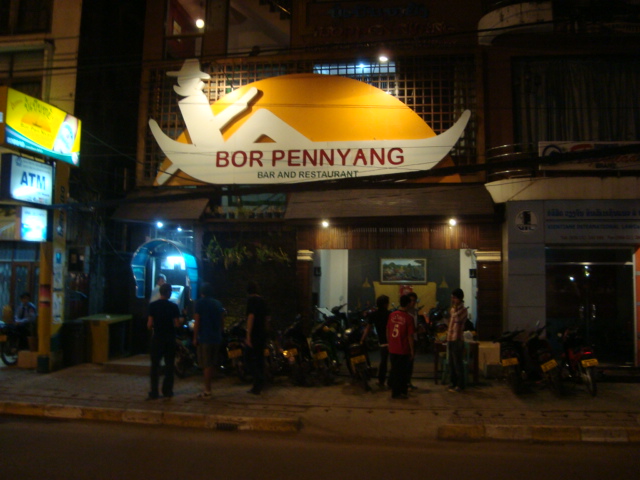
It's late evening in Vientiane, Laos, and I’ve left the lively bar called 'Bor Pennyang'. Stepping onto the Mekong River front, I hail a tuk-tuk, and follow the main road downriver. We pull into Don Chan Palace, though it isn’t much of a palace, it’s really more of an odd river front hotel. With 14 floors it’s among the tallest buildings in Laos, but for rustic Vientiane it looks rather gaudy. It does however, have the town's best disco.

It’s my first time here, and walking in I find the place dark and crowded, with music pumping. Peering across the crowd, I look for the dance floor. Not seeing one, I walk the entire length of the place. There's no dance floor to be found. This is a disco, but only in the conservative Asian style. Here the patrons dance only next to their tables!

I eventually find a friendly group to hang out with, a mixture of westerners and Laotians. Grabbing a beer, I join the dancing by their table. A Dane with them explains why there's no dance floor. “They don’t understand the concept of a discotheque,” he says. 

Unfotunately for those who enjoy night life, there are strange culture laws that restrict evening entertainment here. This gives Vientiane the reputation as one of the more boring capitals in Southeast Asia.

A recent story in the Vientiane Times, mentioned that the government was closing some discos down. The Director of the Vientiane Information and Culture Department was quoted as saying, “Each district (of the city) should have only one disco.”

The Don Chan 'Palace' in Vientiane
The fun squashing bureaucrat complained of the “overuse of imported music at the expense of local songs.” That ‘overuse’ is evident tonight, since I don’t hear any Laotian music at all. The selection here is mostly pop music from Thailand, with a smattering of western dance tunes. The bureaucrat also complained that according to law, discos must close by 11:30pm. Since I just arrived at Don Chan near to midnight and the party’s going strong, I see the law isn’t enforced here. Varied disco closing times are often connected to corruption.

Eyeing up the clientele, there is not a hint of Laotian attire; everyone wears western clothes for clubbing. Looking around, there are plenty of drunks. Some Asian men of smaller stature, seem to be intent on drinking as much as the larger bodied westerners present.

This is about as crazy as it gets in this town. The wild, ‘anything goes’ bars that Vientiane was known for during the war years, like the 'White Rose' and the 'Green Latrine', are long gone. The only remnant of that tradition here, are a few prostitutes trying to catch the attention of western men. Prostitution exists in Vientiane, but in the more subdued Asian manner. This isn't Thailand, there are no strip clubs in Laos.

I’m less worried about violence here since night life in Vientiane is known as the safest in Southeast Asia. Since Laos is landlocked and without ports, they don’t have to worry about drunken sailors going out looking for trouble. That’s not to say that bar fights don’t occasionally happen though. In between swigs of Beer Lao, an English teacher tells me about a bar fight here a couple weeks ago. “I turned around, and see a foreigner down on the floor,” he says. “This Laotian was beating him with a bottle.”

He stepped in to stop the beating, but not for long, as his Laotian girlfriend pulled him away. Fortunately for him, she recognized the bottle wielder as a Laotian involved in the drug trade, and wisely kept him out of the melee. When the rare beatdown does happen in a Vientiane night spot, it’s often drug related. Vientiane was once known as a place where opium was easier to get than a cold beer. That has flip-flopped, and the drug trade has gone underground. But it does occasionally rear it’s ugly head, such as in this case reported in the Vientiane Times.

Police arrested a Nigerian man on June 21 in Khualvang Village, Chanthabuly District, Vientiane, after finding him in possession of 900 grammes of heroin, according to the Khomsangoh (security) newspaper yesterday.

The story went on to report on another sensationalized case, that gained international attention. British national Samantha Orobator was sentenced to life in prison after being found guilty of possessing 600 grammes of heroin. Ms. Orobator was born in Nigeria, but is now a resident of the UK and has British citizenship.

A Tuk -Tuk, these are 'taxis' in Vientiane
The story neglected to mention that the young lady became pregnant while in prison. Whether she became pregnant intentionally or not, it helped her case. She was originally given the death penalty for drug trafficking, but pregnant women are exempt from this punishment. In the end, she was extradited to the UK to serve her sentence there.

I continue to dance and chat with my newfound friends, until closing time nears. Some wish to party on, but there are few options for Vientiane’s night owls when discos shut down. “If you want to drink after three a.m. you can only go to the bowling alley,” the knowing Dane tells me. “You can drink there until four or five a.m. It’s the only place open.”

I’m not the type to drink until dawn, so Don Chan is my last stop of the night. I leave the late night revelers, and head for the tuk-tuks.

Friday, September 6, 2013

THE 'NO PROBLEM' BAR IN LAOS

The 'No Problem' Bar in downtown Vientiane, one of the best in town
Bor Pennyang in Laotian language means, “no problem”. The saying is a reflection of the laid back Lao lifestyle. Expatriates who stay in Vientiane long term, tend to share the Laotians preference for quiet, stress free living. Like the Mekong, life here flows along slowly. 

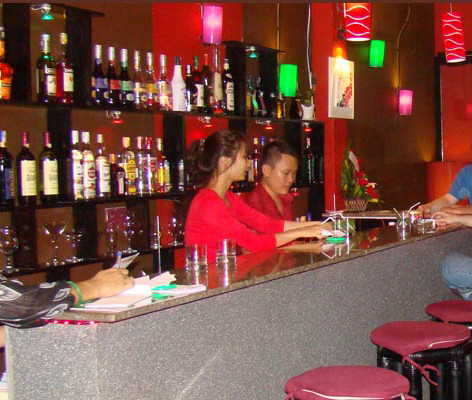
Bor Pennyang also happens to be the name of one of the better restaurant bars in Vientiane, and it’s an expat favorite. I’m playing pool tonight, and luckily for me, playing pool here is free. Located on the top floor of a four story building, the necessity of climbing three flights of stairs keeps the lazy customers out. 

The establishment is open air, with a roof protecting patrons from the elements, but there are no walls. There are only railings, with catch nets beneath. The nets keep inebriated bar patrons from dropping their beer bottles onto unsuspecting pedestrians below. 
(I wonder how often that has happened.) When winds blow the monsoon rains inside, waitresses lower bamboo shades to keep the water out, rolling them up again when the skies clear. 

As far as a night spot goes, Bor Pennyang has the best night view of the Mekong River. Looking out over the railings I don’t  see Vientiane, I see… Thailand. Since the building is located on the river front thoroughfare, I’m getting an unobstructed view of the Mekong, with the riverbank homes of the ‘land of smiles’ beyond. It makes for a very romantic view when the Thai lights are lit up at night. For those who enjoy the nightlife, Bor Pennyang  is one of the few locales that make Vientiane worthwhile.

Looking down across the street onto the river front, the open grass lot atop the riverbank has been transformed. As night has fallen, enterprising cooks have hauled in gas stoves, coolers of food, and plastic tables and chairs. Extension cords have been strung up, with bare bulbs to light up the diners. Voila, an instant line of river front restaurants. 
Every night, instant restaurants pop up on the Mekong riverfront

The downtown riverfront is filled up every night with these mobile restaurants, popular with Laotians and visitors alike. I’ve enjoyed traditional Laotian dishes there, and they even have fresh seafood. One of the small restaurants keeps a huge bowl of live shrimp ready for cooking. With Laos landlocked, they must have been brought in from Thailand. 

Turning back from my view of the river front, I step up to the circular wooden bar, and order a cold Beer Lao. This is one of the few pub’s in the city that has the national beer on tap. I'm greeted by the manager, a friendly Aussie named Ian. He's the key to Bor Pennyang’s success; he runs a bar business that both locals and foreigners enjoy. A former chef, he has lived in Vientiane for years, enjoying the slow pace of life. Even among foreigners he stands out, with his odd choice of hairdo. Although balding, he still grows his grey hair long in the back, keeping it in a ponytail. Thankfully, he’s a much better bar manager than hairstylist. 

Tonight is a Friday night, and the crowd begins to roll in to play an early game of pool, or grab a late dinner. After a few games, I notice a Russian couple playing at the next table. Russians aren’t very common in Vientiane these days, there were far more of them here during the post-war years, when there the Soviets were in town working on infrastructure projects. 

“When I was young, the only foreigner I see was Russian,” I recall a Laotian woman telling me. “When I see them, I scared,” she said. “They have blue eyes.”

I take a break from pool, and strike up a conversation with these new Russians. They prove to be an interesting pair. Yuri and Olga are both funloving, outgoing, and young at heart. Yuri says he makes a living importing cars from the USA, shipping them to Russia. Olga is a part time interior designer, and mother to their two children. He’s 45 years old, fairly fit, and balding. She’s aged 29, thin, blonde and very attractive. Olga tells me that when Russians get married these days, age differences like theirs are very common. 

Stepping away from the pool tables, conversation shifts to their home in Moscow. I’m taken aback when out of the blue, Yuri mentions that Moscow has nude sunbathing, on the banks of the Volga River. I tell him that I didn’t know that was possible in Moscow. I didn’t think that it was hot enough there either. 
Interior of rooftop bar 'Bor Pennyang'

Yuri corrects me, “In Moscow, yes. In Siberia, no!”

I ask if he ever sunbathed nude. “Yes,” Yuri says in a matter of fact manner, “we are nudists.” 

While we are chatting, Olga is getting a lot of visual attention from others in the bar, since she’s wearing a very short skirt, and a tight shirt with no bra. Conservative Vientiane is no tourist beach town; she’s probably the only woman in the city showing so much skin in public. 

“She likes to go to strip clubs,” her husband tells me, confessing more personal information. As I continue chatting with Yuri, I eventually find out why the pair are so outgoing. 

They are both swingers. 

“We have alternative lifestyle.” Yuri explains. 

No kidding. After hearing that, I’m not surprised to learn that they are presently living in Pattaya, a beach town in Thailand with a seedy reputation. The only reason that they came to conservative Laos with their kids, was to make a visa run. This is their first trip to Vientiane, and they’re bored. They haven’t found any other couples in Laos who share their lifestyle, so they are disappointed with the city’s nightlife. 

It’s been an interesting conversation to be sure, but since I don’t share their lifestyle, I decide to move on to my next evening destination. I say goodbye to the Russian swingers, who continue their evening’s search for a like minded couple. 

Thursday, February 21, 2013

LADY BAR OWNER IN VIETNAM

Bartenders spin flaming bottles in a Danang bar
Chau is an attractive, friendly Vietnamese woman, with a wide smile and a kind voice. She speaks English well, and at 30 years of age, she’s already the owner of her own business in downtown Danang.

“I have this bar two year,” she says proudly from behind her dimly lit bar. Tonight's a rare occasion when she’s wearing tight clothing, and it complements her womanly figure. This gets more than a few looks from her male customers. Some are Vietnamese, but most are western men. But unlike less reputable places, this isn’t a bar for working girls. In Chau’s bar, (name is withheld), she doesn’t allow prostitutes. “When they come in, I ask them to leave,” she says.


Chau isn’t from Danang, she’s from a village outside the city. She may be a businesswoman now, but capitalism wasn’t always popular with her family.

“My father was Viet Cong,” she confesses to me. “He no like Americans. He still hate Americans. Many VC, still hate Americans. But most of them are dead now.”

Back in the war years, Chau’s hometown was a Viet Cong stronghold. Her father’s side may have won the war, but his family paid a high price. “His two brothers died. His mother and father died,” Chau tells me. Her father was also wounded by a US bomb, and his old injuries bother him in his old age. For the first time, I’m hearing about a Vietnamese that still hates Americans. Given all that the war did to her father’s family, I’m not surprised. Fortunately his hatred didn’t spread to his chipper daughter, who seems to enjoy chatting with me. 


Chau says her father doesn’t understand her. “He ask me, ‘how can you talk to Americans’? I tell him, that (the war) was long time ago. That finished,” Chau says. “I don’t have a problem with Americans.”
Chau first came to know Americans as a tour guide, when she traveled extensively doing tours for returning US veterans. “Most of them nice. Some of them not so nice,” she says, giving her view of the vets. 

She traveled with them all over the region, from Danang, to the former De-Militarized Zone, and even to the infamous site of My Lai.

“What was it like with them there?” I asked.

“They cry,” she says. “They feel bad. They talk with lady there who tell them what happen. She tell (them) their story. Another lady was a child (then). They cry.” 


Chau's village endured fighting during the war
Chau also brought the veterans to an orphanage, where children continue to arrive today with deformities attributed to Agent Orange. The vets cried there too. Now that Chau owns her own bar, she doesn’t travel with vets anymore. But she’s still happy to translate for American medical teams that come to Danang, who treat the sick in poor communities for free.

Chau likes the American doctors, but there is another group she despises. “The old American men, they come back Vietnam. They marry young Vietnam lady. I don’t like,” she says with disdain. She allows these old men with young brides to come into her bar and drink, but that doesn’t mean that she approves. Nightlife is more relaxed in Danang than in Ho Chi Minh City, so she's had few problems with customers.


“Have you had many bar fights?” I ask, remembering the brawl I had witnessed in the former Saigon. 

“Only one time,” she answered. Predictably, the bar fight involved an American, although he didn’t start it. “It was old American man in the war.”

During an evening at Chau’s place, an American Vietnam veteran was talking with a twenty-something English teacher from England. They both had their share of drinks, when the subject of the war came up. Among other things, the burly young teacher told the veteran that he thought the Americans were baby killers. It went downhill from there.

“The English man, he know boxing,” Chau said. Being bigger, younger, and a trained fighter, the Englishman wasn’t afraid to back up his words with his fists. Chau kicked the brawling pair out, but not before a lot of blood was spilled in the bar. The American got the worst of it.  But that wasn’t the end of it. The American lives in Danang, and he got the last laugh. The Englishman had a well paid job at an international school, and the American found out which one.

“The American, he have Vietnam wife,” Chau told me. “They call the school where he work. Teacher fired.” Out of a job, the English 'boxer' was soon out of the country.

I ponder over this conflict. During my whole time in Vietnam this is the only fist fight I’ve heard of that involved a disagreement about the war, and no Vietnamese were even involved. The two pugilists were from two countries that are supposed to be allies.

Chau tells me later of a fight in a different bar, that ended tragically for her family. Some years back, one of Chau’s brothers was killed. He was just a university student then, out for a night with his friends when the fight broke out. He tried to break it up, and was stabbed fatally in the melee.

The new river front walkway in downtown Danang

The perpetrator was tried and sentenced to a long prison term, but he wasn’t behind bars for long. Less two years after her brother’s death, Chau’s family found out that the killer had already been released. He was long gone, and nowhere to be found. It turns out that the prisoner’s father was a powerful figure in the government. Chau’s father also worked in local government and was a war veteran, but that wasn’t enough power to guarantee justice for his murdered son. In the end, he didn’t have anywhere near the clout that the father of the killer did.

These days, Chau is doing very well. Her parents have retired, and with her pub thriving, she earns enough money to support them. She’s even saved enough to do some traveling. Unlike most Vietnamese, Chau has seen a lot of the outside world, and has traveled throughout Southeast Asia. She’s even flown to New Zealand and her favorite, Australia.

“I would like to go see America some day, but it very far,” she tells me.

I ask her if she would like to go work in America, but she doesn’t see the need. “Here I do what I want,” she says. “I’m free.”

I suppose it’s all very relative. Freedom of speech and freedom of the press don’t concern her. Chau enjoys the freedoms that she wants the most. She has the freedom to travel, and the freedom to run her own business. In her case, that’s all the freedom that she needs.


Friday, November 2, 2012

SAIGON'S DARK SIDE, COPS & THE GODMOTHER

An Alley scene near Pham Ngu Lao.
Travel books recommend Saigon's Pham Ngu Lao area, and it is indeed reasonably safe and cheap. Most tourists eat and sleep here with few problems, taking advantage of the low prices. The neighborhood has a dark side though, giving it a bad reputation among Saigon’s residents.

In among the shops and legal street vendors, are many hustlers. Attracted by the foreigners with money, there are many scammers. The cyclo, taxi and motorbike drivers tend to be the worst offenders. Some will charge a foreign backpacker double, or triple the usual fare.

The closest thing to violent crime in this neighborhood, is an occasional purse snatching. One day in Pham Ngu Lao, two young Vietnamese men on a motorbike grabbed a purse from an older western woman, knocking her to the ground in the process. While making their getaway, a nearby policeman tried to stop them with a flying kick. He missed. The driver then cut a sharp corner, skidded, and the bike ended up on the ground. That’s when the crowd descended. Vietnamese shopkeepers who had been watching this drama unfold, attacked. The two thieves took off running. The first was captured immediately. The second, pursued by more neighbors and police, was brought back in minutes. The woman’s purse was returned. Admittedly, it’s rare for purse snatchers to be caught, but it shows that average Vietnamese will occasionally gang up on street criminals. They are victimized by thieves even more than foreigners.

Then there are the drug pushers and pimps who pester the westerners, sometimes to the point of harassment. Take the case of Dave. He was walking through Pham Ngu Lao one night, when he came to a street corner. Heavy traffic forced him to wait before crossing, and a short young drug dealer approached him. “Marijuana? You want marijuana?”

“No,” he firmly replied.

With traffic heavy, he still couldn’t cross the street, and had to wait. The little Vietnamese drug pusher pestered him further, and wouldn’t take no for an answer. Final straw: the pusher tugged his shirt sleeve.

Wondering if the little pest was trying to pick his pocket, Dave lost his temper, swearing at the pusher to finally leave him alone. The pusher came right back at him, and the confrontation nearly escalated into a fight. Knowing that few pushers in Vietnam have guns, Dave could have easily pummeled him, but decided to do the right thing and inform the police. He quickly walked to a nearby police station.

Inside, he heatedly explained what had happened, informing them that the drug dealer was only 50 feet down the road. If they hurried, the police could easily catch him. The policemen stoically listened to the upset foreigner, and did nothing. They declined to leave the station, and instead began setting up a DVD player to watch a movie!

Infuriated at their inaction, Dave lost his temper again. “You’re worthless,” he bellowed at the policemen, “absolutely worthless!”

He then stormed out of the police station. He couldn’t get them to arrest the two-bit drug dealer, but he still felt better. After all, he had yelled at a roomful of lazy policemen, insulted them, and had gotten away with it. Apparently Dave wasn’t the only person who decided that that particular police station was worthless. Months later, the station was torn down.
New location of Godmother's Bar. The Godmother is a battle scarred ex-Viet Cong.

One night in Pham Ngu Lao, I checked out a hole in the wall bar popular with long term expats. Once inside, a buddy introduced me to the Godmother. As I shook her hand, I managed to avoid staring. The Godmother has a deformed face. Her left eye is out of place, and her nose has been shortened, twisted off to one side. The Godmother may have a scarred face, but she’s lucky to be alive today. The left side of her face was torn up by a grenade blast during the Tet offensive in 1968. At the time, the Godmother was a 17 year old Viet Cong fighter, taking on the American Army.

This female war veteran owns this bar, and it is appropriately named,  “Godmother’s Bar”. As her name implies, the Godmother is from a very connected family. Her relatives had fought on the communist side for decades, first battling the French, and then the Americans.

As the war ended, Saigon boomeranged from capitalism, to communism, and back to capitalism again. The Godmother went along for the ride. She went from being a communist Viet Cong guerilla, to a respected businesswoman today. Since her side won the war, her family’s political connections have paid off well. The Godmother owns four bars in the city, and has her hands in a few other businesses as well.

Her connections have even benefitted her foreign customers. When one of her long time German customers was robbed of his mobile phone, one of the thieves was immediately caught. The stolen phone ended up in the possession of the police, who refused to return it. It only took one call from the Godmother, and the phone was returned to its rightful owner.

She spends most of her time these days at Godmother’s Bar. It’s popular with expats living in Saigon, especially the English teachers. Without air conditioning, foreigners still come for the food and low prices. A bottle of beer is only 20,000 Vietnam Dong, about US $1.20. Some of her regulars even include American veterans of the war, who have returned to live in Saigon. I’ve watched her toast and drink with these old veterans on occasion, men she would have eagerly killed in her youth.

Today there are no hard feelings between them. She doesn’t speak much English, but between these old war veterans, words aren’t really needed. In her bar, everybody knows who everybody is, and what their past is. The war is in the past, and she's happy to welcome them as her customers.

My buddy Kenny, the former US Marine veteran from the war, is a frequent customer here, and the two old adversaries are friends now. Since he’s friendly and speaks some Vietnamese, he’s popular with the Godmother, and the bar staff. One night in the bar, a loud drunken American was being rather belligerent. Spewing obscenities, he shoved one of the bartenders off a stool. Kenny stood up, and walked over to his fellow American. Then Kenny picked him up, and threw the drunken idiot out of the bar into the street.

You don’t mess with Kenny, or his friends at Godmother’s.

Monday, October 22, 2012

WHERE THE ACTION IS: SAIGON


A modern day view of the Saigon River from the Majestic, one of the city's oldest hotels.
District 1 is where the action was, and still is, in the former Saigon. This downtown zone includes stunning French colonial architecture, government buildings old and new, and famous hotels that the international press corps used to call home. After years of communist stagnation, the heart of the city is bustling anew once again. The promise of foreign investment has brought big business and foreign corporations back into Vietnam. The country joined the Association of Southeast Asian Nations (ASEAN) in 1995, and later the World Trade Organization (WTO) in 2007. With so much money returning to town, the resulting construction boom is forever changing the old city’s skyline.
     
Since it’s a lovely sunny day, and since the downtown is fairly safe, I decide to make my way around on foot.I begin at the Bellevue, an open air restaurant bar high on the old Majestic Hotel in the heart of District 1. Standing at the railing, I take in the scene of the Saigon River, and the best riverfront view in the city. This colonial hotel dates all the way back to 1925. During that time when Europeans arrived on the docks in front of me, the territory was known as Cochinchine. Affluent French colonists, weary from their long journey, took their first steps onto their conquered land onto the river walk below, before checking into the Majestic to rest from their long voyage. Atop the rustic hotel, I watch the ferries and cargo boats make their way steadily back and forth across the flowing brown waters. The craft chug along slowly, with the relaxed pace of Asia. It wasn’t such a serene scene here when the French left in the 1950’s, as their colonial empire was collapsing.
     
“We were evacuating the French. They were getting their butts kicked,” my Uncle Jim once told me, of his time on the Saigon riverfront. Then he was a US Navy sailor, aboard the destroyer USS Walker. “We were loading up the French nationals and taking them out.”

The former colonial masters had become refugees. They were loaded onto LST’s, and taken north to Taiwan. LST means “Landing Ship Tank”, and these flat bottomed navy vessels were used to transport troops and cargo. Only this time, the LST’s were crowded with so many French civilians, they didn’t have room for cargo. 

Hot drinks in Vietnam today
"They would only let them leave with one small suitcase, my Uncle Jim recalled. "They showed up there with grand pianos, and their cars. They had to leave them all on the pier." With all the excess baggage and debris crowding the dock, what wasn't looted was pushed by a bulldozer onto a barge.  He believed it was taken out to sea, and dumped overboard. With the chaos of those days, my uncle never even made it off of the destroyer. "I didn't want to get off the boat," he said of that troubled time. "My sailor outfit would have made a good target."

Later during the American war years, American military officers and diplomats stayed here at the Majestic. Hotel guests with a riverfront window occasionally had a front row seat to the war too. Looking across the river, jets would occasionally bomb Viet Cong positions on the opposite side. The hotel wasn’t immune. Shortly before the fall of Saigon in 1975, an NVA rocket slammed into this hotel, destroying the penthouse suite.

Looking around, I see guests here are rich tourists and businessmen. Like the city, the Majestic is making a comeback. Downstairs the hotel has a casino, but Vietnamese are barred from entry. Apparently, they only want to suck money out of foreigners. Since I only came here for the view and not a meal, I head to the elevator and step onto the streets. Across the way, I see a coffee shop, the Catinat Café. This is a rare reference to this street’s former French colonial name, the Rue Catinat. For decades, this street had a very seedy reputation. Back in the days of Cochinchine, the neighborhood was well known for its opium dens. The Saigon of old has been called many things. ‘Pearl of the East’. ‘Whore of the Orient’. The odd thing is, various writers of old have labeled colonial Shanghai and Singapore with the same names. Any way you look at it, all three of these locales are former colonial cities with dark pasts.

A few doors down is Maxim’s, catering to rich Vietnamese. Open since 1964, it’s a rare business still open from the war years, thought it's evolved. Besides offering live music and cabaret shows, they have succumbed to the Asia craze of karaoke.

When the French era ended, the Rue Catinat took on a new name. Reflecting its new independence, this road became known as Tu Do Street, which meant Freedom Street. During the American era, Tu Do was the most infamous street in all of Saigon. Back during those years, Tu Do resembled Las Vegas, with countless bright neon signs. There were many night clubs and bars here, catering to American soldiers and the local elite. The street was full of prostitutes, hustlers and drug pushers. One of the streets more notable residents was the journalist Sean Flynn, son of the movie star Errol Flynn. The well known star of ‘Son of Captain Blood’ had turned his back on Hollywood to make a name for himself in Vietnam as a war correspondent. In between his trips to the battlefields, Flynn used to live in an upstairs apartment on this seedy street. Like many in the 1960's, Flynn did his share of drugs, so he fit in just fine on Tu Do Street. Along with the rest of the city today, the street has changed quite a bit. The bright neon lights of Tu Do’s girlie bars are gone now, although there are a couple of low key ‘lady bars’ and massage parlors still in the neighborhood. Most of the street is now a respectable part of the city. This also means more expensive. Many of the shops here now are high end boutiques selling fashionable clothing, expensive jewelry, and artworks.

Vietnamese woman in District 1 stands atop a 4th floor balcony. 
No elevators here.
The strangest shop on the street today is named ‘Old Propaganda Posters’. Taken from the American war years, these framed posters prints are sold as souvenirs, a curiosity from days gone by. Here they sell brightly painted scenes of smiling Vietnamese cadres, gun toting soldiers, and old Uncle Ho. Smiling workers labor in the rice fields. Viet Cong militia take aim at high flying American jets. These prints are now fairly rare, you never see anti-American posters in public anymore. With the war long over, they’ve been replaced by billboards and advertisements. The Vietnamese government now seeks more American contact, not less. 

Out on the street, a cyclo rolls by, with an old driver pedaling along a mother and child as passengers. If you’ve not seen a cyclo, it looks like a backwards tricycle. A one speed bicycle makes up the back end, with a covered chair between two wheels at the front. Saigon once had many thousands of these cyclos, but few are left now. Those that remain are used mostly for tourists. Many cyclo drivers are ex-ARVN soldiers, or former civil service professionals from the old regime. Banned from their old jobs, this was the only work that they could get in the city.

Coming up the sidewalk, a group of schoolboys no older than eight approach me. The bravest one asks, “Hallo, how are you?”

“Fine,” I reply, “and how are you?” They answer by giggling and smiling, and the whole group scampers away. White foreigners are still something of a novelty to many Vietnamese. 

With dinner time nearing, I look for a place to dine. During the 80’s there were few eateries left in town that catered to foreigners. These days there are downtown restaurants of every style. Italian, French, Indian, Japanese, American food, and more. Economic liberalization brought about an explosion in culinary diversity.

A band performs in the dimly lit Tu Do Liberty Bar, 
on what is now Dong Khoi Street.
I stop in a basement restaurant aptly named, “The Underground Bar and Grill”. Although British themed, the chef is French. I order lunch, and then head for the pool table for a game of nine ball. As I play, I look around at the patrons, and notice two odd couples. Each has an older European man, sitting with a much younger, much better looking Vietnamese woman. Indeed, one of the men looks old enough to be not just his girlfriend’s father, but grandfather. Of course, these kind of relationships aren’t unique to Vietnam, they happen in many poor countries. Old, divorced men come to find a young pretty girlfriend or wife. Many attractive young Vietnamese ladies hope to marry an older westerner, seeing it as their ticket out of poverty, and as a way to help their families.

I lose at nine ball, and a waitress approaches, bringing my food. She asks, “Where you from?”

“America,” I answer, wondering what her reaction will be.

“I like America,” she says with a big smile. It seems my country has a better reputation here than I expected.

On my way out, I’m amused by a poster on a bulletin board. “Don’t miss, ANNIE GET YOUR GUN. VIETNAM’S FIRST FULLY STAGED BROADWAY MUSICAL! Featuring the Ho Chi Minh City Ballet Symphony Orchestra and Opera, with the International Choir of Ho Chi Minh City, and The Saigon Players. Showings at the Hung Dao Theater.” I wonder, could it be that Ho Chi Minh City is developing a taste for American musical theater? I don’t think they’ll be showing ‘Miss Saigon’ here anytime soon though.

Back out on the street the sun’s gone down, and I pass by old shop house boutiques. Colonial shop houses were built tightly together, packed one after another. There are still plenty of these in the city, but in District One they are increasingly being torn down to be replaced by larger, modern structures. Continuing down the street, I reach a construction site taking up a large section of the block. Plans are for a skyscraper to be built here. The name of the development is not befitting Vietnam: ‘Times Square’. HCMC hopes to emulate big time capitalism, at least in name.

Back when the communists took over in 1975, they didn’t want anything resembling ‘freedom’ to be seen in Saigon, so Tu Do street was renamed ‘Dong Khoi’, which translates as ‘Uprising’. (This refers to the 1960 rebel uprising against the old dictator Diem’s regime.) In recent years, those restrictions have been relaxed. Down the street I see a reference to the street’s old name, the Tu Do Liberty Restaurant Bar. This ‘Liberty’ restaurant is owned by the communist government. The downstairs restaurant has live music, and there’s dancing upstairs. I climb the stairs to check out the second floor entertainment. 

Walking in, I’m met with a dark scene. The lighting is very dim, and my eyes struggle to adjust. There is only low lighting surrounding the bar, with stage lighting illuminating the entertainment. I’m directed towards some dark tables, but I grab a bar stool instead.

Up on the stage, an older chanteuse in an evening gown is belting out a Vietnamese love song, accompanied by a five piece band. The manager tells me she’s famous in Vietnam, although I wouldn’t know the difference.

After a few minutes, my eyes adjust, and I finally see who’s at the tables. There are much older Asian men, sitting and drinking with young Vietnamese women. It turns out these women work for the bar. I’ve come upon a ‘hostess bar’. Vietnamese men with money come up here to drink and chat with the pretty young hostesses, who keep pouring them more drinks. These couples are much like the others I saw over at the Underground, except that here, they prefer to cozy up in the darkness. In HCMC it’s common for rich men to leave their wives at home, and take out their mistresses to a dimly lit club like this. They have less chance of being seen snuggling here in the dark. For them it’s all about appearances really.

I leave the couples in the dark, and return to the street, with a brighter building facing me on the next block. It’s one of the tallest in town, the 23 floor Sheraton Saigon. With its high end shops and restaurants, it’s for foreign businessmen and tourists with deep pockets. Would you like the Presidential Suite? It will only cost you $2,000 a night, which is more than most Vietnamese earn in a year. I move on.