Showing posts with label tourism. Show all posts

Saturday, June 25, 2016

STRANGE TRAIN

Riding the bizarre 'norry' train in Cambodia
I’m riding the rails in Cambodia, and this is unlike any train I’ve ever ridden in my entire life.

I’m sitting out in the open, and the wind is in my hair. I’m riding on a miniature flatcar and locomotive, all built into one. Much of this bizarre flatcar is made of bamboo; it's only about the size of a king size bed! Behind me, the ‘engineer’ mans the engine, which is about the size of a motor from a lawnmower. This is one strange train.

This train is known locally as a norry, a makeshift mini-train. It’s also known as the 'bamboo train', and it just may be the smallest functioning commercial train in existence.

It’s 240 kilometers to Phnom Penh,” says my trusty guide Sok, as we chug along on old tracks just south of Battambang. We pass an old village train station. Like the original train system, it was originally built by the French colonials. There are no passengers waiting today, there haven’t been for years. The real trains stopped running 10 years ago. Service was slow, and it took a lengthy 12 hours to travel all the way to Phnom Penh. Trains occasionally derailed.

I look down as we cross a wooden train trestle, a rarity these days. Few train trestles anywhere in the world are still made of wood. I wonder how much support the beams still have left in them, as the wood is deteriorating in the tropical heat.

Rail service in Cambodia deteriorated gradually, going all the way back to the war years of the 1970’s. Despite their rejection of technology, the Khmer Rouge managed to keep trains running during their repressive years of rule. After they were forced out of power, they returned to attack the trains in the 80’s and 90’s. The new government took measures to protect them. On each train, they transformed a boxcar into a rolling bunker, installing gun ports and a heavy machine gun to discourage attacks.

2 trains meet, 1 is disassembled, then reassembled, so both can pass!
Further south back in 1994, the communists hit a packed train headed to the coast. First they blew it up with mines, shot dead 9 civilians. They then took numerous hostages into the jungle, including three foreigners from France, Australia and the UK. These unfortunate three were later killed when government troops tried to rescue them.

After attacks like this, the engineers employed an old train trick to counter the use of landmines on the tracks by the Khmer Rouge. To keep the locomotives safe, they pushed two flatcars out in front of it as they traveled. If a flatcar hit a mine and blew off the tracks, the more valuable locomotive survived. That didn’t stop Khmer passengers from riding the front flatcars though. With little money, they were glad to ride these rolling mine detectors, since the tickets were cheaper!

But the war is over now, and my translator Sok and I are enjoying the breezy ride on our simple, rolling bamboo bed, I’m serenaded by the loud clackety-clack of the wheels on the rails. I’m out in the open air, and the rails are warped, so the racket is even louder than when I recently road an overnight train to Vietnam. There are wider gaps between the rails here too, making the ride sometimes jarring, but no less fun.

Sok informs me how locals use these mini-trains. “The people use (it) to move the rice to Battambang,” he says, “because we have no roads.”

As we pass rural houses, I see Sok’s point. Without road access, some houses are built right next to the rails, surrounded by flooded rice paddies. The train tracks are their only dry access into town during this time of year.

The norry train's 'engineer'
We scare birds and squirrels off the tracks along the way, and the foliage grows high, leaning over the tracks in places. If it weren’t for these norrys, the tracks would be completely overgrown. As I lie flat, I looking down below my feet. The brown, parallel train tracks stretch straight ahead to the horizon, seemingly into oblivion.

There’s a light sprinkle of rain, but I hardly notice. We’re only going about 15 mph, but the wind in my hair feels great. Some rice farmers out working the fields wave to me as we pass. I’m grinning from ear to ear. This sure beats riding the bus.

Straight ahead of us on the tracks, another norry is chugging along towards us, head on! This ought to be interesting, I think. There are no switches to pull off to the side, so something has to give.

Both engineers/drivers slow as we approach, and we coast to a stop. Apparently there are no brakes. Since the other norry has eight passengers crowding it, it’s up to us to get out of their way. So we do. We climb off, and our driver removes the drive belt, then lifts off the small Kawasaki engine. Then the other norry driver walks over, and helps my driver lift off the frame. Finally the wheels are removed, and their way is clear. Amazingly, it took less than 30 seconds. All the norry drivers know each other, and they have this dis-assembly process down to a science.

The other mini-train moves through, and the two drivers immediately reassemble our mini-train. Wheels down, frame on top, put on the motor, attach the drive belt. He winds up the pull string, yanks it to a start, and we’re off again. Still amazing me, the reassembly took less than a minute. We continue our journey towards the horizon.

I’m amazed at the ingenuity of this simple system. Cambodians may be poor, but these farmers are certainly inventive, in coming up with this strange train.

*NOTE* - Sometime after this trip to Battambang, long delayed plans to resume real train service came through, and the 'Royal Railway' company is finally running trains again in Cambodia.

Thursday, November 19, 2015

BEAUTIFUL DANCE OF KHMER WOMEN

An Apsara dancer strikes an elegant pose
The beautiful young ladies are adorned with gold necklaces, and gold earrings. Gold armbands, and gold bracelets are worn on both wrists and ankles. Gold trim is woven throughout their elegant dresses, colored blue, red or yellow. A bright yellow flower sits over each ear as they dance.

Their headdresses are also gold with studded, circular layers rising above them like a bent Buddhist stupa. Some headdresses look like those seen on topless dancers carved into the walls of the temple of Angkor Wat, that I saw earlier. The dancers on stage before me are all young Khmer women, but the only thing that looks modern about them, is their bright red lipstick.

I'm at the Temple Restaurant in Siem Reap, enjoying an upstairs dinner show. The gold may not be real, but the dance is authentic: this is Apsara. It's unlike any dancing you'll ever see in the west; it has the charm of an Asia that was lost centuries ago.

This ancient art was nearly lost after the communist Khmer Rouge banned it
For those who don't know any better, they might think that these dances and costumes are from old Siam, a.k.a. Thailand. But it's better not to say that to the Khmers. They'll tell you that many centuries ago that the Thais copied them from Khmer dancers of the ancient Angkor kingdom.

The only western dance that looks anything similar to this, is classical ballet. Apsara movements are slow, deliberate, and beautiful. Foreigners quickly notice the women's hands; their thumb and forefinger touch together. The remaining three fingers are pulled back, with each succeeding finger pulled further back. The flexibility of the fingers on these dancers is amazing.

The dancers never smile, keeping their red lips together for the entire performance. Like ballet, their dances and movements tell stories; classical Khmer stories about life and love.

As I watch mesmerized, a traditional Khmer band plays acoustical string instruments, while old style drums keep the beat.

Apsara dancing was often performed for Khmer royalty
Slow and elegant, one dancer balances on only one foot, and pivots around, keeping her other foot elevated. The display of balance and control is amazing. At times this style resembles Hawaiian hula dancing, without the hip movements.

This beautiful Khmer dance tradition was nearly lost from Cambodia forever. When the communist Khmer Rouge took over, Apsara dancing was banned. Nearly all of the master teachers of Apsara were either executed, died from disease, or fled Cambodia.

Later after the radicals were forced from power, a cultural revival began. A few surviving refugee dancers returned to Cambodia. With a princess's support, this traditional dance began to be taught again in Phnom Penh. Slowly but surely, Apsara made a comeback.

Now Apsara is popular once again, and dancers regularly perform for royalty, for Khmer audiences, and for tourists like me. 

Despite all the tragedies that Cambodia has endured, it's good to know that one of their most treasured cultural traditions still survives today. 

Sunday, September 27, 2015

TOMB RAIDER TREES

This monster tree knocked down a wall!
When it comes to ancient Asian temples, everyone has seen that romantic image of an overgrown temple ruin in the jungle, as put forth by Hollywood movies. Massive carved stone heads are surrounded by immense stone pillars. Abandoned centuries ago, green vines cover the stone walls, while trees grow out of collapsed ceilings.

For once, Hollywood was right. That place does exist, and I'm looking at it now. It’s found here in Cambodia, in the Khmer temples of Angkor.

Part of the amazement of experiencing these temples in person, is seeing the variety of condition these many temples are in. Some like Angkor Wat are fairly well preserved. 

Others lie completely collapsed and destroyed. Several have been completely overgrown with jungle growth. Others seem to be a combination of all of the above.

But perhaps none quite captures the human imagination, as the temple of Ta Prohm.

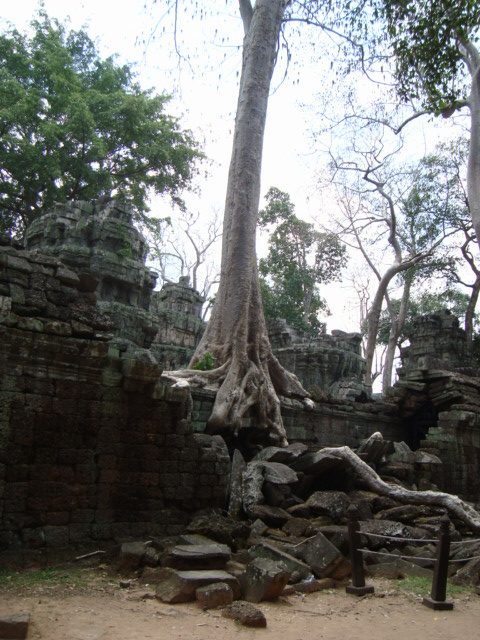
Part temple, part ruin, part nature, as I approach Ta Prohm, the first sight that grabs my attention, is what can only be described as a great tree of destruction.


Is it a giant snake?? No, it's tree roots!
This massive tree sits on top of a wall, and towers high above it. Meanwhile, the tree’s roots look like the tentacles of a giant squid, as though formed from Jules Verne’s imagination. The roots appear to have pushed over this strong stone wall, with no more effort than it takes for a child to push over a wall of toy blocks. A gaping section of the wall, is now only a pile of stone bricks. A root of the great tree has creeped across them, burying itself in the earth beyond these measly human cut stones. The tree’s light bark contrasts with the blackened stones that have tumbled down below.

If you have read J.R.R. Tolkien, this tree could have been an ent from Lord of the Rings. It’s as though a mythical tree hopped up on the wall one night, and reasserted the power of mother nature, bringing back the jungle to cover the vanity of man. 

'Tomb Raider Tree' made famous by Angelina Jolie
Along another part of the wall, a colossal tree has grown up on both sides of the wall, towering over the tons of stone below it. This one gives the impression that it is supporting the wall, and holding it in place.

Others great trees have their roots flowing down over the walls smoothly, reaching downward like running water. They resemble a waterfall, frozen into tree roots. Still another has grown lengthwise over stone blocks, appearing as a giant serpent.

Movie buffs may recognize one stone gripping temple tree, from a scene in the film, ‘Tomb Raider’. I once chatted with a Khmer policeman, who had worked with the production crew while the film was in production here. “I see Angelina Jolie,” he told me perkily. “She beautiful!”

As a melding of temple and nature, Ta Prohm truly is a place of wonder and romance. I wonder if this exotic locale had any influence on Angelina Jolie. Cambodia certainly made some impression on the famous actress; she adopted a Khmer orphan to be her own son.

There used to be far more jungle growth covering Ta Prohm temple, but most of it was removed during restoration. When they got to these impressive trees however, they noted that removing them would damage the walls and monuments even further. Leaving the great trees where they are leaves a visual balance; it shows that Angkor is not just about temples, it is also jungle.

Restoration laborer, hard at work
Closer examination on some walls and reveals perfectly round holes dotting stone building blocks. These are not bullet holes as I saw at Angkor Wat; these are all holes left over from the days of original construction. Ancient Khmer construction methods had these blocks moved by sticking wooden rods into these holes for easier lifting.

I come to one of the temple's stone archways, and it’s blocked off. A sign reads, “NO ENTRY, WORK AREA”. Looking in near the sign, I find a workman lying asleep on a dislodged block. So much for working. That’s one thing I’ve noticed about Khmer men, they can sleep soundly on almost any surface. Whether it’s grass, concrete, a motorbike seat, or a stone block, you can find them snoozing almost anywhere.

Besides Ta Prohm, restorations are in progress in several other temples around the Angkor complex. As Cambodia is such a poor country, most of the funding comes from foreign sources. India is providing financial aid to restore one temple. That's not surprising, since India is the home of the Hindu religion. When these temples were first built, the Khmers were Hindu, before later turning Buddhist. The Japanese and German governments fund repairs on other temples. There are so many hundreds of temples around Angkor, that all of them will never be restored in our lifetime.

I know an American Vietnam War veteran, who spent time in Cambodia in recent years. He decided he would personally visit every single ancient Khmer temple in the Siem Reap region. 

It took him six weeks to see them all!!

The towers and trees of Ta Prohm


Thursday, July 30, 2015

AMAZING ANGKOR WAT

Stone sentinels on the causeway, leading to the famous Angkor Temples
The kingdom of Angkor was once the greatest empire that Southeast Asia had ever known. Their lands included not only Cambodia, but what are now parts of Thailand, Laos and Vietnam. They were a culture far ahead of their time, accomplished in architecture, engineering, irrigation and agriculture. 

Recent history during the Khmer Rouge era was a low point in Cambodia, but through it all the glorious sights of Angkor survived the wars, survived communism, survived the jungles, survived the ages. Long unknown to the outside world, these wondrous Angkor temples are again open to foreigners like me. 

On this tropical day, I’ve departed Siem Reap, an unromantic town that is awash in hotels, restaurants and bars aimed at tourists. Fortunately, the town is far from the temples. I've rented a tuk-tuk and driver for the day, and headed out to the temples to explore. I won't be disappointed. 


Archway used by royalty to mount elephants!
On my way into the temple complex, my tuk-tuk crosses onto a long causeway bridge. The railings on both sides are like those I’ve never seen. Each is formed from a long line of ancient stone statues. Stern warrior faces are topped with Khmer headresses. The long snake-like railing they bear has broken off in some places. Some of these statues have been decapitated by looters, in years gone by. 

Reaching the end of this bridge, I'm met by an amazing archway of stone. At the top, enormous faces look out from three towers, as if keeping watch over all who enter. This high archway was made for elephants! Used by Angkor royalty, the king and his family used to mount and dismount elephants from the steps beneath the arch. Elephants still occasionally walk through here today, though most traffic passing through these days are tuk-tuks and bicycles. As I pass through, I look up to see numerous bats clinging to the high ceiling. Like most of Angkor nowadays, there are more animals here in this ancient city than anything else. 

Continuing on through the jungle, we soon reach my destination, and I leave my ride. My eyes widen, and I stare. 

Angkor Wat! 

I gaze at a wonder of the ancient world. It is the unmistakable outline of Angkor Wat, the largest religious building in the entire world. It's spectacular, awesome, stunning, mind blowing. The Angkor temples are one of those places, where adjectives are insufficient in describing them. Angkor Wat is so synonymous with Cambodia, that this temple is on the country's national flag.


Amazing Angkor Wat, the largest religious building in the world
Approaching the complex another causeway leads me across an ancient man made lake, arriving at a stone entranceway. A doorway between two stone pillars leads inside. I notice some lightly colored dots and marks to the sides. These were bullet holes from the war years, only recently filled in with cement. Renovations are still underway. 

The doorway takes me through the outer wall of this grand complex, and onto a long stone walkway. Angkor Wat is directly in front of me in the distance. It’s blazingly hot! It’s afternoon, and the tropical heat is at it’s peak, easily over 90 degrees. I’m unfazed though, since the heat at this time of day will keep away many tourists. There are some visitors about, but not the masses that will be here for sunset. It’s a long hot walk; seems a mile. But it’s fitting for me to walk this way. It is better to approach Angkor Wat just as its pilgrims did centuries ago, on foot. With each step, the great 12th century edifice grows larger in front of me. 


Remains of a brightly painted interior hallway, the whole temple was once this color
Finally arriving at the temple itself, I climb the steps and walk into the cool shade inside. 

Along the interior, there is a noticeable splash of color. The exterior is all dark stone, but here I see the originally painted colors. These pillars still have patches of dark crimson. As magnificent as this temple looks now, I can only imagine how Angkor Wat must have looked back before the paint started to fade.

There are many great carvings upon the walls. Common among  them, are the Apsara nymphs. These female Apsara dancers are depicted performing their graceful dances in front of the Khmer king. They wear shapely outfits, low cut skirts, tight tops, and ornate headdresses. Some have mysterious smiles. 

There are few statues to be found in Angkor Wat, and I soon find out why. Coming into one hall, I find many Buddhist statues. Most have been decapitated, by looters, or by the atheist Khmer Rouge. With so much else to fill the senses here, the lack of statues is hardly noticeable. 
Monkey resting in temple shade

There are many faces, friezes and bas reliefs all over the walls, along with the stunning architecture. I find a long covered walkway in the back, with a bas relief stretching the entire width of the temple depicting a religious scene from antiquity. It’s crowded with carved Hindu deities, royalty and mythical figures. Gods, chariots, and soldiers, with fighting depicted. Like many of the Angkor temples, Angkor Wat was originally made for Hindu worship, and converted to Buddhist use later. 

As I walk along, I notice a stray dog far ahead of me, and it walks out a corner doorway. Taking my time, I finish my stroll admiring the huge bas relief, until I walk out the same door. 

I freeze in my tracks. That wasn’t a dog walking in front of me, it was a monkey, and a big one at that! It’s now only two steps in front of me. Brown with a long tail, and white fur on his chest and neck, it’s a macaque monkey. He’s seated, resting in the shade of the entranceway. 

Upon seeing him, I jump back with a start, and he glares up at me, perhaps annoyed that I’ve disturbed his privacy in the shade. He turns, walks down the steps, and makes his way across the grass before disappearing into the jungle. 

Before it gets too late, I take my leave of this magnificent place. 


Buddhist monk walks in Angkor Wat

On my way out, I head down the walkway from whence I came. A Buddhist monk slowly walks towards me, on his way to the temple. He wears the simple orange robe and sandals that all Buddhist monks wear. The only thing modern about him is his orange umbrella, which is  shielding him from the hot sun. 

As these temples were once a place of conflict, I'm glad that they are once again a place of peaceful religious worship. Angkor Wat is now a place loved by many; both tourists and Buddhists alike. 


Apsara dancers on the temple walls

Thursday, January 15, 2015

CLIMBING A CAMBODIAN MOUNTAIN

Bokor Mountain, on Cambodia's southern coast
I've never climbed a mountain before.

Today I’m riding shotgun in a pickup truck. The windows are down, sun is out, and a few hearty souls riding with me are heading for Bokor Mountain in southern Cambodia. We've left the the town of Kampot to climb this mountain in one day, aiming to reach the old French hill station at the top.

We pull over, and a Cambodian park ranger climbs on, donned in a brand new khaki uniform and wide brimmed hat. He’s young; looks barely out of his teens, I wonder how long he’s been a ranger. Our destination: Preah Monivong Bokor National Park, a protected reserve (at least officially) so climbing groups must have a ranger accompany them. Our ranger isn’t armed; how will he protect us if a problem arises?

Our pickup turns off the highway, and onto a rutted dirt road, crossing railroad tracks from the old French built railway. There's no need for crossing gates; the trains haven't run for years. The dirt road narrows to a path, and the pickup halts. Climbing out, we grab our backpacks, and begin our trek. The wide dirt path soon narrows, and the greenery grows thick. The path steepens, and soon we are rising up the mountainside and into the jungle.

Grabbing our backpacks off the pickup, we start our trek
We stop for our first break by a creek, and I'm startled by two young Khmer men. They are walking back down the mountain path, each with a bicycle. It’s too steep to ride the bikes, and strangely, each bike has a long plank of newly cut wood strapped to it. I quickly realize who they are: wood poachers!

The ranger accompanying us stops them, and a long conversation in Khmer begins. Though they have been caught red handed, they don’t make any effort to run, which wouldn’t have been easy, since they both wear sandals.

Then our guide says it’s time to go. He takes us up out of sight of where the ranger and poachers are, and then we stop to wait for the ranger. When he finally rejoins us, we depart again. Hmmm.... Since the ranger dealt with the poachers out of our sight, I wonder if he had collected a bribe from them. Poaching of all kinds is a serious problem on Bokor Mountain.

We continue climbing, and we run into two more poachers! They're probably working with the others we saw earlier. Each carries a chopping tool, which looks like a cross between a machete and a meat cleaver. We walk up out of sight, and wait for the ranger again. When he rejoins us again, this time he's carrying the confiscated cleavers.

We encounter wood poachers on our way up the mountain path!
Although we are mostly in the jungle's shade, it’s still very hot and humid as we climb. Soon my shirt is soaked through, complete with a couple holes torn into it from a passing thorny vine. Six climbers have joined me on this ascent, including three Israelis, an Englishman, the park ranger, and our Khmer guide.

Continuing our jungle ascent, we reach a scenic waterfall. The wildlife is beginning to show itself. A lizard with a spiny back glares at me without moving, as I try to stare him down. He wins. He lives here on this tree branch, and I’m just passing through.

This mountain is a good choice for a national park. Along our journey I will see two pelicans, a hawk, and a large black monkey that ambled across our path. There are even elephants and tigers here too. Sadly, their numbers are very few, thanks to all of the poachers.

We find other wildlife here as well, but the unwanted kind: LEECHES! Our guide finds a leech on his neck. An Israeli spots one on his lower leg. I'm glad I'm wearing long pants; it’s not a good idea to wear shorts in the jungle. They remove the unwanted hitchhikers, and we continue on our way.

Dangerous White-Lipped Pit Viper by the path
Suddenly our guide stops our progress. Coiled in the brush right next to the path, is a bright green snake with yellow eyes. It’s not very long, it's no cobra, (of which Cambodia has many) but when it comes to venomous snakes, size isn’t everything. “Very dangerous,” our guide says. We've encountered a White-Lipped Pit Viper! Our guide pokes at it with a long stick, and it slowly slithers away into the jungle. Our climb continues.

As the day heats up, we rest again on a surprisingly wide dirt road that crosses our path. This road follows the tracks of the old original road up the mountain built in 1921. Supervised by the French, the heavy work was done by indentured Cambodian laborers. Some worked so hard, that they died from overwork. The new widening of this track today is being done by a Chinese construction company, and they've been troubled with labor disputes. Cambodian laborers working here now complain about being overworked for little pay. Exploitation of local labor continues.

Before this project began, visitors to the mountain top drove up the old road in pickup trucks, spent the day there, and were back down before dark. But now the Chinese construction company totally closed down the road to visitor traffic. So we're going up the only way we can: on foot. After spending the night up top, we'll go back down tomorrow morning.

Odd looking lizard stares me down
After hours of climbing steep trails, drinking two liters of water, and with muscles growing sore, we reach a dark stone building sitting on the edge of a cliff. It’s time for lunch, and we’re having it at the 'Black Palace'. I walk into this abandoned shell, and it's not much of a palace, it’s more of a ruined villa. Khmer naga heads sticking out from the rooftop corners let on to its royal ownership: this was once owned by the king. But since then the palace has been totally looted. There’s not only no furniture, but the windows are gone, bathroom fixtures are gone, even some of the floor tiles have been torn up.

Sitting on the window ledges looking out towards the cliff and the ocean, we dive into our lunches of vegetable fried rice. 'Black Palace' is an odd title for this place, as the inside walls are covered with bright orange paint!

With lunch in our bellies, we pick up our packs and move on. The rest of our hike up will be on the road, so it’s not so steep. Now that we are at higher altitude, the temperature is noticeably cooler.  I breathe a sigh of relief in the clean mountain air. From here on in, the climb will be easier.

Waterfall on the way up the mountain
A couple more hours into our trek, a light rain begins to fall. Fortunately we're prepared, and we all don rain gear. We pass a Buddhist shrine, and down a side road I make out a Buddhist monastery. This was built recently, after the departure of the brutal Khmer Rouge communists. Normally this would be worth a visit, but we're all anxious to reach the old hill station, so we press on.

Finally, after seven hours of hiking and climbing, we arrive. I've made it: the top of Bokor Mountain. I have to admit, I'm proud of myself. I've never climbed a mountain before, and having lost lots of energy in the climb, I'm relieved. The heat and humidity I suffered on the way up are forgotten, as up here at the top of the mountain, it’s very windy, even cold.

But even more, I'm amazed at the view. This is isn't just an old hill station, it's much, much more.  It's a French ghost town! I'm re-energized by this historic scenery, and I can't wait to explore what covers the peak of Bokor Mountain.


CONTINUED IN NEXT TRAVEL STORY: FRENCH GHOST TOWN


'Black Palace', once owned by King Sihanouk

French ghost town atop Bokor Mountain

Monday, December 15, 2014

PORT TOWN REVIVIVING

Coco House in the coastal town of Kampot, Cambodia
I’m taking an after dinner stroll down an old Asian riverfront. It’s dark and quiet; few are out walking this evening. Along the way I pass old French shop-houses, they’ve been uninhabited for years. Once stylish archways and pillars are now in gradual states of decay. Where bright yellow paint shone, it's now dingy and peeling. These used to be prestigious river side homes, businesses that brought important foreign trade into Cambodia.

This is Kampot, on Cambodia's southern coast. The Prek Kampong River flows through town, emptying into the nearby Gulf of Thailand. Kampot was once Cambodia's principal port. But when the larger port at Sihanoukville opened in the 1950's, this small town's importance rapidly declined.

Now these former buildings of commerce are empty; decaying and dilapidated. Weeds out front grow high through cracks in the sidewalk. 

There are lovely old French colonial buildings in town, but like these many are idle and deteriorating. Some are unoccupied and boarded up.
Dilapidated shop-houses on the river front

Fortunately, Kampot has been reviving. As I stroll further up Riverfront Road, I pass restored restaurants, and cafes. In recent years these have been renovated and reopened. Here diners are seated on sidewalk tables, with palm trees surrounding them. Redevelopment downtown is ongoing, though progress is slow. There are no crowds of customers out tonight; unlike Sihanoukville, Kampot has not capitalized on the rising tourist trade. But that's why some of these foreign folk have come here. It's quiet and serene, with scenic views and fresh seafood.

As little known as Kampot is today, it was once known as a center for one of the world's favorite spices. If anyone wonders what unique and quality product Cambodia provides to the world, the answer is: pepper. Kampot was known for exporting pepper to foreign markets as far back as the 13th century.

“Kampot pepper is the best in the world,” a lady drink seller told me. She’s right, and the Khmers aren't the only people who believe this. So do the French, and of course they know good food. Kampot's pepper was preferred by France’s gourmet chefs. During colonial times, all the best restaurants in Paris had pepper from Kampot on their tables.

Up until the radical Khmer Rouge halted all pepper plantation production, pepper was one of the country’s largest agricultural exports. At the height of production here, the fields of Kampot Province had more than a million peppercorn plants. With the Khmer Rouge gone, local farmers are growing peppercorn again today. Kampot pepper is once again gaining international prestige.
Tasty fish cakes for dinner in Kampot

Further down the river front,  I come to the town's oldest bridge. Crossing the Prek Kampong River, it leads right into the town's center. 

It's dark now and hard to see, but if you look at this bridge in daytime, it’s a rather bizarre looking structure. Parts of the bridge are old, parts are new. As far as construction styles go, there are not one, not two, but three different styles of bridge construction evident here! The oldest section has large arches, with steel support beams rising overhead. But two adjacent sections are basic flat bridges, with two distinct sets of support pillars descending into the riverbed.

This oddity is another legacy of the Khmer Rouge; the old bridge was destroyed during the war. Afterward, rather than tear it all down and rebuild it from scratch, they had to reconstruct it using what remained. I don't blame the engineers, as poor as Cambodia is, it's a wonder they were able to rebuild it at all back during that turbulent time. Having seen the three different building styles, I wonder, was this bridge destroyed more than once? 


Daytime view of the river. The old bridge beyond, destroyed during the war, has been rebuilt.
Winding up my riverfront walk, I go from the old, to brand new. Pounding music and flashing lights announce a disco. I've arrived at “Alaska Super Club”. It’s the only new building I've yet seen in all of Kampot. Cheesy neon signs show figures of female dancers. This gaudy night spot is out of place on this otherwise rustic riverfront. It's a weeknight, so they don't have much of a crowd. I decide not to pay a cover charge for a near empty club, so I turn back. 

I chuckle at the name: 'Alaska Super Club'?? I don’t think I’ll see Sarah Pailin and her brood walking in here anytime soon.

I head back to my hotel, avoiding some stray dogs on the way. Beyond the bridge and the river, loom the nearby Elephant Mountains. The most notable of these, is Bokor Mountain.

I’ve never climbed a mountain before, but I'll be climbing it tomorrow morning.

Tuesday, April 8, 2014

AUSSIE AND THE BOMB

Rice paddies and karst mountains in the remote, beautiful town of Viengxay
Viengxay in Laos, was once just a series of scattered villages, until the war put this place on the target map for US bombers. After it became the underground headquarters for the communist Pathet Lao rebels, it grew to shelter 20,000 soldiers and citizens. Now with the wartime caves emptied, Viengxay is among the larger towns of the remote northeast. 

Today the town looks like any rural Laotian community. Walking dirt streets, I pass traditional wooden Lao houses, with handmade bamboo fences. Local men play petang, a game brought here by French colonials. On the outskirts, farmers tend their rice paddies by hand, as they've done for generations. 

Meanwhile the misty and mysterious karst mountains stand sentinel around Viengxay, ancient guardians of history. I pause to watch them, as passing clouds move between the peaks. Before my eyes, the mists completely obscure entire mountains that were visible only minutes before. 


Meg, only white foreigner living here
Continuing my stroll, I find the local tourist office. Walking in, I meet a worker that I was never expecting to see in this remote place. 

A white woman!

I say hello, and chat with Meg, an Aussie. She’s short with white hair, and appears to be nearing retirement age. She tells me that she used to teach at a university in Australia, and now her kids are all grown. She decided to keep working because she enjoys it, and she heard of a position here in the tourist office. 

“Philosophically, I’m a peacenik,” she explains. I wonder if she protested against Australia’s involvement in the war in Southeast Asia, all those years ago. 

I ask Meg why she came to Viengxay, and she answers, “I liked the challenge.” There’s no mobile phone signal here, and no internet either. When she wants to check her email, Meg has to take a bus to Sam Neua, over an hour away. And there isn’t always a bus to come back either. 

I can tell she's worked in Viengxay for a while, since she walks around the office barefoot! One of her jobs here, was editing text on the historical signs that I’d seen in the caves. For once, most of the tourist signs here were written with correct English grammar, so I can thank Meg for that. 

Meg even worked in Viengxay before, and returned to work again. The warmth of the Laotian people brought her back. “I love the Lao people,” she says. “The Lao people are so optimistic. So much destroyed, and they are still optimistic.”


Men play petang by old cluster bomb casing
As it turns out, Meg was unexpectedly a firsthand witness to some recent destruction. One morning she was walking to work here in the office, just like she did every day. On the way, she heard official announcements blaring from the community loudspeakers. She can’t speak Lao, so she didn’t understand the announcement’s meaning. 

She soon found out. She was arriving in front of the tourism office when it happened. 

B-O-O-O-M!!!!! 

A massive explosion shattered the calm of the quiet morning. This deafening sound was unlike anything Meg had experienced in her life. When the bomb went off around 100 meters away, she was more than just surprised. 

“I was knocked to the ground!“ she told me.  

An explosive ordinance disposal team had just detonated a 500 pound bomb that had been recently found, left over from the war. Rather than trying to remove the dangerous old weapon, they had decided to detonate it where it had been discovered: within town limits. The community loudspeaker announcements that she hadn’t understood, were warning town residents to take shelter for the coming blast. 

“I felt violent nausea,” she said recalling those shocking moments, “and horror.”

I ponder her thoughts on the explosion. This was only from a single 500 pound bomb, and so many of these were dropped on Viengxay nearly every day during the war years. Those caves where they took shelter weren’t comfortable, but they were preferable to living out here in the open, where death rained down from above. 


Caves of Viengxay, where residents and soldiers sheltered during air raids
I bid Meg good bye, and continue on through town. 

Her job certainly is a challenge. Given Viengxay's remote location, trying to attract tourists here is an uphill battle. As I’ve walked around town, I’ve only seen two other visitors all day long. 

Although few journey this far, there are those in high places that still remember Viengxay’s importance. Recently, an impressive caravan of 120 cars rolled into town all the way from Vientiane. It was a government convoy arriving for a commemorative event for this former communist wartime headquarters. It was a grand affair, and the current Minister of Foreign Affairs gave a speech. 

Like many of the others attending the official event, back during the war the Minister had been born here in the caves.

Tuesday, December 3, 2013

KNIFED BY AN ELEPHANT !

Elephants and their Laotian mahouts. I rode the elephant in the center.
There are many ways to travel across rugged terrain in poor countries that lack paved roads. To reach my destinations over muddy tracks, I’ve ridden in all manner of four wheel drive vehicles. When there have been only paths, I’ve occasionally ridden mountain bikes, motorbikes, and horses. I even rode a camel once. But this one definitely tops them all.

An elephant!

I’m high on the back of an Asian elephant, riding the ultimate beast of burden as it ambles down a jungle trail in northern Laos. Except for the occasional flap of its great ears, the massive animal’s movements are slow and deliberate. She walks slower than I had imagined, but then again, I never imagined I’d ever ride an elephant at all.

My elevated seat is a chair shaped saddle, strapped to the pachyderm’s back. Directly in front of me a mahout in camouflage fatigues sits astride the elephant’s neck. 
Temple mosaic shows royalty rode elephants

Wondering how it feels, I reach down to touch the powerful animal’s skin. It feels thicker than leather; rough to the touch. 

I have a commanding view up here, high enough that I occasionally have to push tree branches away from my face. I have the same vantage point European hunters had as they hunted tigers from atop these pachyderms during the colonial era. King’s of old from this region used them too. Rather than horses, many Southeast Asian monarchs preferred riding elephants into battle. 

Old Laos was once known as ‘the land of a million elephants’, but there are far fewer of them in the country these days. Some remote communities still use them for labor in the lumber trade. Using their great strength, they are trained to knock down trees, and drag logs through terrain too rough for vehicles. In remote regions, there are still wild herds that survive in the shrinking jungles. 


The view from atop the elephant, crossing a river
The trees open up to a river bank, and the mahout climbs up from the elephants neck to take a seat on the chair next to me. He barks out commands, and the elephant steps into the water. Apparently we’re crossing this dark river just as we are. This isn’t the Mekong River but it’s no creek either, it looks deep. 

I want to ask the mahout how deep the channel is, but he doesn’t speak English. The great beast carefully moves ahead step by step, and the water comes up the beasts shoulders. I glance at the mahout, he’s pulled his bare feet up on the saddle to stay dry. Soon the water is high enough that the elephant lifts the tip of his trunk above water, so that she can continue breathing. 

But the water level doesn’t reach the saddle; I remain dry as the beast ascends the far riverbank and emerges from the water. The elephant probably enjoys these occasional dips, since it’s such a hot tropical day. The water drips off her hide, as she continues down a well worn path into a riverside village. 
Friendly local children greet me as our elephant passes through their village

Three petite children run out to watch the elephant lumber through their village. “Sabadee! Sabadee!” (Hello! Hello!) one calls out, smiling as he waves at the strange white foreigner. 

“Sabadee!” I yell back. Another Laotian villager on the ground greets my mahout, who commands the elephant to stop while they briefly chat in Lao. For some reason, he then hands the mahout a long knife. The knife doesn’t have a sheath, and he stows the blade just beneath my seat. I don’t think anything of it at the time, but I will regret this later. 

After continuing on through more jungle, my all too brief ride above this magnificent animal comes to an end. The mahout guides my ride toward a bamboo platform, where I can safely dismount. 

But it’s not as safe as I think. As the elephant approaches the platform, he brushes up against a nearby tree. The tree bumps the side of my chair, right where the handle of the knife is sticking out. In a flash, the knife is wedged out, and cuts right into my leg!

R-I-I-I-P! I hear the sound of my blue jeans tearing, as the long blade cuts at my right thigh. 

"YEOW!" I yell, as I jump to the side. I’ve been cut! That happened so fast, I had no time to avoid it. My mind races, I’m in serious trouble. 


The knife cut a hole in my blue jeans
I lift my knee to look, and I’m both surprised and relieved to see no blood flowing. A long V-shaped hole has been slashed open in my trousers. The skin on my thigh stings, but fortunately it wasn’t cut open. I've been saved by blue jeans! Gotta love that strong American denim. It’s a good thing that I wasn’t wearing shorts, or I would have been cut and bleeding for sure. 

I climb off the elephant onto the platform, and the mahout looks at me blankly. I’m raging at his carelessness, which nearly injured me. I point at the gaping hole in my jeans. He makes no reaction, not saying a word. He knows he screwed up, and now he’s trying to 'save face'.

I mutter a few insults at him that he doesn’t understand, and walk away. No tip for him. 

Seething with anger I climb into a van, for a safer ride back to Luang Prabang. I’m upset that I lost a pair of jeans, but I’m very lucky to have walked away from that knifing without needing stitches. I guess I could call that a really close shave. Literally. 

Thursday, November 7, 2013

MEKONG RIVERFRONT AND OLD TOWN NIGHT MARKET

Laotian paddles traditional boat on Mekong River at Luang Prabang

This afternoon I'm strolling through the historical neighborhood of Luang Prabang, in the old capital of Laos. Walking downhill, I arrive at the famed Mekong River. Having been on it before, it's as though I’m reunited with an old friend. It doesn’t disappoint; I’m treated to another fantastic view. The majestic Mekong flows before me, and beyond it are ancient forest covered mountains. Since the sun has returned the colors are bright, and the intense green colors of the jungle blanketed hills really stand out. 

There are no tourists around this serene scene, so I find a walkway down from Khem Khong Street to the riverbank. There are no speedboats here, like everything else in Laos, movement on the river is slow. There’s no bridge either, any one crossing uses their own small boats, or takes the ferry. With the ferries docked, river traffic is light. The only sound is the putt-putt of one longtail boat chugging upriver.


Buddhist monk by Mekong River, opposite Luang Prabang. This side of river was once part of Thailand.
Far downriver is Vientiane,  but unlike in the south, the Mekong is not an international border here. The bank on the far side here is now Laotian territory, but it wasn’t always this way. There was a time when the land west of the Mekong was part of Thailand. That back and forth change of frontiers led to border battles further west in the 1980’s. But all is calm now; the far bank is now home to quiet ethnic minority villages.

I head further down the Khem Kong river road, behind the royal palace. This was once the royal pier, a miniature port where the world’s dignitaries arrived by boat for official visits with the king. Back before there was a decent road between here and Vientiane, the Mekong was the main highway of Laos. 
Long houseboats lined up on the riverbank
With the rise of roads in Laos, river traffic has dropped, but there are still some boats that carry passengers up and down the Mekong. This area has become a passenger port for journeys on the river. A whiteboard outside the booking house promotes a two day boat trip to Huay Xai, a town upriver bordering Thailand. It claims that the trip is by ‘VIP boat’. I let out a chuckle, since I spoke with some travelers that dispute that classification. They arrived in Luang Prabang on that same river route, and the boat they traveled in was far smaller than they expected.

“It was so crowded, full of cargo and passengers, there was little room to spare,” a young lady complained. “We only slept a little, and that was in hammocks.” Well, when those backpackers travel, they like the true local experience. They certainly got one. 

I look down towards the river bank now, and there some passenger boats, but they are outnumbered by much larger craft. There are more than 20 blue houseboats, all lined up on the bank, one right after 
A family lives on this houseboat
another. This part of the shoreline has been transformed into a floating residential area. I’ve never seen houseboats like this before, long and narrow, most are more than 80 feet in length. This makes for affordable housing, in an exclusive neighborhood. These boats are docked next to the most expensive land in northern Laos, and their rent to dock here is  probably quite low. Some of these families seem to do well; a number of the rooftops are adorned with solar panels and satellite dishes. 

Still, this isn’t a very sanitary lifestyle. I see a few children playing about, and laundry is drying in the windows. The laundry water and the bath water both come from the river. Unfortunately the river is also the neighborhood toilet. 

Leaving the river I go to check out more of the town’s commerce, so I walk up the hill into the heart of this historic town. I notice Laotians walking into a market resembling a barn, and I follow them in. Inside is a market not for tourists, but for local folk. Booth after booth is selling cheap clothes, costume jewelry and pirated DVDs. 


Old basketball court is now a market
The ceiling is unusually high for a local market, and looking up, I notice familiar hoops hanging from each end. This barn-like building wasn’t originally a market at all, it was a basketball court. Given that basketball is an American game, I wonder if these old backboards were installed when pilots of the CIA's Air America used to be here during the war. Since most Laotians are fairly short, they don’t have much use for a game favoring tall people. At least they’re putting the building to good use with the market. Not to miss a place to display their merchandise, one vendor has hung her colorful t-shirts from the far hoop. 

Leaving the market, I turn onto the main street of the town’s old part, Sisavangvong. Passing the palace I visited earlier, I reach the best preserved section of town. There are French shophouses, cafés, popular restaurants, and stores selling works of local artisans. And yet, there is a distinct, un-Laotian feel to this street. Also occupying these old buildings are travel companies and internet cafés. The foreigners have invaded.  

Looking around, I see Laotians on Sisavangvong have been outnumbered by white foreigner tourists. Walking down the busy street, I hear German, French, Swedish, and various English accents. In 1995 Luang Prabang was declared a UNESCO World Heritage site, which helped to preserve the old French colonial houses. After the war Laos was a forbidden land for foreigners, but they have come back to Luang Prabang in droves. 

Passing one tour company, I pause to read the elaborate placard out front. It advertises elephant rides in the countryside, a favorite of foreign visitors. Ride an elephant for a couple hours, or all day. For those who want to spend even more time with the great Asian elephants, they advertise a mahout school for $140. In learning the mahouts ways, you are taught the basics to be an elephant driver, or handler. The introductory course takes three days. 
Local vendors set up for Night Market in Old Town Luang Prabang
Or if you prefer an old fashioned jungle trek like the colonial explorers used to do, you can take a four day elephant caravan into the Hongsa Forest. That will only set you back $800 a head. 

Walking on, another elephant tour company advertises this: “Three days trek to visit old opium fields”. 'Old' opium fields? Really? Are they saying that there aren’t any more new ones? 

I head back to the guest house to rest, but there's more coming in the evening. Sisavangvong is known for its night market, and I return later to check it out. 

This is actually my second time to the night market; I had seen it five years before. It was a unique night market back then, the street was closed to traffic, and each vendor had their wares laying out in the open on the roadside. There were no tables, their goods were laid out on the ground on top of colorful woven blankets. Each lady vendor had only a small light bulb to brighten their merchandise beneath the moonlight. 
Lady vendor smiles at customers in Luang Prabang Night Market
Many ethnic minority women came in from the countryside to sell their goods, some of them working with a baby still strapped on their back. There was a wide selection of Buddhist statues, incense and silver jewelry of traditional designs. The best wares were the hand woven fabrics and traditional clothing. These weren’t just cheap tourist souvenirs, this was real craftsmanship. Almost everything you could see was made by hand.

In the years since my last visit, I return to the night market to find it has expanded exponentially! There are now so many vendors here that they don’t just line the roadsides, they are crowded together out in the street. It'ss no longer open to the skies either, most vendors have erected pop-ups for the rainy season. They're all packed so tightly together on the road, that there isn’t much space to walk through. To make my way down the street through the pop-ups, I'm forced to duck up and down repeatedly like a target in an arcade game! 

2005: The Night Market before it became swamped with tourists


Having Luang Prabang declared a world heritage site has been a mixed blessing here. The old buildings have been preserved, that’s true, and business is booming. 

But I fear Luang Prabang’s old district has become a victim of its own success; its romantic allure is fading. The high season now has mobs of tourists here, with most businesses catering solely to foreigners. 

This historic street is losing the old world charm that made Luang Prabang a world heritage site in the first place.