Showing posts with label Russian. Show all posts

Wednesday, November 19, 2014

FUGITIVES AND FOREIGN MISFITS

Beach in Sihanoukville. Many misfit expats live here, some are hiding from the law.
Chris is a twenty-something from England, with beard stubble, and a dark t-shirt. I met this friendly Brit one night at a no-name bar in Sihanoukville, where he worked as a bartender. 

He doesn't earn much, Chris only gets six dollars a day for eight hours of night time work. “Slave labor,” he tells me. But he does get a free meal every night, and free drinks. “I’m a bit of an alcoholic,” he admits to me.

Like many young folk I've met in Asia, Chris has been traveling around for months, and stopped to work in Cambodia for a while. I asked him if he had ever been to the states during his travels. His response wasn't what I was expecting. 

“They won’t give me a visa,” Chris said, “since I was convicted of production of cannabis.” Apparently Chris has a hippie side to him, which got him in trouble with the UK police a few years back. 

While we're chatting in this beach side hang out, a grungy, older Aussie that Chris knows walks into the bar. I’d seen this shabby guy yesterday on the street. He’d asked me for a cigarette, but I don't smoke. 

The Australian asks Chris, “You want to buy some weed? Two dollars a bag? I have to pay my hotel bill,” he explains. Chris declines, since he doesn’t do drug transactions while he's working. I also decline, since I stick to beer. Obviously the Aussie was in dire straits; he looked like a transient. He probably won’t sell marijuana for long here either, since local pushers won’t like him competing for their business.

Checking out the Aussie, I notice a large infected cut on the back of his hand. It was so infected, that his whole hand was swelled up. I figured he must have injured it in a motorbike accident, the usual way that foreigners get injured in Cambodia. But I was wrong. 

“A whore cut him”, Chris told me, after the Aussie walked away. Apparently since the Aussie didn’t have money for rent, he didn't have money to pay a prostitute that he took home either. 

Chris and the old Aussie are just two of the down-and-out examples, that make up the soap opera scene of foreigners living in Sihanoukville. Long time expatriates call the town ‘Snookville’ or just ‘Snook’, for short. During my days checking out the beach, I learn that there are many expats hanging out here with skeletons in their closets. 

One night out at a restaurant with a group of foreigners, I was introduced to a German lawyer. I don’t recall his name, but it was probably an alias. That's likely, since I was told that this tall Aryan looking guy, was wanted for murder back in Germany! 

I already met a Swede in Phnom Penh who was hiding out from the law, but he was a peaceful guy, wanted only for media piracy. 

Could it be that this tall German with thinning hair, was really a killer? I noticed the German had a scar to one side of his forehead; an intimidating looking fellow. 

I wonder, just how did he got that scar??

* * * * *


The strange 'Airport' disco.
I’m sitting at the controls of a Russian aircraft. It's an older two engine, Antonov 24 airplane. I reach for a gauge on the control panel, and the knob comes off in my hand! 

Obviously, this plane has seen better days and fortunately, I'm not airborne. In fact, I'm not even in a real airport. But I am in a disco in Sihanoukville that is named 'Airport', and this plane is parked right over the middle of the dance floor below me! How weird. 

I peer out the cockpit windows, where the building housing this night spot resembles an old airport hanger. Adding to the odd ambiance, old photos with advertisements from long gone airlines line the walls. I can see the need to stand out in Sihanoukville's night life, but this is just unreal. 

I leave the cockpit to go aft inside the plane, and find the passenger compartment in total disarray. The seats have been removed; it's dusty and grubby. Apparently this old plane is still being renovated for the club. I imagine they'll add more tables and chairs before it’s finished. 

It's fitting that an old Soviet plane is parked in here, because this strange disco is owned by Russians. Of course that helps the disco to attract a Russia clientele, but not tonight. I exit the plane and descend down to the dance floor, into a disco that's nearly empty. It's the off season, so fewer Russians are flying down from Siberia to Cambodia while I'm staying here. 

With the house music blaring, I finish my beer, and head for the door. This plane is yet another foreign misfit in Cambodia. 

Wednesday, January 22, 2014

THE TANK, THAIS AND RUSSIANS IN LAOS

Remains of Russian built PT-76 tank sits on old battlefield site in northern Laos
I’m at the base of an old battleground in the Laotian village of Nako. This hill has been left to the elements, covered with brush and young trees. No farmers will plant crops atop this knoll, because it’s still too dangerous to walk up there even today. The brush still hides landmines and unexploded ordinance from the battle that took place here. 

There are no ancient relics here like I saw at the nearby 'Plain of Jars', but right on the hillside is other evidence. An abandoned PT-76 tank has been left behind by the North Vietnamese Army! My guide Phin says this part of the hill has been cleared of explosives, so we walk towards the old wreck, without fear of losing a leg to a landmine. 

As tanks go, it’s not very large at all. It’s a lighter Russian built tank, brought by the Vietnamese deep into Laos as they fought to take over the Plain of Jars during the 1964 - 1973 war. Back then there were no paved roads in northern Laos. It was so rugged, that only a light tank could have made that difficult journey. Even then, it appears that this tank traveled all that way, only to get stuck here. It now rests on an angle against a tree, as though it got stranded in a muddy ditch long ago. 


Opposite view of the abandoned tank. Even the treads have been stripped away for scrap.
But Phin tells a different story. “This tank hit the anti-tank mine,” he says. If that’s true, it’s hard to tell by looking at it now. Both of the tank’s treads are gone. Like other abandoned American built tanks that I saw earlier in Vietnam, it has been stripped of everything that could be cut away, and sold for scrap or other uses. Even the hatches are gone. The gunless steel turret is lying upright on the ground just steps away, right under a fence. Strangely, the locals are using the tank’s small turret as a step, in order to climb over the barbed wire. 

As a light tank the armor isn’t very thick. Looking closer, I find a small hole in the side, with shrapnel scars around it. Apparently some kind of armor piercing round struck the front corner. The deadly round was well placed, because it hit right next to where the tank’s driver was seated. I doubt he survived. 

“All the tank drivers were Vietnamese,” Phin informs me. I imagine that most of the North Vietnamese troops that fought here, never imagined that they’d be fighting in Laos. Instead of fighting Americans over in South Vietnam, they were sent across the border into Laos. The only Americans they faced here were pilots in the air. On the ground they fought the Hmong, the Royal Laotian Army, and a 'special' army from Thailand.


The tank's detached turret is now used by locals to step over a farm's fence!
As the war dragged on in Laos, the Hmong troops that fought here on the Plain of Jars suffered heavy losses against the well armed NVA. With few adult men left among the Hmong to replace their losses, Hmong boys joined the fight as child soldiers. This wasn’t enough, and to fill the gap to stop the advancing communists, the Thai military joined the fight. It’s often forgotten that thousands of Thai troops fought not only in Vietnam, but also here in Laos. Back then, (and continuing today,) Thailand and Vietnam were the main powers in Southeast Asia. 

Since the Thai and Lao languages are so similar, Thai soldiers fit in well with the Royal Laotian Army. These Thai troops were tasked with defending many bases and hilltop outposts like this one, leaving the Hmong to conduct combat operations in the field. The fact that Thai troops were fighting within Laos was a closely guarded secret at the time.

We return to our tiny van, and head back towards Phonsavan. Cruising across the rolling hills, we pass more farming villages, green with the growing season. As we drive, Phin recalls what life was like in these villages after the war. “1975 to 1990 was the hungry period,” he says. “Not enough food.” Agricultural collectivization brought shortages to the farmers, and it also brought the Russian advisors. 


Parked chopper above, for MIA search teams
“This was Russian farm,” Phin says as we pass a vacant facility. Pointing the other direction, he says. “over there, was Russian cattle farm.”

The arrival of Russian advisers also meant a revolution in foreign language study in Laos. “At that time, there was no more French in schools. No more English,” he tells me. “Everyone learned Russian.” Phin speaks English better than most Laotian translators I’ve met, but he still wishes he had begun studying it earlier. Remembering his student days, Phin made fun of one of his former language instructors. 

“My teacher tell me, 'Learn Russian. Later, go to university in Soviet Union. In 20 to 30 years, whole world will be communist'.” Then Phin laughs aloud at how wrong she was, given the outcome of the Cold War. “I think, where is she now?” He chuckles. 

As the van rounds a corner, I look up to the sky, and spot a red and white helicopter high ahead of us. It looks like the small chopper that I had taken a photo of earlier. I had seen it parked in Phonsavan, the town where I'm staying.

“That for the US government,” Phin says. “They looking for missing body.” 

Apparently there is nothing secret about the mission of the two US soldiers that I met in Phonsavan in Craters Restaurant recently. Even Phin knows that there are Americans here looking for remains of servicemen still 'Missing in Action' (MIA) from the war.   

Watching the helicopter head for the horizon, I reflect on the past. Years ago, the skies over Laos were criss-crossed by so many US aircraft. There were US Air Force jet fighters, bombers and rescue choppers. There were CIA spotter planes and cargo planes. Now the only aircraft flying over northern Laos under the control of the Americans, is a small helicopter, and it's not even American owned. It's rented from New Zealand!


Wednesday, November 27, 2013

THE TEMPLE, THE HILL AND THE OLD RUSSIAN GUN

Climbers reaching the peak are rewarded with a view of the old capital and the Khan River
Today the skies are mostly clear, so I head back into the downtown of the old capital of Laos, Luang Prabang. On my way I find a coffee cart, so I stop to buy a mocha coffee shake. At 6,000 kip, it only costs me around US $.70. It’s delicious, and I slurp it down quickly as I walk away. Then I get to the bottom of the shake, and something gets stuck in the straw. 

It’s a rubber band!

Oh well, I don’t think the coffee vendor put that in there intentionally. Or did she charge me extra for it?

Tossing what’s left of it in a bin, I continue to Chomsy Hill, near the royal palace. Today I’ll climb it. I get winded as I head up the numerous red brick stairs, since this is the highest point of Luang Prabang. It’s a tiring climb, and after pausing at different levels on the way I reach the top step, number 228. I’m thankful I didn’t have to deal with anything dangerous on this climb, unlike that mishap that I had back on Marble Mountain in Vietnam. 


A young lady shaking sticks in a cup, a Buddhist ritual
There’s not a lot of room atop Chomsy Hill’s peak, but there is a small temple. Since I’m sweating from the climb, I wonder if ascending this hill is a type of Buddhist pilgrimage. 

I look through the window of the tiny temple, and two young Lao women are within praying in front of a small altar. Burning incense is in the air; one young lady is shaking a can of sticks between her hands. Resembling chop sticks with writing on them, these are Buddhist fortune sticks. The young lady shakes the canister up and down at an angle repeatedly, until one stick falls out onto the temple floor. This stick will be taken to a monk, who will interpret the stick’s message as her fortune. Each stick can also be matched to a longer written fortune, to be taken along for reference. 

Beyond the temple is the highest point of Chomsy Hill, the golden Phousi Stupa. It looks familiar, much like the immense golden stupa that I saw in Vientiane, though smaller. But the view from here is far better. As a pair of butterflies flit by me, I walk around the stupa and get a panoramic view of Luang Prabang. With fewer clouds today, I can see for miles. 
The golden Phousi Stupa adorns the peak

To one side is the Khan River and the approach to the airport. Without tall buildings, most of the cityscape is thankfully blanketed with old trees. The highest structure in view is another golden temple off in the distant hills. 

From the other side of the stupa I look down on the old colonial town, with the Mekong River and many mountain chains beyond it. It’s very tough terrain, I can only see one dirt road beyond the river that heads into the rugged mountains. Anyone hardy enough to cross the many miles beyond those peaks will find an important boundary. There is the center of the ‘Golden Triangle’, where the borders of Laos, Myanmar (Burma) and Thailand meet. Further beyond in that direction: China. Laos may be poor, but it does have its strategic places. 

I’m grateful for the excellent view, but today it’s blazing hot up here. I’m still overheated from my ascent, so I find a bench to sit in the shade. Taking a seat, I’m startled to find I’m sharing the bench with two tiny birds, inhabiting an equally tiny bamboo cage. This may seem a strange place for caged birds, but a vendor is selling them up here to the Buddhist faithful. One way a Buddhist can earn merit at a temple, is to buy caged birds, and release them back into the wild. Of course this only encourages the vendors to go back out into the wild and trap more birds, to be used for the same purpose. But it works for the Buddhists. 

Almost on cue, a Laotian Airlines plane swoops nearby in the valley, straight across from me at eye level, at the same altitude. As the plane’s engines blare, the birds hop around and chirp excitedly from within their cage. They want to fly too. 


Russian anti-aircraft gun mount on temple hill
Not long after, a Buddhist woman who bought the birds returns to retrieve them. Soon the bamboo bars are pried apart, and the feathered ones are set free. They quickly dart into the air, landing in nearby trees. I hope that they won’t be re-captured, and have to go through this all over again. 

Feeling sufficiently cooled, I walk to the other side of the temple ridge. Beyond a flagpole flying the Laotian flag, I find something completely unexpected. The communists have been up here too, and they left behind the remains of an old Soviet 23mm anti-aircraft emplacement. The gun itself has been removed, leaving the base and the mount behind. 

I wonder to myself, why on earth was this placed here next to a temple? Probably because this hilltop has an excellent view overlooking the valley, facing the approach to the airport. Perhaps this old Russian weapon was brought up here in the post-war 1980's, when Pathet Lao communists were worried about conflict with Thailand. 

I find the gun mount’s supporting arm unlocked, and I give it a strong shove. The steel arm swoops around in a full circle, creaking loudly as it rotates. The mount isn’t level, so the arm continues to swoop back and forth like a swing, until it finally comes to a stop. 

The gun’s arm is aimed straight at the flagpole, and at the temple buildings behind it. 

How eerie.

Really, they ought to drag this old gun mount down from the temple peak, and recycle it for scrap. It doesn’t belong in such a peaceful place. 
Another view from atop Chomsy Hill facing the Mekong River, with mountain ridges beyond

Monday, September 16, 2013

CORRUPTION, DAMS AND GULAGS

Once dry land, the water level has risen due to a dam
Gazing out our vehicle’s window, palm trees wave in the breeze as we cruise down a narrow rural road. While watching the world pass by, I see an odd looking lake in the hills to the east. Out in the brown waters of a lake, are small hilltop islands close to shore; longtail boats cruise their way between them. On one small island, I spot cattle that have been stranded. They have a confused look about them, as they wait to be rescued. That’s when I realize that that this isn’t a natural lake. These waters come and go, and these islands are only temporary. What the cattle are standing on, is really just a hill that became an island after recent rains. This isn’t a natural lake at all, it’s a vast reservoir for the Nam Ngum Dam, north of Vientiane.  

Built with foreign aid, Nam Ngum was built during the war, opened in 1971 to provide hydroelectric power. After the communists took over, the dam’s reservoir took on an additional function: as a prison. The islands held not loose cattle, but Laotians associated with the old regime. Out on larger islands of the reservoir, two prison camps were built. One island prison was for men, another for women. 

When the Pathet Lao took over in 1975, they rounded up an estimated 20,000 – 40,000 Laotians. These included soldiers, policemen, teachers, Royal Laotian Government officials,  and office workers who had worked for westerners. Just as had been done in Vietnam, the prisoners were sent to remote prison camps for ‘re-education’. Added to these 'enemies of the state', were other undesirables that didn’t fit in with the new ‘communist paradise’. Also sent to the bamboo gulags, were prostitutes and opium addicts from Vientiane. 

Fortunately, with the liberalization of government policies, that dark chapter has for the most part passed. The prisons on the reservoir were closed years ago. 


The Nam Ngum resevoir (Photo: 123 rf)
Nam Ngum Dam is still in operation today, and some of the electricity produced provides power for Vientiane. The rest of the electricity is exported to Thailand, and I remember the power lines across the Mekong that I had seen at Friendship Bridge. As a poor landlocked country, Laos has few prospects for development, and hydropower is being pushed even more these days. As one Laotian government official boasted, “Laos will be the battery of Southeast Asia.”

Hydroelectric dams in Laos are controversial, since there is an ongoing boom of dam construction. There are currently seven dam projects under construction in Laos, and even more are being proposed for the countries many rivers. 

One of the larger dams, called the ‘Nam Theun 2’, is currently being built in central Laos, on the Nakai plateau. Although the project is backed by the World Bank, it’s been running behind schedule. Since the Nam Theun River is a tributary to the Mekong, the project has received a great deal of criticism from environmentalists, and sociologists concerned about affected communities. 6,000 villagers from the area have already been relocated to make room for the reservoir, and nobody knows what the long term effects of the dam will be on the environment. Initially I thought that hydroelectric dams would be good for Laos, but an Australian scientist I spoke with in Vientiane convinced me otherwise. 

“Laos doesn’t need any more dams,” he said knowingly. According to him, it wasn’t need that was driving their creation. “A guy shows up with a suitcase full of money,” he said, “then they get approval to build another dam.” 

Hydropower, as well as increased logging and mining, have been a mixed blessing for Laos. The rise in business has brought in much needed foreign capital, and more villages are receiving electrical power. But the Laotian people are still not the main beneficiaries. With the return to Laos of large scale infrastructure projects as well as mining and logging, the resulting rise in corruption was predictable. Local government officials who had been earning less than $100 a month, soon found fat contracts crossing their desks that were worth millions of dollars. 

The Vientiane Times gave one example of the problem. This rare story condemning corruption by government controlled media, is startlingly frank. 

Laotian power lines. Most hydroelectric power here is sold to neighboring Thailand.
“Prosecutors fail to bring corrupt officials to trial

Prosecutors are still unable to bring to trial government officials who break the law and abuse their position of power because of lack of cooperation from the sectors concerned. The Lao People’s Supreme Prosecutors’ Office has identified a number of criminal cases among government officials, ranging from corruption to helping people illegally sell timber and provide land concessions. 

But prosecutors are unable to pursue these cases and submit the results of their inquiries to the court for subsequent trial and judgement because other government agencies do not provide the necessary cooperation, according to a report from the office. At present, the only stop most state agencies take against offending officials is to ask them to make a commitment not to repeat their wrongdoing. Those who commit a serious crime are removed from office without the case going to court. 

The Supreme Prosecutor urges the government to use its administrative powers to address the isue, saying unless it does so people will lose confidence in the leadership of the Party and government.”

With the lack of accountability, the Laotian judicial system is failing to reduce corruption. It’s no wonder that Transparency International’s 2012 Corruption Perception Index ranked Laos as 160th out of 174 countries in the world. That makes Laos more corrupt than Vietnam. 

Since Laos lacks high tech professionals, it continues to be foreigners supervising the work on these big projects. I recall a dinner in Vientiane, where I met Tatiana, a twenty-something Moscovite who had been here for a year.

“I work for construction company, (they) build dam,” she said from behind her glasses. She told me that even though the dam wasn’t yet finished, the power had already been sold to Thailand. 

Although Tatiana enjoyed her work, she didn’t like Laos. In less than a week, she would go back to Russia for vacation. She missed home, and missed Russian cuisine. But it wasn’t just the food that made Tatiana dislike Laos. She'd been sick lately, home in bed for a week with a bad fever. “I had ra tifis,” she said.

“Excuse me?” I said. “Sorry, I don’t understand.” She repeated herself a few times, and I finally got her meaning. 

“Oh!” I said realizing, “Rat Typhus!!!”

That poor young lady. She came all the way here to work in a foreign country, and ended up with a disease transmitted by vermin. I’m enjoying my time in Laos, but I wouldn't be surprised, if Tatiana never came back from her vacation. 

Friday, September 6, 2013

THE 'NO PROBLEM' BAR IN LAOS

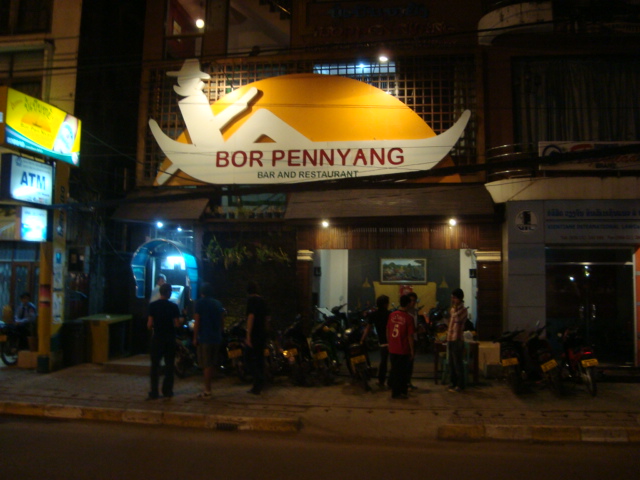
The 'No Problem' Bar in downtown Vientiane, one of the best in town
Bor Pennyang in Laotian language means, “no problem”. The saying is a reflection of the laid back Lao lifestyle. Expatriates who stay in Vientiane long term, tend to share the Laotians preference for quiet, stress free living. Like the Mekong, life here flows along slowly. 

Bor Pennyang also happens to be the name of one of the better restaurant bars in Vientiane, and it’s an expat favorite. I’m playing pool tonight, and luckily for me, playing pool here is free. Located on the top floor of a four story building, the necessity of climbing three flights of stairs keeps the lazy customers out. 

The establishment is open air, with a roof protecting patrons from the elements, but there are no walls. There are only railings, with catch nets beneath. The nets keep inebriated bar patrons from dropping their beer bottles onto unsuspecting pedestrians below. 
(I wonder how often that has happened.) When winds blow the monsoon rains inside, waitresses lower bamboo shades to keep the water out, rolling them up again when the skies clear. 

As far as a night spot goes, Bor Pennyang has the best night view of the Mekong River. Looking out over the railings I don’t  see Vientiane, I see… Thailand. Since the building is located on the river front thoroughfare, I’m getting an unobstructed view of the Mekong, with the riverbank homes of the ‘land of smiles’ beyond. It makes for a very romantic view when the Thai lights are lit up at night. For those who enjoy the nightlife, Bor Pennyang  is one of the few locales that make Vientiane worthwhile.

Looking down across the street onto the river front, the open grass lot atop the riverbank has been transformed. As night has fallen, enterprising cooks have hauled in gas stoves, coolers of food, and plastic tables and chairs. Extension cords have been strung up, with bare bulbs to light up the diners. Voila, an instant line of river front restaurants. 
Every night, instant restaurants pop up on the Mekong riverfront

The downtown riverfront is filled up every night with these mobile restaurants, popular with Laotians and visitors alike. I’ve enjoyed traditional Laotian dishes there, and they even have fresh seafood. One of the small restaurants keeps a huge bowl of live shrimp ready for cooking. With Laos landlocked, they must have been brought in from Thailand. 

Turning back from my view of the river front, I step up to the circular wooden bar, and order a cold Beer Lao. This is one of the few pub’s in the city that has the national beer on tap. I'm greeted by the manager, a friendly Aussie named Ian. He's the key to Bor Pennyang’s success; he runs a bar business that both locals and foreigners enjoy. A former chef, he has lived in Vientiane for years, enjoying the slow pace of life. Even among foreigners he stands out, with his odd choice of hairdo. Although balding, he still grows his grey hair long in the back, keeping it in a ponytail. Thankfully, he’s a much better bar manager than hairstylist. 

Tonight is a Friday night, and the crowd begins to roll in to play an early game of pool, or grab a late dinner. After a few games, I notice a Russian couple playing at the next table. Russians aren’t very common in Vientiane these days, there were far more of them here during the post-war years, when there the Soviets were in town working on infrastructure projects. 

“When I was young, the only foreigner I see was Russian,” I recall a Laotian woman telling me. “When I see them, I scared,” she said. “They have blue eyes.”

I take a break from pool, and strike up a conversation with these new Russians. They prove to be an interesting pair. Yuri and Olga are both funloving, outgoing, and young at heart. Yuri says he makes a living importing cars from the USA, shipping them to Russia. Olga is a part time interior designer, and mother to their two children. He’s 45 years old, fairly fit, and balding. She’s aged 29, thin, blonde and very attractive. Olga tells me that when Russians get married these days, age differences like theirs are very common. 

Stepping away from the pool tables, conversation shifts to their home in Moscow. I’m taken aback when out of the blue, Yuri mentions that Moscow has nude sunbathing, on the banks of the Volga River. I tell him that I didn’t know that was possible in Moscow. I didn’t think that it was hot enough there either. 
Interior of rooftop bar 'Bor Pennyang'

Yuri corrects me, “In Moscow, yes. In Siberia, no!”

I ask if he ever sunbathed nude. “Yes,” Yuri says in a matter of fact manner, “we are nudists.” 

While we are chatting, Olga is getting a lot of visual attention from others in the bar, since she’s wearing a very short skirt, and a tight shirt with no bra. Conservative Vientiane is no tourist beach town; she’s probably the only woman in the city showing so much skin in public. 

“She likes to go to strip clubs,” her husband tells me, confessing more personal information. As I continue chatting with Yuri, I eventually find out why the pair are so outgoing. 

They are both swingers. 

“We have alternative lifestyle.” Yuri explains. 

No kidding. After hearing that, I’m not surprised to learn that they are presently living in Pattaya, a beach town in Thailand with a seedy reputation. The only reason that they came to conservative Laos with their kids, was to make a visa run. This is their first trip to Vientiane, and they’re bored. They haven’t found any other couples in Laos who share their lifestyle, so they are disappointed with the city’s nightlife. 

It’s been an interesting conversation to be sure, but since I don’t share their lifestyle, I decide to move on to my next evening destination. I say goodbye to the Russian swingers, who continue their evening’s search for a like minded couple. 

Thursday, August 29, 2013

THE 'WAR AFTER THE WAR' AND THE DRONE

USSR built Kamaz truck, damaged by US cluster bomb attack
A dark green, Soviet made Kamaz 66 truck is in front of me, and it's a battle scarred ruin. Full of countless holes and dents, it was hit in a cluster bomb attack in northern Laos during the war. 

It’s a new day, and once again I’m seeing the effect of cluster bombs. When I went to the COPE center, I saw what cluster bombs did to Laotian civilians.  Here in the 'Lao People’s Army History Museum', I see what a cluster bomb did to a communist vehicle. A laminated caption with bad grammar tells the story: 

“In 1971, Camrade BounLap, a brave driver, of the 3rd Squadron of the 2nd Company of the Battalion 402 drove the truck to deliver ammunitions from Nonghaed District to Combat Operation Command...
in difficulties of the three serious days and nights admist enemy’s bombings, but he bravely broke through and safely arrived the destination even he was hit by US bombies”

Looking over this old Russian beast, there are numerous jagged shrapnel holes throughout the body of the truck. Most of the windows were blown out. With all this damage, I’m seeing visually how exploding 'bombie' shrapnel from cluster bombs could penetrate even thick steel. I doubt the caption’s dubious claim that the driver delivered his cargo of ammunition after the attack. Judging by all the shrapnel holes above the driver’s seat and through the driver’s door, he would have been very lucky to have survived at all. If this truck really had been carrying a cargo of ammunition, the bombies probably would have ignited them and blown the truck sky high. 


So when were General MacArthur & the USS Missouri in landlocked Laos?? (museum photo)
As I wander about and check out the army museum, I find most exhibits are similar to what I’ve seen in museums of Vietnam. Display cases are filled with the US made weapons, captured from Royal Laotian Army troops. There are also propaganda photos of Pathet Lao troops, posing and fighting. Some show real action, but others were obviously staged, presented as authentic. 

A caption beneath one photo is almost laughable. It has the following text: “Japanese fascist troops were defeated in Laos in 1945.” The photo here was not taken in Laos at all, it was taken in Tokyo Harbor. What the photo actually shows, is the Japanese signing their official surrender to the American military on the deck of the USS Missouri! That’s a long way from Laos. 


Vietnamese guerrilla weapons captured in 1989
Making my way upstairs, I learn about a surprising chapter in the history of Laotian and Vietnamese conflict, which occurred long after the Vietnam War was officially over in 1975. 

On display are captured rifles made in the US and USSR, from a little known conflict in southern Laos. The cases are full of captured evidence: binoculars, radios, documents, a canteen and compass. I quickly notice that some of these items are marked with a forbidden insignia: the red and yellow striped flag of the former Republic of Vietnam. These were captured from a rebel group called the 'National United Front for the Liberation of Vietnam', a group well known in Vietnamese expatriate circles.

From 1987 – 1989, this group of anti-communist Vietnamese guerillas from refugee families inflitrated the southern Laotian provinces of Saravanh and Xekong. They hoped to establish safe havens in southern Laos, and then from there infiltrate Vietnam, just as the Viet Cong had done years before. The bold aim of these insurgents was to restore the former government of the Republic of Vietnam. 

Led by a former Navy Admiral from South Vietnam, Hoang Co Minh, the group crossed from Thailand into Laos, where there were a series of attacks and skirmishes. Hoang and as many as 100 of the rebels were killed. Others were caught and given long prison sentences in Vietnam, where some of them still are today. The Vietnamese and Laotian casualties from this hidden campaign aren’t publicly known. 

Other photos and exhibits here highlight the most recent conflicts Laos has had with their old nemesis, Thailand. This battle also happened during the 1980’s, when tensions flared up over small amounts of territory in the northern Laotian province of Xaynabouly. Fighting broke out 
Captured drone from the Thailand - Laos border battles of the late 1980's
in Botene and Paklay, and these weren’t just little border clashes. The casualties from these armed confrontations reached well into the hundreds. 

One caption beneath an old 23 mm anti-aircraft gun here boasts of Laotian success, “In 1987 – 1988 it was used to fight enemy at Botene battlefield which shot down 11 aircrafts of the Thai extreme rightist troops.” In an age of guided missiles, that’s an unlikely number. 

Captured during that time, is something I’ve never seen before: a pilotless drone! We know a great deal about drones today, but in the 1980's they were almost unknown. Used by the Thais, it must have landed somewhere on Laotian territory during the brief border conflict. Much more primitive than a Predator drone, this drone is far smaller. Driven by a propeller, it has a split tail. A camera sticks out of the nose; it was obviously used for reconnaissance. I wonder, who built it?


Statue of Pathet Lao fighters. Apparently some fought with crossbows and spears??
Although the current peace between Thailand and Laos is much improved, there are still occasional incidents from violent groups that are beyond the control of both governments. In 2000, a group of around 60 Laotian rebels crossed over from Thailand at the Chong Mek border crossing, and took over the Laotian border post. They were hoping for a popular uprising, which never materialized. The Laotian Army opened fire and killed five insurgents, while the rest fled back to Thailand. The Laotian government blamed the Thai government, and used the incident to crack down further on local dissent.

After seeing all of the museum, I found some chapters of their military history are missing. There is little information on the long war that the ‘People’s Liberation Army’ waged against one of the country’s own ethnic minority groups, the Hmong. 

I also didn’t find any displays on the thousands of North Vietnamese soldiers who died in Laos, as they fought alongside the Pathet Lao, against the Laotian army and their US supporters. They didn’t give credit where credit is due; the Pathet Lao never would have taken over the country without the help of the North Vietnamese Army. Their only tribute shown to the Vietnamese, is a bust of Ho Chi Minh. 

I wonder if their absence of appreciation shown here, is a reflection of the dislike that many Laotians still feel for Vietnam today. 

Monday, January 28, 2013

VIETNAM BEACHES AND DEPARTED ARMIES

Scenic Nha Trang, Vietnam's favorite beach town
When looking at the layout of Vietnam, one can’t help but notice that this entire country is one long, skinny stretch of land, whose entire eastern border is one continuous coastline.  And what does everyone love about coasts?

Beaches.

With picturesque beaches, offshore islands and turquoise waters, the southeastern town of Nha Trang is Vietnam’s most popular beach destination. Once a sleepy coastal town, the haven was a getaway for Bao Dai, Vietnam’s last emperor.

When the Americans came to town, for a while Nha Trang became a rest and relaxation (RNR) center for US soldiers during the war. Surprisingly, the beach town was also popular with the Viet Cong for the same reason.

“We didn’t have any big attacks. Charlie (a nickname for the Viet Cong) liked to go there for RNR too,” said Jay, a retired soldier I know. As a US Army Lieutenant, he was based in Nha Trang in 1969. During the time Jay was there, the town was quiet. “You could be at the beach, and the guy swimming there next to you could be Charlie. It was like an understanding. If you don’t give me any problem, I won’t give you any problem either.”

As strange as that sounds during wartime, there were a couple vacation places in South Vietnam that saw less fighting, since soldiers from both sides used them for RNR. While Rick was there, Nha Trang was one of them. “Americans didn’t bother the Viet Cong, Viet Cong didn’t bother the Americans,” Jay said.

There were periods of heavy fighting around Nha Trang, but for a while, it was an RNR destination for US soldiers. That brought with it the usual vices that soldiers pursue in war zones, namely bars and brothels. “We would go downtown to get drunk, and to get laid,” Jay said of those days. “We had curfew at nine pm. Some guys would just stay out all night, sleep with their girlfriends, and come back the next morning. There was no bedcheck for officers.”

The Nha Trang skyline today, with the ocean at upper left

As I walk through downtown Nha Trang, I see it’s still popular with tourists, with fewer bars. There are plenty of restaurants, art galleries and travel agencies. Most of the hotels are smaller family owned places, but there are also new mega-hotels. It’s a major change in development from Jay’s days here. “There were no buildings over four stories then,” he said of that time. Jay would hardly recognize Nha Trang now.

Heading back to my hotel, I came upon something that Jay would recognize. My eyes widen at the sight of a 1960’s era American military jeep. Parked in front of a bar, it had the logo of the USMC, the United States Marine Corps. The workmanship looked all the same, the instruments, the military antennae, everything. This jeep was known as a '151' and though common during wartime, very few are left in Vietnam. 

I’ve been told that back in the 1990’s, an Australian had bought up hundreds of the old American jeeps still in possession of the Vietnamese Army. He then packed them all up, and shipped them off to Australia. I had seen only one genuine 1960’s era American jeep during my entire time in Vietnam, and it was used by the Ho Chi Minh City fire department. Although in good condition, it looked like no other jeep in the world. It was painted bright red, with whitewall tires.

But what about this one in mint condition? I couldn’t believe my eyes, this dark green jeep before me in downtown Nha Trang looked like new. How did this jeep survive so many decades, in such excellent condition? Examining the jeep closely, I walk around it for a better look. Then there on the back of the jeep, in small lettering, was the reason it looked so new: “Made in Vietnam”!


A counterfeit US jeep near the beach, made in Vietnam!

This was a counterfeit jeep. As it turns out, somebody had copied the design locally and began manufacturing them a few years back. This was not the only time I would see such a jeep in Vietnam, I would see more of these copies in other cities.  This is part of the Vietnam’s strange nostalgia for the war years, which includes the popularity of  American military items.

On my second day, it’s sunny out, so I take an afternoon to venture further around town on foot. I end up atop a hill near the edge of town, and I happen upon a small old military base. This post was first built first by the French, then inhabited by the Americans, then the Russians, and finally the Vietnamese. These days, it’s mostly empty. With the sun beating down on me, I stop at a small restaurant across the street for something to drink. Since there were few customers, the owner had plenty of time to chat with me. As it turned out, the restaurant had been open here for many years, under the ownership of the same family. The old owner had hosted many soldiers as customers over the decades, from many different foreign armies. 


I wondered who he preferred serving here over the years, so I asked him, “Who did you like as guests at your restaurant?”

“Like Americans, he answered. “Americans good customer.”

I thought of the flip side of that question, and inquired, “who did you not like in your restaurant?”

He was quick with his answer: “No like Russians. No money.”

Statue on a Nha Trang military base, once inhabited by French, American, Russian, and now Vietnamese troops
 
Obviously he was speaking of the Russian sailors who stayed here in the 1980’s, who had little money to spare from their meager military wages. The USSR Navy had taken over Cam Ranh Bay after the American departure. But even the Soviet sailors have gone. When the cold war was ending, the Russian economy took a dive. So the Soviets vacated their base here, even before their lease agreement had expired.

Oddly enough, the Russians have invaded Nha Trang again, only this time it’s sun worshipers. With the improvement of the Russian economy in the last decade, the number of tourists in Nha Trang from Russia is on the rise. Their presence has become so profitable, that many local businesses have posted Russian language signs to attract them. As more Russians have money for vacations these days, Nha Trang has become one of their preferred holiday beach destinations. It sure beats Siberia.