Showing posts with label cave. Show all posts

Sunday, April 10, 2016

SURVIVORS AND JUSTICE IN BATTAMBANG

Old French colonial buildings in Battambang
Sok has a shocking story of survival. He's lucky to be alive, like so many others that lived through the years of the Khmer Rouge genocide. 

But today, he's my guide and translator. Sok is 67 years old, and I tell him he looks much young for his age. He runs his fingers over his head, and tells me, “I paint my hair.”

He’s better dressed than your average Cambodian; wearing dark dress pants and a collared pink shirt. He looks like a teacher, except for the safari hat he wears for shade.

Years ago, Sok used to be a French teacher until Khmer Rouge guerrillas overran the country. He apologizes for his English; it’s not as good as his French. I tell him his English is better than many other translators I’ve had in Cambodia. Driving through the northwestern city of Battambang, I learn his story.

When the Khmer Rouge captured Battambang, his hometown, Sok wisely hid the fact that he was a French teacher. The Khmer Rouge hated colonial influences. I ask him what happened, the day the city fell to the Khmer Rouge. Sok says, “Khmer Rouge say all rich man, all teacher, go on bus. They say 'go to Phnom Penh to see (King) Sihanouk'. They go three, five kilometers on the road, and (they were all) killed.” Demonstrating, Sok makes a slash motion across his throat with his hand. During the course of the day, he uses this motion often, as he tells me how the Khmer Rouge executed many people.

Rice paddies here are among the richest in Cambodia
Escaping death that day, Sok and the city's population were forced to march into the countryside.

In 1975, I work rice fields. I tell (Khmer Rouge) I from poor family in the country,” he explains. “If I tell them my history, they cut.” Then Sok makes the throat slashing gesture again. Sok was forced into slave labor on a farming commune. He says Battambang Province is big on agriculture, and very fertile with the best land for growing rice in the country. He says they used to load rice onto boats on the Stung Sangker River, sending it south all the way to Phnom Penh.

It’s good soil here,” Sok says. He describes how they worked the fields all day, harvesting crops. The Khmer Rouge took it all. They took all food, and cooked it only for themselves. They gave the field workers nothing.

There was very little food. Maybe no food,” he says of those awful years. “(My) three brother died from starvation.” Sok's sister died too.

I ask Sok how he managed to survive, while others died around him. “I eat everything,” he answers. “I eat leaf, small frog, insect. I eat like dog.”

Finally, the day came when the communists fled. “I free from Khmer Rouge when Vietnam Army and Khmer Army push Khmer Rouge to the Thailand border,” Sok recalls. “I free April 25, 1979. I very happy. Very happy,” he continues. “I cannot compare my happiness.”

Sok left the commune, walking for days in search of food. He passed many weak, malnourished seniors by the road on the way. It was very difficult. I see many old people, sit under tree, no rice,” he recalls sadly of the dying elders he saw. Nearly starved himself, he could do nothing to help them.

Our tuk-tuk heads south on a Cambodian 'highway'
Eventually, he made his way back home. “I go to Battambang City,” he says. “Three months after, they need me to be a teacher.” He returned to his chosen profession. The Khmer Rouge had abolished currency, so there was no money for his salary. So he was paid with rice.

Sadly, his tough times didn't end after the Khmer Rouge years ended. In the 1980's his wife was killed by a drunk driver. He managed to raise his three children himself, and support their education. One son became a math teacher; he tragically died in a drowning accident. His other son became a banker. His daughter immigrated to Australia.

As I listen to Sok, our tuk-tuk (motorcycle-trike-taxi) continues through Battambang, Cambodia’s second largest city. Crossing the Old Iron Bridge, we head through the town center. Looking through a wrought iron fence, I spot large old yellow buildings. “Before in 1904, the governor stay there,” Sok says, pointing to a well preserved colonial mansion. It still houses government offices today. Sok is old enough to remember the colonial years; he’s a great source on local history. We pass two fabulous looking French mansions, and I ask who lived there during colonial times.

Rich French, or rich Khmers," Sok says. Back in colonial times, Khmer elite wanted to emulate the French. But not all of Battambang's old French buildings are preserved, as many were torn down in the name of progress. We pass a downtown construction site. “Years ago, that was prison,” he says. “Now they build market.”

Ieng Sary on trial for crimes against humanity
We head west out of Battambang, and the road turns rural. This road is safe enough, but many nearby villages have yet to be cleared of landmines and old munitions. Shortly before my visit, a local woman and her teenage son were killed outside Battambang when their oxcart rolled over an anti-tank mine. The scourge of landmines still claims innocent lives here. 

Sok describes the journey ahead. “Up there, road not like this,” he says. “Bad road.” True to his word, soon our tuk-tuk is off the blacktop, and on a It's a slow, dusty dirt highway. Motorbikes, tuk-tuks, and trucks loaded with cargo pass in both directions.

This road to Pailin,” Sok informs me, as the paved road ends and we continue on aj reddish dirt road full of potholes. When the Khmer Rouge fled from Battambang, they weren't completely defeated. Pailin became one of their remote hideouts by the Thai border. By the 1990's, cold war support for the Khmer Rouge disappeared, so they turned to the black market for money.

There many gemstone and ruby (mines). They cut down tree, they dig gemstone. Now, all gone,” Sok says. The Khmer Rouge sold lumber and gems from Pailin to Thailand, with the help of unscrupulous Thai generals. This black market economy kept the guerrillas equipped well enough to fight on for years.

Ieng Sary, Khieu Samphan, Nuon Chea had house in Pailin,” Sok says. These former Khmer Rouge politburo members, pushed on in their losing war from their border hideout.
A Buddhist memorial for those murdered at the caves
With the war dragging on, in 1996 Ieng Sary and 3000 of his fighters finally defected from the Khmer Rouge, making their own separate peace with the Cambodian government. It was a giant leap towards ending the war. That separate peace didn’t keep them from being arrested later though. All three of these communist radicals ended up in a Phnom Penh prison, on trial for genocide at the Khmer Rouge Tribunal.

Even though Ieng Sary went to prison and died during his trial, his family still has some power in Pailin. Sadly, his son Ieng Vuth is now deputy governor there. They still have influence in Battambang too. “Nuon Chea family have house in Battambang,” Sok says. “He from rich family.”

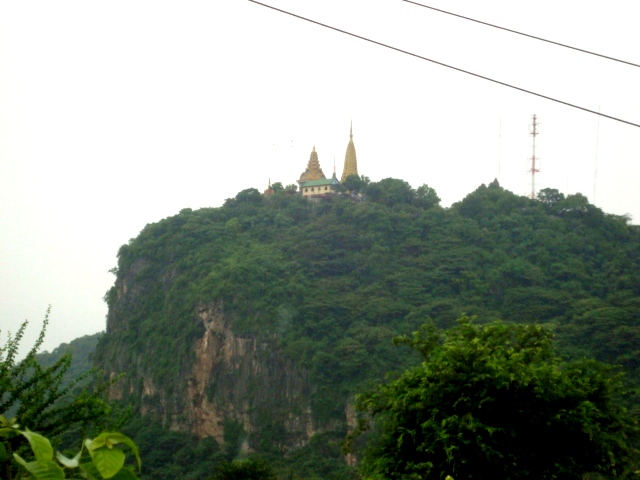
Our tuk tuk passes a tree covered hill with a Buddhist pagoda and stupa visible at the top. This is Phnom Sameau. I'd like to go up for a look, but Sok stops me. What's up there is a very sad memorial. “This killing field too,” Sok says somberly. “They have one cave for adult, have one cave for the children. (Khmer Rouge) kill baby with rock. The other cave for the parents. I don’t like see that."

What Sok is trying to tell Me, is that he doesn’t want to go to that horrific place again. I don't blame him. I’ve already seen too many cracked skulls and human bones at other killing fields during my stay in Cambodia, so I agree to travel on. We continue in our tuk tuk, heading down the bumpy dirt road. Next stop: the scenic, and tragic site of Kamping Poi.  

Tuesday, April 8, 2014

AUSSIE AND THE BOMB

Rice paddies and karst mountains in the remote, beautiful town of Viengxay
Viengxay in Laos, was once just a series of scattered villages, until the war put this place on the target map for US bombers. After it became the underground headquarters for the communist Pathet Lao rebels, it grew to shelter 20,000 soldiers and citizens. Now with the wartime caves emptied, Viengxay is among the larger towns of the remote northeast. 

Today the town looks like any rural Laotian community. Walking dirt streets, I pass traditional wooden Lao houses, with handmade bamboo fences. Local men play petang, a game brought here by French colonials. On the outskirts, farmers tend their rice paddies by hand, as they've done for generations. 

Meanwhile the misty and mysterious karst mountains stand sentinel around Viengxay, ancient guardians of history. I pause to watch them, as passing clouds move between the peaks. Before my eyes, the mists completely obscure entire mountains that were visible only minutes before. 


Meg, only white foreigner living here
Continuing my stroll, I find the local tourist office. Walking in, I meet a worker that I was never expecting to see in this remote place. 

A white woman!

I say hello, and chat with Meg, an Aussie. She’s short with white hair, and appears to be nearing retirement age. She tells me that she used to teach at a university in Australia, and now her kids are all grown. She decided to keep working because she enjoys it, and she heard of a position here in the tourist office. 

“Philosophically, I’m a peacenik,” she explains. I wonder if she protested against Australia’s involvement in the war in Southeast Asia, all those years ago. 

I ask Meg why she came to Viengxay, and she answers, “I liked the challenge.” There’s no mobile phone signal here, and no internet either. When she wants to check her email, Meg has to take a bus to Sam Neua, over an hour away. And there isn’t always a bus to come back either. 

I can tell she's worked in Viengxay for a while, since she walks around the office barefoot! One of her jobs here, was editing text on the historical signs that I’d seen in the caves. For once, most of the tourist signs here were written with correct English grammar, so I can thank Meg for that. 

Meg even worked in Viengxay before, and returned to work again. The warmth of the Laotian people brought her back. “I love the Lao people,” she says. “The Lao people are so optimistic. So much destroyed, and they are still optimistic.”


Men play petang by old cluster bomb casing
As it turns out, Meg was unexpectedly a firsthand witness to some recent destruction. One morning she was walking to work here in the office, just like she did every day. On the way, she heard official announcements blaring from the community loudspeakers. She can’t speak Lao, so she didn’t understand the announcement’s meaning. 

She soon found out. She was arriving in front of the tourism office when it happened. 

B-O-O-O-M!!!!! 

A massive explosion shattered the calm of the quiet morning. This deafening sound was unlike anything Meg had experienced in her life. When the bomb went off around 100 meters away, she was more than just surprised. 

“I was knocked to the ground!“ she told me.  

An explosive ordinance disposal team had just detonated a 500 pound bomb that had been recently found, left over from the war. Rather than trying to remove the dangerous old weapon, they had decided to detonate it where it had been discovered: within town limits. The community loudspeaker announcements that she hadn’t understood, were warning town residents to take shelter for the coming blast. 

“I felt violent nausea,” she said recalling those shocking moments, “and horror.”

I ponder her thoughts on the explosion. This was only from a single 500 pound bomb, and so many of these were dropped on Viengxay nearly every day during the war years. Those caves where they took shelter weren’t comfortable, but they were preferable to living out here in the open, where death rained down from above. 


Caves of Viengxay, where residents and soldiers sheltered during air raids
I bid Meg good bye, and continue on through town. 

Her job certainly is a challenge. Given Viengxay's remote location, trying to attract tourists here is an uphill battle. As I’ve walked around town, I’ve only seen two other visitors all day long. 

Although few journey this far, there are those in high places that still remember Viengxay’s importance. Recently, an impressive caravan of 120 cars rolled into town all the way from Vientiane. It was a government convoy arriving for a commemorative event for this former communist wartime headquarters. It was a grand affair, and the current Minister of Foreign Affairs gave a speech. 

Like many of the others attending the official event, back during the war the Minister had been born here in the caves.

Wednesday, April 2, 2014

ELEPHANT CAVE AND UNDERGROUND THEATER

Ledge for anti-aircraft guns
I continue exploring this communist caveland of Viengxay, and now I'm climbing many, many steps up the stone mountain. The steep climb is enough to make my long legs sore. 

Finally, we reach a large ledge that has been cut right into the limestone of the mountainside. It’s a steep drop below me, with a commanding view beyond. In the distance are more mountains, with feathery clouds dotting their peaks. Beautiful rolling farmers fields are swathed in many shades of green. 

My guide Kale tells me his family is from Viengxay; his parents were farmers here during those fearful times of war. He says that when they were out working the fields then, and enemy aircraft came, they ran into the jungle or into the caves to hide. When day time air attacks became frequent, they could hardly get any work done at all. So they began working fields at night. 

The commanding view from this ledge is no accident, because this vantage point was once the site of a Pathet Lao anti-aircraft emplacement. The old guns are gone, but a sign here describes what days were like back then. 

“Defending Viengxay

Anti-aircraft guns were fixed inside this cave and on the plain below. The Anti-aircraft gunnery commander was situated high in this cave, where there was a good view across the plain to the west. From here field telephones were used to command the gun emplacements on the plain and to direct fire at the incoming enemy aircraft. Warning sirens on top of the peaks were set off when incoming planes were spotted. 
Anti-aircraft gunner's view of plains and mountains surrounding Viengxay
Anti-aircraft gunners sat here for hours on end surveying the skies to the west. They were waiting for American bombers to arrive from their bases in northern Thailand, mainly from a specially constructed base in Udon Thani, or Royal Lao Government aircraft from Vientiane. When the bombers were seen, the noise from the guns firing from inside the confined space of the cave must have been deafening. For the gunners on the open plains below, the risks were even higher than for their comrades in the caves, as they were directly exposed to attacking aircraft. You can see bomb craters just below this cliff, at the base of the stairs to the Artillery Cave.”

I peer down at the ground to look for the craters, but they're difficult to see with the thick brush below. It may not be entirely safe down there either. Even though there have been three decades for erosion to fill in many of the old craters, there are still many unexploded bombs in the ground all around Viengxay. 

Farmers still find these old bombs when they're out plowing fields in the region. Being a farmer can be a hazardous profession in Laos. 


'Elephant Cave', the largest cave in the underground communist city

Continuing on, I finally reach the biggest cave in all of Viengxay, and it’s an impressive sight. I’m gawking at the cave of Xanglot, which translates as ‘Elephant Pass Cave’. The jagged and uneven limestone ceiling curves from 20 feet high at the sides, up to more than 30 feet near the middle. The cave is well named; a full grown Asian elephant could walk in through one end of this cave, and straight out the other. 

In the underground world that made up wartime Viengxay, this was an important political center. There were official functions in this huge cave; communist party rallys and propaganda meetings.  For the Pathet Lao, this was kind of like Moscow’s Red Square, only in a bomb shelter. It was also used as a lecture hall for military training. 

Thanks to it’s larger entrances, I have plenty of light to see. At the far end is a curious sight, a theatrical stage. That reveals this place's other name: 'Theater Cave'. 
Photo display of old wartime performances and rallies

The cave stage is complete with an orchestra pit, and a room in the wings for costume changes. The stage floor isn’t made of wood though, it’s smoothened bedrock. I imagine there wasn’t much tap dancing here. 

Out in front, the audience section had room for 2,000 comrades, where they sat out on the bare rock floor to enjoy the show. 

In the sheltered, underground life that everyone in wartime Viengxay endured, this was one of the few places where the soldiers and locals could enjoy themselves and forget about the bombings for a while. 

There were cultural shows, circus acts, and singing with live music for the party faithful. There were even special appearances by female performers doing traditional dances, brought all the way in from Vietnam. These were the communist versions of USO shows. It wasn’t Bob Hope, but it did a lot to lift their spirits and boost morale. 

Visitor walks across the old empty stage


The Theater Cave still gets some use nowadays; the local community uses it as a venue for the Laotian New Year’s celebration. But for the most part, the old stage is quiet and bare; even the old curtain has been removed. 

The days when Pathet Lao troops here, enjoyed the communist version of vaudeville underneath a mountain, are now only distant memories. 

Tuesday, March 25, 2014

PRINCE'S CAVE HIDEOUT

This pool for the Red Prince lacks water
I’m standing outside a cave in Viengxay, the communist's underground city,  and I’m looking at a strange sight. It’s a small swimming pool, and there isn’t even any water in it. It's an odd place for the only swimming pool around; outside an uninhabited cavern. 

An odd fact about this pool, is that the construction team that built it years ago, didn’t do much digging. That’s because the original hole here was from a bomb crater, from an American 500 pound bomb! If that isn’t strange enough, the pool’s edges form an unusual shape. 

My guide Kale explains. “Souphanouvoung say they make the pool in the shape of a heart, because Lao people have strong heart.”

This dry pool fronts the entrance to former Prince Souphanouvoung's cave. The infamous 'Red Prince' had turned from his life of royalty, and joined the communists. The prince had gone from living in Luang Prabang's royal court, to living in a damp cave here in Viengxay. 

To be precise, this was the Red Prince’s second cave. Prior to that he had lived in another cave 10 km away, and he relocated here in 1967. By moving to Viengxay, the future 'President of Laos' was able to stay more connected with the politburo and the rebellion. 

Walking past his strange pool, I head to his cave’s entrance, where several large, dark boulders are piled about. 


Aerial bomb attacks knocked these boulders from the cliff sides overhead
“These from the bombs,” Kale tells me. “The rock fall. See there?” I look where he’s pointing, at the high rock walls overhead. Some notches were blown into the sides of the mountain from the devastating explosions of aerial attacks, and the boulders fell below, piling up around the cave entrance. 

The wreckage of these rocks truly showed the limits of air power. When the attacks came, the prince and the communists were sheltered deep inside these underground caves, beneath towering limestone mountains. Even if a perfectly targeted bomb managed to cave in one entrance, there were always other exits they could use to get out. 

Forget what you see in the movies. These mountains could have been bombed for decades, and their deep, solid rock interiors would have remained intact. 

Also outside the cave’s entrance, is a grapefruit tree. “This tree present from General Giap,” Kale tells me. Apparently the hero of Dien Bien Phu and general of the North Vietnamese Army had traveled all the way here to Viengxay during the war, and met with Central Committee members. Having fought both the French and the Americans, Giap knew a few things about tunnel warfare. 


Entrance to the Red Prince's cave
An airtight interior door in case of chemical attack

Walking through another wooden doorway, I enter the underground home of the ex-prince. His caves are much like those where Kaysone slept nearby. Wooden walls were installed inside the cavern, to create basic bedrooms for him and his children. There is less to look at though, since the interiors have been stripped, (or looted,) and there’s no furniture left. There’s an office area, and a 'squatty potty' toilet. There's also another airtight emergency room, with an air pump in case of chemical attack.
Stupa for prince's son, killed in 1967

An informational sign tells about the prince's life. Here's an excerpt: 

As a student in Hanoi, Prince Souphannouvong developed a great interest in literature, design and foreign languages that continued throughout his life. He continued his education in France, graduated in 1937 as a civil engineer and returned to Nha Trang in Vietnam to work as a road and railway engineer. In Nha Trang, Souphannouvang met his Vietnamese wife, who was actively involved in politics – she may have introduced him to Viet Minh campaigners. 

The Souphannouvang family had 10 children, and some of them lived in these caves during the war years. Children in many of the families based in Viengxay, including those of the leaders, were sent out of the area for safety. They spent many years growing up far away from their parents.”

I imagine that his children were probably holed up in China or Russia, or in untargeted areas of North Vietnam. Just like Kaysone, the Prince spent some of his time in North Vietnam as well, where life was more comfortable than this caveland.

Regarding his family, the sign neglects to mention that one of the prince’s sons was killed in this region in 1967. Assassinated at the age of 28, a photo of the young man wearing a suit and tie is outside the cave, next to a red memorial stupa erected for him. It seems that even the children of the Red Prince were not immune from the war's violence. 


Road to Prince's hideout. With the war over, Viengxay is now a scenic place to visit.

After the war's end, the old prince died in 1995. 

A few years later in 2000, another of his sons, Khamsai Souphannouvang, fled Laos. At the time, Khamsai had been the Minister of State Enterprises. Some Laotians believe that once his powerful father was gone, the son had no one left to protect him and his corrupt dealings. Although he left behind a house and other property, many Laotians say the son of the Red Prince fled the country with millions of dollars in state funds. 

He was eventually granted asylum in New Zealand. 


Tuesday, March 18, 2014

UNDERGROUND CITY OF THE COMMUNISTS

This ought to be a jail cell. There are iron bars on the doors, and just above eye level there are more iron bars running along the top of the white wooden walls. Furniture is sparse; there's only a pair of simple beds with a coat rack. Yet this isn’t a jail cell, it’s a bedroom. And during the war, this happened to have been the bedroom of the most powerful communist in all of Laos. 
Secure bedrooms for the leader's family
Central Committee Chairman Kaysone's bedroom

Kaysone Phomvihane slept here, and this iron-barred bedroom is inside what was once a secret underground complex of caves, deep under the towering stone mountains of Viengxay. These caves were the Pathet Lao’s main headquarters during the long war in Laos; the most closely guarded place in the country. Kaysone was not a prisoner here, but at times he certainly lived like one. He spent many days and nights in this cave, hiding from the aerial bombing that rained down from the US and Royal Laotian air forces. 

It was way back in the 1950’s, that the Pathet Lao first gathered their forces in this region. Since it was so remote, and so close to Vietnam, it was out of reach of the Royal Laotian Government. And it stayed quiet here until 1964, when US led aerial bombing began. When the massive American bombing campaign commenced that year over northern Laos, it was dubbed, ‘Operation Barrel Roll’. At the time nobody could have imagined that Laos would be bombed for eight more long and devastating years, making Laos the most heavily bombed country on earth! 


Viengxay - once littered with bomb craters, it's now a beautiful town
With American aircraft ruling the skies, the Pathet Lao leadership quickly moved into these caves that same year. The continued bombing forced most of Viengxay’s residents to live underground, like troglodytes. So Viengxay became a city of caves. In these tunnels deep within the mountains, there were sleeping quarters, offices, workshops, a hospital, even an underground market. One thing not kept below ground, were the anti-aircraft guns used to shoot at attacking aircraft. An informational sign outside explains those difficult and dangerous years. 

“On Watch Night and Day - On 17 May 1964, the first US plane, a T28, attacked the Viengxay area. During the years of bombardment until 1973, this area was hardly ever quiet in the daytime. Warning sirens were set off at the sight of approaching planes, and explosions would echo around the hills and valleys. There was a complete blackout at night and during raids all cooking had to be done inside the caves. The area was defended by anti-aircraft guns placed on top of many of the mountains that you can see from here. Because of the danger of bomb damage and rocks falling from the mountains, it was said to be safer to be on top of the mountains if you could not shelter in caves. A gun emplacement at what is now the post office was hit by a bomb, causing several deaths.”
Door to chemical attack shelter

The sign fails to mention that the T28’s were not flown by Americans. Although donated by the US, these slower propeller planes were flown by Laotian pilots of the Royal Government. 

Steps away from Kaysone’s bedroom, I approach another secret hideout. The sign overhead reads, ‘THE EMERGENCY ROOM’, and the door and its frame are made of thick steel. Four large corner handles enabled Kaysone to lock the door airtight from the inside. I enter, and suddenly, I feel very much like I'm back in the days of the cold war. A lone bulb above illuminates this inner room, carved completely out of bedrock. This was Kaysone’s last bunker refuge. Besides another bed and a pair of wooden chairs, a blue pump in the corner reveals the real reason for this room. This hand operated pump, connected to the cave wall wasn’t for water. It was to pump filtered air, in case of chemical attack.

With the long war raging in Southeast Asia, Kaysone was worried that the US Air Force would drop chemical weapons on Viengxay. Although aerial bombings went on for years, the caves were never attacked with chemical weapons. 

I ask my local guide Kale how long Kaysone lived in this cave hideout. 

“Nine years,” he answers.
An air pump is inside this shelter in case of chemical weapon attack


That’s the stock party answer, but it’s an exaggeration. This may have been Kaysone’s 'official' wartime home, but the old party boss also spent much of his time across the border with his patrons in North Vietnam. As the crow flies, it’s only 10 miles to the Vietnamese border, source of the aid that kept his rebellion going. Although bombings were a constant threat, Viengxay was never seriously threatened on the ground. If Kaysone and his cronies ever had been threatened by advancing government troops, (and they weren’t) they would have easily fled across the border to North Vietnam in minutes. 

As I make my way through the damp caves, I’m impressed at the height and width of many of the spacious rooms. This is a much more comfortable underground experience, than when I had to crawl through the pitch black tunnels of Cu Chi in Vietnam. In most places here I can walk fully erect, as I explore the darkened passageways of these historical caves. 

Connecting cave in the labyrinth
Beneath a nearby overhanging rock ledge, is an elevated platform. Two cement blocks the size of feet give away how this spot was used. This was an Asian style squatty potty; Communist Party Chairman Kaysone’s toilet! Since this subterranean world lacked plumbing, there were no sitdown toilets down here. With caves carved out of solid rock, it was impossible to create a pit latrine without stinking up the limestone labyrinth. It seems that Kaysone, and anyone else who sheltered in here during air raids, had to relieve themselves into buckets. These waste filled containers were later carried away by hand, and emptied outside the caves. That had to be one of the least glorious of jobs; disposing of the Great Leader’s excrement. 

My guide Kale leads me down another damp, dimly lit tunnel. Passing through a doorway, it opens up into a large room. Like most communist meeting rooms, it’s austere and basic, although a small opening at the end gives this room better ventilation and lighting. Simple cloth covered tables are surrounded by seven wooden chairs. Old maps hang from the walls. 

A blue sign gives the rooms significance: “MEETING ROOM OF THE CENTRAL COMMITTEE POLITBUREAU OF THE ” Strangely, the sign ends there. Of the what? The Communist Party? It appears that whoever painted the sign, ran out of space to complete the leadership’s full title. 

This well protected cavern, was a nerve center for the Pathet Lao. Here politburo members plotted their revolution, discussing victories and defeats during their long war of rebellion. 

For an added historical touch, standing on the table in front of each seat, is a framed photo of each of the politburo’s members. Unlike certain members of the Vietnamese Politburo that gained international fame and notoriety, most of these men remained practically anonymous to the western world. I wonder if any of them are still alive today. 


The 'politburo' for the Laotian communist party held their meetings here
In an adjoining room, six simple bedframes are lined up in a row. This was the ‘resting room’, for the communist leaders. This was also needed due to the air raids. When the politburo would meet, apparently there were occasional attacks that prevented them from leaving the cavern when the meetings adjourned. 

I’m disappointed that there aren’t many artifacts to see here. Most of the furnishings, weapons, and everything else that the Pathet Lao stored in these caves are long gone. Since the war ended, this hidden sanctuary has remained quiet. 

I leave Kaysone’s lair, and outside the entrance there are plenty of trees and greenery. There is no grand entrance to the cave, no massive steel door either. Sandbags used to protect the entrances are gone too. The entrance now is a natural stone arch, partly blocked by boulders and brush. Except for a nearby cement stairway, you would never guess that this was once the headquarters of communism in Laos. 


A hidden cave's entrance (at left)
After the war in Laos, as the Cold War continued, these caves remained officially secret. They were closed and guarded for years. The Pathet Lao wanted to keep their caveland refuge safe, just in case they were ever needed again. But they weren't needed. In recent years when Laos opened it’s borders to tourists, soon after they opened these caves as well. As I explore the caverns today, there are no guards anywhere. Not one. Even the entrance gate to Kaysone’s cave was left unmanned. That may be due to lack of tourists, since there are no other visitors here either. It is only my guide and I, exploring this obsolete, subterranean world.  

Close to Kaysone’s cave entrance, is what looks like a strange Swiss chalet. Built after the bombing stopped, Kaysone moved in here after the peace was signed in 1973. Along with other nearby government buildings, it now sits empty. The Pathet Lao built his home near the cave entrances for safety. They wanted to be able to run back into the caves, if the bombings had started all over again. They never did. 


F-111s over Southeast Asia. An F-111 was the last US aircraft to bomb Laos.(Source:USAF)
The last USAF bombing mission over Laos was from an F-111, which dropped its bombs on February 22, 1973. The massive American bombing campaign over Laos was finally over. The US military had learned that victory through air power alone, didn’t work. Much of the Laotian countryside had been destroyed, and many were killed. Yet the communists, like these caves, were still here. 

In the end, the winning side in Laos was decided by the extent of continuing military support. The Royal Laotian government was able to survive, as long as they received massive amounts of military aid, and air support from the US. But without American help, they couldn’t survive for long against the North Vietnamese Army. The support of the nearby North Vietnamese, had outlasted the support of the distant Americans. 

Wednesday, January 15, 2014

DESTRUCTION ON THE ANCIENT 'PLAIN OF JARS'

Plain of Jars Site 1. The purpose of these ancient stone monuments is a mystery.
A light rain falls as I make my way along a soggy path towards a grassy hill. Muddy water from the trail is splashing all over, leaving my shoes cargo pants thoroughly muddied. But I could care less about the stains; I’m excited about what I see ahead of me. 

Reaching the top of the hill, I’m surrounded by signs of an ancient civilization! These remnants are enormous jars, made of solid stone. The jars are magnificent; immense in size. Each ways several tons, and has been carved out of a single giant block of sedimentary rock. A couple are so massive, that they stand taller than me. These giant jars are what gave the ‘Plain of Jars’ its name here in northern Laos. 

These mysterious stone relics are thousands of years old, and running my fingers across them, I can’t help but wonder. How on earth did such primitive people create these? Why were they brought to the top of this hill? What were they used for? The answers to all these questions have been lost to history. 


Large stone jar destroyed during 1964 - 1973 war
The jars are dark in color, spotted with whitish fungi. I peer inside the jars for a look. Whatever their ancient contents were, they are long gone. Now most of them have algae and small plants growing inside, with rain water pooling in the bottom. Some jars have immense stone covers lying next to them, though few of these remain. Curiously, they are shaped much like the covers of modern aluminum garbage cans. 

The people who lived here on the Plain of Jars during ancient times were not ethnic Lao, and they weren’t Hmong either. Nobody knows who they were, where they came from, or where they went. These weighty relics are some of the only remnants left from their lost and ancient culture. 

The location of this anthropological riddle, is known as Site 1, and like other jar sites scattered across the plateau nobody knows for sure what its use was. Most experts agree that the jars had some sort of burial function, since human remains and artifacts have been found beneath some sites. But not everyone agrees with that theory; one local told me that the giant jars were really used to make whiskey! 


Huge crater from bomb that destroyed or damaged many ancient stone jars
For years the jars’ origin was also a mystery, until a quarry with unfinished jars was found recently west of the region. But the quarry’s discovery created another mystery. If the wheel wasn’t in use yet during those ancient times, how is it that they were able to bring these heavy stone jars here from so many miles away?

The rain lightens, and I look out at the open country surrounding the hilltop. Like most of the Plain of Jars, the countryside is rolling hills covered with green grass, dotted with a few trees. More stone jars are situated across a ridge and nearby field. Site 1 has more than 300 of these mysterious jars. 

Walking through wet grass to another side of the hill, I find some jars that were here are gone. In their place, is an immense bomb crater, and the rain runoff has formed a rising puddle in the bottom. The crater is deep enough that if I stood in the bottom, I wouldn’t be able to see above the sides. 

Standing on the crater’s edge, I spot a lone stone jar further down the hill, further away from the rest. Lying on its side, it was probably thrown down there from the blast force that created this crater. Although these jars survived the weather and ravages of nature for millenia, they couldn’t withstand the ravages of war. 

As I walk about the hill I count 10 of the giant jars as undamaged, but most of the rest have been cracked or destroyed. Some have been chopped in two, or blown into many pieces from the heavy aerial attacks. One jar still standing upright, has a telltale hole blown into its side. 


Lower left warning marker, left by deminers. Down path on right are unexploded bombs!
This hill once had religious significance for the ancients, but during the 1964 - 1973 war this high ground drew foot soldiers, who found it a defensible position. Digging trenches into the hillside, fighters shared this hilltop with the 2,000 year old stone jars. When the battle came, it was fierce and powerful. 

As the jars were blown apart, defenders died here alongside them. In the ebb and flow of the 'Secret War', nobody knows how many men died up here.

The Plain of Jars was strategic for holding northern Laos, so the communists coveted it. As it was also a home for thousands of ethnic Hmong, they fought to keep it from the invading North Vietnamese Army (NVA). So control of the Plain of Jars shifted back and forth between the warring sides several times during the war, depending on the season. During the dry season, the NVA and Pathet Lao mounted large scale attacks, gaining ground across the plateau. During the wet season roads turned to mud, much like today. Moving heavy weapons, troops and supplies became difficult for the communists. That’s when the Hmong gained the upper hand, since they were resupplied by air from CIA planes and helicopters. During rainy season, they forced the communists back, and the territory was theirs again for another season. 

Besides bomb damage to the old jars, other evidence of heavy fighting remains. Along another corner of the hillside a trench line is still visible in the deep grass. Much like in the old craters, erosion is taking over, and the earthen fortifications are gradually disappearing. The evidence of war is fading from this archaic site, while the sturdy stone jars continue to stand guard. 


At base of hill, cave was used by communist side to hide weapons from air raids
I’m glad I was able to make it to this site now, because years back, it was too dangerous to even walk up here. As a former battlefield, the hill was literally littered with tons of unexploded bombs. Hoping to lure tourists to the Plain of Jars, the government brought in the non-profit organization known as MAG: the Mines Advisory Group. Specializing in finding and removing landmines and unexploded bombs, MAG worked Site 1 for three months. By the time they left, they had found and cleared 127 unexploded bombs, along with 21,814 pieces of shrapnel! 

Further down the hill from the jars, I spot the dark entrance to a cave. Walking down a path for a look, I notice red and white markers on both sides of the trail. These markers are from the bomb disposal teams. The white sides of the rocks mark safe areas, while the red sides point to the danger zones. Although a great deal of UXO was removed from Site 1, there are still many areas that haven’t been cleared yet. Unexploded bombs remain hidden underneath the thick wet grass. 

Reaching the cave entrance, a young Laotian boy is playing with rocks, while his father looks on. Next to the opening is a small Buddhist ceremonial spirit house, with stubs of incense left in remembrance. 


Buddhist spirit house with incense at cave entrance
Peering into the darkness, I find it’s not a very large cavern, thought it did have an important function during the war years. Used by the Pathet Lao, the cavern made a great air raid shelter, and was a convenient place to safely store ammunition. Apparently American pilots knew this, since a few bomb craters are outside the entrance,  left by pilots that tried to destroy the cave and its contents. 

Since this cave is so close to the stone jars, the ancients probably used it too. My guide tells me he believes they used to burn fires inside the cave to cremate their dead, burying the bones up by the jars afterwards.

Circling past a ridgeline, I pass more of the mysterious jars. Before departing, I look back at the first hill of jars that I climbed earlier. New visitors have arrived, holding umbrellas due to the rain. From a distance, the jars resemble headstones. I’ve seen this scene before. With people under umbrellas, atop a hill with stone monuments around them, it looks just like a cemetery funeral.

Maybe there is something to that old theory after all. 

Thursday, September 19, 2013

RIVER OF DEBAUCHERY

Downtown Vang Vieng, haven for hard partying backpackers
The sights are familiar to anyone who has attended a western university. Sunburned, college age kids, wearing shorts and bikinis. A long strip of riverside bars, with volleyball nets and cheap drinks. Dance music pounds loudly from amplifiers. Alcohol is imbibed in large quantities. Some young adults here are even taking drugs. This isn’t a wild spring break beach party, and this isn’t ‘The Jersey Shore’ either. 

It’s Laos.

Well, a small part of Laos. Vang Vieng to be exact. In a country where the culture is so conservative, and the government’s hold on power is tight, this is an island of western decadence in East Asia. Since the government is publicly against drugs and western music, I’m astounded this kind of behavior is allowed. Vang Vieng is the exception in Laos; the one place where decadent foreign influences run wild. 

Away from the wild partying river, I take a walk down the streets of Vang Vieng. This town isn’t a tourist trap in the classic sense; there are no families here. Although it has morphed into a playground for adults, it’s nothing like Las Vegas. There are neither casinos, nor fancy hotels. This town is a haven for only one kind of tourist: young western backpackers, looking to party for cheap. Some of the bargain hotels or guest houses here offer a bed for as little as four dollars a night. Just don’t expect any air conditioning. 

With business catering to the cheap backpacker crowd, businesses on the main strip are predictable. Both sides of the main street, are packed with cheap guest houses, open air restaurants, bars, internet cafes, food carts, tour companies and tee shirt shops. 

How things have changed for tourists in Laos. Back in the country’s post-war years, westerners were expelled, and the country became isolated. Foreign tourism here was virtually non-existent. 

Vang Vieng restaurant/bar, where you can watch episodes of 'Friends' for hours on end...
But then the cold war thawed in the 1990’s, and neighboring Vietnam and Cambodia began cashing in on tourism. Soon after, the Laotian government decided to hop onto the tourist bandwagon. Visa restrictions were dropped, and borders were flung open. Now this communist country welcomes foreign visitors, anxious to take their tourist dollars. Better late than never. 

The backpackers here are mostly young adults of university age, from western Europe and Australia. Every afternoon they can be seen lounging inside the main strip’s open air restaurants, watching DVDs of American sitcoms for hours. These run all day long, as many backpackers are recovering from a hang over. Perhaps they come here because their guest houses are too cheap to install TVs in their bedrooms. 

Some young women wear skimpy beach attire, and some young men go shirtless. This is nothing to Americans, but conservative Laotians find this scandalous. Showing so much skin is taboo everywhere else in Laos, but here the massive backpacker presence has overwhelmed local culture. 

These frugal foreign travelers were originally drawn to Vang Vieng for the lovely scenery. There are beautiful mountains, caves to explore, scenic rural villages and Buddhist temples. As the first visitors came, tour companies sprang up, selling trips for hiking, canoeing, kayaking and mountain climbing. But those are really just side shows now. Most backpackers come here for two reasons: the partying, and the tubing. These two intertwined events have made Vang Vieng infamous, and even dangerous. Backpackers anywhere in Southeast Asia, are often seen wearing tank tops bearing the same message: “Tubing on the Vang Vieng”, the number one activity here. 
Like this bridge, more than one drunk backpacker has not survived the Nam Song River

I take an afternoon to check this out for myself, and after paying six dollars, I’m given a large truck inner-tube. Then I pile into the back of a crowded tuk-tuk, and we’re driven a few miles north of town. Arriving upriver, we’re dropped off at the first of many cheap riverside bars. Here I encounter a scene I haven’t seen since college. Throngs of rowdy western college kids are drinking cheap beer at several flimsy bamboo bars on the river bank. Many are dancing and carousing to loud popular music. Some have been here for hours already, and are already heavily drunk. One bar is giving away snake wine and scorpion wine for free; I grab a Beer Lao instead. 

Dotted among the riverside pubs are rope swings, water slides and zip lines for thrill seekers. Several circus style trapezes drop revelers from on high, where they shriek as they fall before splashing into the Nam Song river. There is also volleyball, and a muddy tug of war for those who prefer exercise on land. Feeling energetic, I head into a game of 4 on 4 mud volleyball. I get thoroughly filthy in a losing effort, but enjoy the fun. After the game ends, the players scatter to explore other diversions. I’m anxious to get the mud off my face and hair, so I pick up my inner tube and head into the river. 

My next stop is one of the larger drinking holes on this river of debauchery. It’s called the 'Slide Bar'. It has a fairly modern, elevated water slide lined with bath tiles! I pull in, stow my inner tube, and grab some lunch. Then the rain starts. As this is rainy season, the river's running fast. Coming down lightly at first, it’s soon a monsoon. The fun continues, since all the revelers are already wet from the river. As I eat, I view the surrounding action. 
An Argentine died in one of these area caves

Above me, a young man flies off the end of the high water slide, dropping ten feet into the river. He lands right next to an unsuspecting lady tuber, nearly landing on top of her! Both were lucky, it was a near miss. I soon realize, that the emphasis here is on fun, with little regard for safety. As I watch the water slides, trapeze and rope swings at the bars, I see no safety systems in place, no lifeguards. There's little to keep young drunks from falling off high muddy ladders onto the shore, or to keep rope swingers from falling onto other tubers floating by. Nobody wears lifejackets. Swimming drunk in a murky, fast moving, unfamiliar river could easily turn deadly. I hear later that cuts, concussions, and broken bones are a common occurrence when tubing in Vang Vieng. 

The rain lets up, and grabbing my inner tube I continue down river. The shores grow quieter, and bamboo bars give way to tree lined shores. Finally, I stop at a pub known as ‘Last Bar’. I paddle my tube into an eddy, while a couple Canadians float up behind. Standing in shallow water, one spots a dark lizard attached to an overhanging tree. He captures it by hand, and we climb a long flight of stairs to the dumpy little shack bar high over the river bank. As we grab a bench seat, the Canuck plops the reptile on the table. At a foot and a half long, the lizard looked ill or injured. It was breathing, but barely moving. 

An old Lao woman with blackened teeth approaches the table. Her dark teeth are caused by betel nuts, her drug of choice. (The locally grown nut is chewed as a mild stimulant.) The woman points towards the lizard, and motions with her hands that it makes for good eating. She then opens a little bag. Apparently, she was ready to barbecue the reptile right here and now. The Canadians pondered this offer for a while, but the more they discussed the lizard, the more they got attached to it. They declined her offer to cook their newfound pet. 
7 foreign tourists have died in Vang Vieng, some drowned under the influence of drugs or alcohol

While I order my second and final beer, the Canadians order marijuana. They are soon lighting up, disappointed when I turn down their offer to smoke with them. This pair were hoping to hang out with some heavier partiers. Soon after, they found some. Down by the river where we’d arrived, three more westerners pulled up in their inner tubes. These young men had partied too hard already, and never made it up the steps. 

“Hey! We need help!” One of them shouted, “we have to get to a hospital!” The vocal backpacker’s two friends were very stoned; one was so far gone, he was completely unconscious. Soon one of the Laotian bar staff descended to the river bank, loading the three druggies into his long tail boat. Then they were off downriver, just another backpacker overdose headed for the local band-aid station that they call a hospital. 

It’s quite a racket this bar has going. Not only do they make money by selling drugs to backpackers, but they also make additional money from backpackers by turning their boats into ambulances when they overdose. I noticed the boat driver wouldn’t leave for the hospital, until he saw the cash in hand from the backpacker to pay for the trip. 

I don’t know what particular drug his friend overdosed on, but he’s far from the first foreigner to need medical attention in Vang Vieng. In recent years at least seven foreigners have died in this permissive tourist town. Shortly before I arrived in Vang Vieng, an Argentine tourist died in a caving accident. He had been exploring a local cave alone, never a good idea. Other tourists here died from overdoses, drowning, or from driving drunk on rented motorbikes.

A couple weeks after I left Vang Vieng, there was another death. An Irishman who came to town with his newlywed wife drowned in the river while tubing. His poor widow was left to organize the search for his body on her own. It cost her $1,000 out of her own pocket to pay for the search. They finally found his corpse down river, three days later.