Sunday, April 10, 2016

SURVIVORS AND JUSTICE IN BATTAMBANG

Old French colonial buildings in Battambang
Sok has a shocking story of survival. He's lucky to be alive, like so many others that lived through the years of the Khmer Rouge genocide. 

But today, he's my guide and translator. Sok is 67 years old, and I tell him he looks much young for his age. He runs his fingers over his head, and tells me, “I paint my hair.”

He’s better dressed than your average Cambodian; wearing dark dress pants and a collared pink shirt. He looks like a teacher, except for the safari hat he wears for shade.

Years ago, Sok used to be a French teacher until Khmer Rouge guerrillas overran the country. He apologizes for his English; it’s not as good as his French. I tell him his English is better than many other translators I’ve had in Cambodia. Driving through the northwestern city of Battambang, I learn his story.

When the Khmer Rouge captured Battambang, his hometown, Sok wisely hid the fact that he was a French teacher. The Khmer Rouge hated colonial influences. I ask him what happened, the day the city fell to the Khmer Rouge. Sok says, “Khmer Rouge say all rich man, all teacher, go on bus. They say 'go to Phnom Penh to see (King) Sihanouk'. They go three, five kilometers on the road, and (they were all) killed.” Demonstrating, Sok makes a slash motion across his throat with his hand. During the course of the day, he uses this motion often, as he tells me how the Khmer Rouge executed many people.

Rice paddies here are among the richest in Cambodia
Escaping death that day, Sok and the city's population were forced to march into the countryside.

In 1975, I work rice fields. I tell (Khmer Rouge) I from poor family in the country,” he explains. “If I tell them my history, they cut.” Then Sok makes the throat slashing gesture again. Sok was forced into slave labor on a farming commune. He says Battambang Province is big on agriculture, and very fertile with the best land for growing rice in the country. He says they used to load rice onto boats on the Stung Sangker River, sending it south all the way to Phnom Penh.

It’s good soil here,” Sok says. He describes how they worked the fields all day, harvesting crops. The Khmer Rouge took it all. They took all food, and cooked it only for themselves. They gave the field workers nothing.

There was very little food. Maybe no food,” he says of those awful years. “(My) three brother died from starvation.” Sok's sister died too.

I ask Sok how he managed to survive, while others died around him. “I eat everything,” he answers. “I eat leaf, small frog, insect. I eat like dog.”

Finally, the day came when the communists fled. “I free from Khmer Rouge when Vietnam Army and Khmer Army push Khmer Rouge to the Thailand border,” Sok recalls. “I free April 25, 1979. I very happy. Very happy,” he continues. “I cannot compare my happiness.”

Sok left the commune, walking for days in search of food. He passed many weak, malnourished seniors by the road on the way. It was very difficult. I see many old people, sit under tree, no rice,” he recalls sadly of the dying elders he saw. Nearly starved himself, he could do nothing to help them.

Our tuk-tuk heads south on a Cambodian 'highway'
Eventually, he made his way back home. “I go to Battambang City,” he says. “Three months after, they need me to be a teacher.” He returned to his chosen profession. The Khmer Rouge had abolished currency, so there was no money for his salary. So he was paid with rice.

Sadly, his tough times didn't end after the Khmer Rouge years ended. In the 1980's his wife was killed by a drunk driver. He managed to raise his three children himself, and support their education. One son became a math teacher; he tragically died in a drowning accident. His other son became a banker. His daughter immigrated to Australia.

As I listen to Sok, our tuk-tuk (motorcycle-trike-taxi) continues through Battambang, Cambodia’s second largest city. Crossing the Old Iron Bridge, we head through the town center. Looking through a wrought iron fence, I spot large old yellow buildings. “Before in 1904, the governor stay there,” Sok says, pointing to a well preserved colonial mansion. It still houses government offices today. Sok is old enough to remember the colonial years; he’s a great source on local history. We pass two fabulous looking French mansions, and I ask who lived there during colonial times.

Rich French, or rich Khmers," Sok says. Back in colonial times, Khmer elite wanted to emulate the French. But not all of Battambang's old French buildings are preserved, as many were torn down in the name of progress. We pass a downtown construction site. “Years ago, that was prison,” he says. “Now they build market.”

Ieng Sary on trial for crimes against humanity
We head west out of Battambang, and the road turns rural. This road is safe enough, but many nearby villages have yet to be cleared of landmines and old munitions. Shortly before my visit, a local woman and her teenage son were killed outside Battambang when their oxcart rolled over an anti-tank mine. The scourge of landmines still claims innocent lives here. 

Sok describes the journey ahead. “Up there, road not like this,” he says. “Bad road.” True to his word, soon our tuk-tuk is off the blacktop, and on a It's a slow, dusty dirt highway. Motorbikes, tuk-tuks, and trucks loaded with cargo pass in both directions.

This road to Pailin,” Sok informs me, as the paved road ends and we continue on aj reddish dirt road full of potholes. When the Khmer Rouge fled from Battambang, they weren't completely defeated. Pailin became one of their remote hideouts by the Thai border. By the 1990's, cold war support for the Khmer Rouge disappeared, so they turned to the black market for money.

There many gemstone and ruby (mines). They cut down tree, they dig gemstone. Now, all gone,” Sok says. The Khmer Rouge sold lumber and gems from Pailin to Thailand, with the help of unscrupulous Thai generals. This black market economy kept the guerrillas equipped well enough to fight on for years.

Ieng Sary, Khieu Samphan, Nuon Chea had house in Pailin,” Sok says. These former Khmer Rouge politburo members, pushed on in their losing war from their border hideout.
A Buddhist memorial for those murdered at the caves
With the war dragging on, in 1996 Ieng Sary and 3000 of his fighters finally defected from the Khmer Rouge, making their own separate peace with the Cambodian government. It was a giant leap towards ending the war. That separate peace didn’t keep them from being arrested later though. All three of these communist radicals ended up in a Phnom Penh prison, on trial for genocide at the Khmer Rouge Tribunal.

Even though Ieng Sary went to prison and died during his trial, his family still has some power in Pailin. Sadly, his son Ieng Vuth is now deputy governor there. They still have influence in Battambang too. “Nuon Chea family have house in Battambang,” Sok says. “He from rich family.”

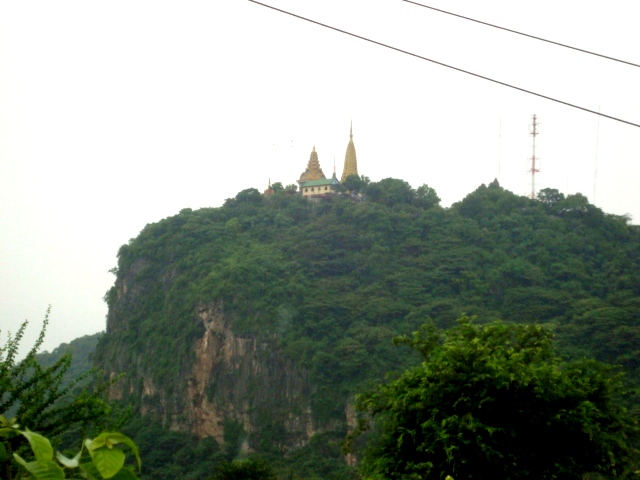
Our tuk tuk passes a tree covered hill with a Buddhist pagoda and stupa visible at the top. This is Phnom Sameau. I'd like to go up for a look, but Sok stops me. What's up there is a very sad memorial. “This killing field too,” Sok says somberly. “They have one cave for adult, have one cave for the children. (Khmer Rouge) kill baby with rock. The other cave for the parents. I don’t like see that."

What Sok is trying to tell Me, is that he doesn’t want to go to that horrific place again. I don't blame him. I’ve already seen too many cracked skulls and human bones at other killing fields during my stay in Cambodia, so I agree to travel on. We continue in our tuk tuk, heading down the bumpy dirt road. Next stop: the scenic, and tragic site of Kamping Poi.  

Thursday, March 24, 2016

SHAKEDOWN AT THE BORDER OF RICHES

This faux 'Tropicana' casino is on the Thai - Cambodian border
I'm in the far east of Thailand, right on the border with Cambodia. I've only left Cambodia an hour ago, on what is known as a 'visa run'. Since my Cambodia visa is running out, I came here only long enough to cross the border to get a new passport stamp. Now that  I have it, I'm free to return to Khmer land. I'm in Thai territory only long enough to get a lunch of tom yam soup.

Finishing lunch, I walk back towards the border post. Passing souvenir shops, I get my Thai exit stamp at immigration, and I'm back on Cambodian land in the northwestern border town of Poipet. And yet, I'm not officially back in Cambodia at all. I'm in a strange 'no man's land', and it's filled with casinos! 

I once saw another Cambodian town dominated by casinos called Bavet,  but the setup  here is different. In Poipet the Cambodians built casinos packed tightly together, pushed almost up to the Thai border post. As I walk out of Thai immigration, the Cambodian immigration post is way out further beyond the casinos, almost a quarter mile down the road. Ingeniously, this allows Thai gamblers to walk onto Cambodian soil, gamble their money away, and then walk back to Thailand without having to get a Cambodian visa or passport stamp! This whole stretch of casinos, is basically a legal no man's land. Since you have no arrival stamp while you gamble in Poipet, you are not officially here!
I'm leaving Thai territory

Long before there were casinos here, there were periods when this was a no man's land due to armed conflict. There has been more than one gun battle fought along this border between the armies of Thailand and the Khmer Rouge. Even before then, there had been a standoff in Poipet between King Sihanouk's army and Thailand, as land dividing the two neighbors was in dispute. 

Some lands remain contested, but at least here in Poipet, both sides are content (at least for now) to let the only invaders be gamblers and tourists. Poipet is so oriented towards Thai gamblers, that the most accepted currency in town is the Thai Baht!

I don't fell like emptying my wallet today, so I pass by all the casinos, and walk into Cambodian immigration to get my visa. 

I pay the required US $20 in cash, and hand over my visa to the border policemen. Once it's processed, they refuse to give it back. I soon realize this is a shakedown; the two corrupt policemen behind the counter are trying to overcharge me for the visa! They are asking for double the price, demanding the extra money in Thai Baht. 
A strange strip of casinos stretches between the Thai and Cambodian border posts

I persistently repeat, again and again, that I don’t have any Thai Baht. After a few minutes of this back and forth argument, and with a growing line of impatient travelers behind me, the two corrupt border agents finally give up. 

They grudgingly return my passport. I walk back into Cambodia, and break into a smile over my small victory. 

I didn’t tell them that my extra money is in US dollars!

Tuesday, February 23, 2016

WHERE OLD WEAPONS GO TO DIE

An old tank rusts among mango trees near Siem Reap
It's sad but true, that a 500 lb bomb is not an uncommon sight in Southeast Asia. During my travels here, I've seen them used as door stops, and as decorations. They've even been disarmed, hollowed out, and reformed to use as bells for Buddhist temples. The heavy bomb before me standing on it’s end, has a long pole sticking straight up out the nose where the detonator used to be. Atop the pole, is a Cambodian flag. This old American bomb, has become a flagpole base.

Your country have war?” one of the staff asks me as I look.

Yeah,” I answer. “We have war.” 

Although my country now fights a war in Afghanistan, (where I worked as an aid worker) it occurs to me that our war is not fought at home, like happened here. The Afghanistan war is fought in a faraway land, while most at home in America go about their normal lives. But here in Cambodia, war engulfed the entire nation. Every family suffered terrible losses, and Cambodia would never be the same. The tools used to destroy Cambodia and its people surround me here, in the Military Museum near Siem Reap.

Old Chinese and Soviet armor, stripped of parts
Unlike the usual stuffy indoor museums, this is outdoors. Here in between the grass and leafy green trees, are brownish, rusting steel hulks of old military armored vehicles. These are from the cold war era, built in China or the former Soviet Union. There are numerous tanks and armored personnel carriers. Many are stripped of their parts. Without its wheels, one armored carrier looks more like an odd metal boat, rather than a threatening land vehicle.

Some of these heavy beasts had long histories. One Soviet made T-54 tank here was built in 1954. It was later given to North Vietnam; used during the war against the US and South Vietnamese armies. After that war, it was used by the Vietnamese Army when they invaded Cambodia. Next, it was given to the new Cambodian Army. Finally, it was damaged beyond repair by a Khmer Rouge landmine in 1994. Soviet built vehicles had a reputation for mechanical breakdowns, and somehow, this one remained in use for 40 years. That may be some kind of record for a Soviet built tank.

Some tanks here were used by several different armies
I climb onto another old armored carrier parked under a tree. It’s been thoroughly stripped, with the turret and all the hatches removed. I stick my head within for a look, and find many mango laden tree branches reaching inside. The fruit hang down through open steel hatches. So this place isn’t just a military museum, it’s also a mango orchard. 

As far as high tech weapons go, there's little here. There's only an old MiG jet, and a Russian built Mi-8 helicopter outside in the parking lot. But the fact is, most of the fighting in Cambodia took place on the ground, not in the air. It was just too expensive to use jets and helicopters in this dirt poor country.  

Unlike war museums that I've seen in Laos and Vietnam, this museum has no propaganda. It's simply lots of weapons, with simple, hand written captions. A notable example, is the caption for the only unarmored vehicle on display: a wooden wagon. The caption reads:


Old disarmed weapons from Cambodia's wars
COW CART
Cow Cart used to transporte the
Ammunition Weapons by Khmer Rouge
Since 1970 ~ 1998”

Well, if your tanks or trucks ran out of gasoline, I suppose it’s better to have a cow cart than nothing.

Entering a shack, I'm surprised to find a wide range of assault rifles lying on a shelf in front of me. Gun fanatics would absolutely wet themselves here. There must be nearly 50 machine guns on hand. There are weapons made in Russia, China, USA, UK, and more. There's even an Israeli made Uzi. Some look relatively new, some look ancient, including World War II era guns. There is a Browning Automatic Rifle, and a Thompson submachine gun. Surprisingly, these aren’t in display cases, and there are no locks either. I pick up the Thompson, and feel it in my hands. This is the infamous 'Tommy' gun, preferred by American gangsters way back during prohibition. For a small machine gun, it’s surprisingly heavy.

Old Rocket Propelled Grenade Launchers (RPGs)
I pick up a Kalashnikov, with its signature curved ammunition clip. I remove the clip, and pop it back in. Unlike the others, this one isn’t so rusty, and the bolt still works. I pull back the bolt and release it. It's now cocked. I pull the trigger.

Click.

Dry fire. I’m surprised at how light the AK-47 is. The M-16 they have here is very light too. These deadly weapons are so much lighter and easier to handle than the older weapons. It's no wonder they were used by so many child soldiers in Southeast Asia before, and in Africa and the Middle East today. 

I have another sobering thought. With so much violence in Cambodia over the decades, there’s a good chance that many of these weapons here in front of me have killed people, including innocent civilians. 

Finally, they have rocket propelled grenade launchers, M-79 grenade launchers, and a heavier .30 caliber machine gun on a tripod. I’ve never seen such a wide variety of weapons, in such a small place. I notice there aren’t any pistols on display though; they would be too easy to steal. It would be more difficult to walk out the exit, with a Kalashnikov under your shirt. I notice two old red flags here too, from the hated Khmer Rouge. I wonder if they were captured in battle, or if they were turned in after the 1998 peace agreement.

Chinese terror weapon: 177 mm rockets
Walking outside, four long metal cylinders are sitting on small stands. They look like tank shells, but are even longer. These are Chinese made 107mm rockets. These can be launched without the use of any tube. As such, they're very inaccurate. Since these rarely hit any military target, they are principally a terror weapon. The Khmer Rouge used these to target civilian neighborhoods of Phnom Penh in 1975. They are still in use today. When I was in Afghanistan, the Taliban used them frequently, firing them at Kabul a few times a week. Just like here, they rarely hit anything military. It was the civilians who suffered casualties.

A couple of well manicured, grassy areas are more chilling. They are strewn with various types of anti-personnel mines, and unexploded mortar rounds. All these have been disarmed. This isn’t a realistic display of landmines though. Landmines are usually invisible to the naked eye, buried just beneath the surface. It’s only after stepping on them that their exact location is known, when an explosion is triggered. By then someone has lost a limb, or a life.

Nearby are disarmed landmines. Stack after stack, all brown with rust, these have been unburied from Cambodia's footpaths, roads and rice paddies. 

I find one positive thought, among all these weapons of destruction. None of these deadly weapons that I see here, will ever hurt anyone again.

Never, ever again.
Mangoes grow inside this defanged, disabled war weapon


Saturday, January 30, 2016

EX-CHILD SOLDIER SAVES CHILDREN

“The landmine is eternally prepared to take victims. It is the perfect soldier.” 
- Jody Williams, Nobel Peace Prize Winner, International Campaign to Ban Landmines

A massive number of landmines and explosive munitions are in this gazebo. All are disarmed.
I'm looking at a lovely gazebo. With a red tiled roof, it situated in the middle of a placid pond. The shallows surrounding it are filled with green water plants, which sprout bright purple flowers.

But despite its outward appearances, this is the deadliest gazebo on earth. The interior is absolutely filled with landmines. There are landmines of so many kinds. There are anti-personnel mines, and anti-tank mines. There are plastic mines, and metal mines. Most are made for below ground, others for above ground. There are primitive mines that look like drums, cooking pots, and tin cans. Some cost as little as $1 to manufacture.

Then there are the military munitions alongside them. There are mortar rounds of many sizes and styles. There are rockets, grenades, shell casings, and a Kalashnikov rifle. Hanging beneath two of the mortar rounds, is one of the only items inside the gazebo not made of metal. It is a small, simple, wooden cross.

Thankfully, all of these bombs and munitions have already been defused. This gazebo is located in the Cambodian Landmine Museum & Relief Center.

The story behind this center's founder, is almost unbelievable. Some stories you hear about in Cambodia you couldn’t make up. They are beyond fiction. They seem beyond the human capacity to endure. One of those stories involves a child. We know him today as Aki Ra.

When he was young, Aki Ra's mother and father were killed by the radical Khmer Rouge. With the chaos of those years, he’s unsure exactly when he was born. An older acquaintance thinks it was in 1973. Aki Ra was sent to a Khmer Rouge camp for children. By age ten, they had made him a child soldier.

Former child soldier, Aki Ra (Wikipedia photo)
Aki Ra received communist indoctrination, and was given his own rifle. As a child soldier, he was cannon fodder. Like other cowardly armies of the world, the Khmer Rouge sent their child soldiers out in front to fight their battles, ahead of adult soldiers. That way, the children would be the first ones shot, or the first to step on landmines. Aki Ra learned to kill. He saw many of his friends die during the war, and many civilians too.  Knowing conflict all his young life, he grew up thinking that war was normal.

The Khmer Rouge soon taught Aki Ra to lay mines and booby traps. They discovered he had a talent for it, even as a small child. He came to like mines. They protected him from enemies. Wild animals would step on them and die, providing him with food.

As a child soldier, he first fought with the Khmer Rouge fighting the Vietnamese Army. In 1987, he switched sides, joining the Vietnamese against the Khmer Rouge. When the Vietnamese left, he joined the Cambodian Army, continuing to fight the Khmer Rouge. All this time, he continued to lay landmines. He personally laid thousands of mines with his own two hands. He doesn’t know how many. It will never be known how many soldiers and civilians died, or lost limbs from all the mines he laid during his many years as a child soldier.

Aki Ra is short, by western standards, his growth was stunted as a child from malnutrition during his growing years under the Khmer Rouge. But he’s muscular for his size. Not surprisingly, he has a serious face.

Khmer Rouge boy soldiers. Many died. (Arch photo)
Aki Ra doesn't know his original birth name. Like most children during the Pol Pot years, he was forced to change his name.  After he became a child soldier, his name was changed multiple times. His first Khmer Rouge name was ‘Yeak’; chosen for him by a communist cadre. It translates as ‘dirty giant’. But other Khmer Rouge soldiers called him ‘Lo’, meaning ‘cry a lot’. When his reputation as a fighter grew, his name became ‘Clay’, which is a strong, legendary animal. After he joined the Vietnamese, he was called ‘Teov’, meaning 'cute', due to his small size. He finally met a Japanese film crew, who nicknamed him ‘Aki Ra’. He liked that name, and kept it ever since.

In 1993, Aki Ra went to work for the United Nations Transitional Authority in Cambodia (UNTAC) as a deminer. He already knew a great deal about landmines, and now he had a real peacetime job defusing them. He also learned to disarm unexploded munitions. When UNTAC ceased their work, he continued demining in communities where he had previously fought as a soldier.

I once ran into a grey bearded English deminer named Robert from Siem Reap. An explosives expert, he knew all about Aki-Ra.

"He's an absolute nutter!” Robert told me. He disapproved of Aki Ra's unorthodox, reckless style of demining. He refuses to wear the hot, bulky body armor and helmet that other deminers use for safety. Aki Ra is more content working in loose clothing, like he did when he was a child soldier. Often, the only tools he uses for demining are a sheath knife, and steel probing rod. Using only these two simple tools, he could locate and disarm many types of mines.

Landmines in his museum. Millions are still buried in Cambodia.
Eventually, Aki Ra married. In 1997 he bought a small amount of land near Siem Reap, and built shacks to store some of the mines and explosive shells that he had disarmed. Soon after he began allowing visitors to see his collection, and his compound became known as the Cambodia Landmine Museum.

As years passed, Siem Reap officials pressured him to relocate his museum. They may have been embarrassed to have a landmine museum nearby. So Aki Ra moved his museum far from town, in the protected rural region that includes the Angkor temples, where I am today. Before building began, Aki Ra had to use his expertise here as well. Unexploded artillery rounds and grenades were found here on this site, and he removed them.

Seeking to help others, Aki Ra opened his new home to a few children who had lost limbs to landmines. Others from very poor families soon joined them, and he found himself running his own home for children. Today, his home cares for more than 20 kids. Meanwhile, he continues to work as a deminer for his own organization known as Cambodian Self Help Demining.

Aki Ra's reputation has grown, and numerous stories and documentaries have been done about him. Incredibly, he estimates that he has cleared more than 50,000 mines and unexploded bombs over the years. With more than 5,000,000 landmines left to clear in Cambodia, Aki Ra has plenty of work ahead of him. It will take decades for him and all the other deminers in the country to clear them all.

Visitors examine uniforms from demobilized soldiers.
Exploring the museum, I enter a room with a pile of military uniforms scattered on a table. The caption reads, “ALL THESE CLOTHS, HATS, SHOES, BAGS WERE USED FROME 1970 – 2000 BY KHMER ARMY, LON NOL, POL POT AND VIETNAM (ARMIES).

Young Khmer visitors are picking up the shirts, and trying on the helmets. They youth are lucky. Unlike their fathers, they are not being forced to become soldiers. They will not have to go to war, to kill, or die a senseless death.

Along another wall, I find the happiest part of the museum. Here are the photos of happy, smiling Khmer kids that live in Aki Ra’s home for children. The landmine victims now all have prosthetics, they eat balanced meals, and receive an education.

After I depart, I ponder on what Aki Ra has accomplished here. American society tends to write off child murderers. Some end up spending most of their lives in prison.

Aki Ra is proof that children raised in a violent environment, somehow can grow up to lead productive lives as an adult. He is proof positive that people can change.

Wednesday, December 30, 2015

SHE KNEW POL POT - AND LIVED TO TELL THE TALE

2 disarmed landmines in Cambodia
Mali's legs are different. Each of her legs is a different color. Really. One is darker, one is lighter, and they will always be that way...

It took me a while to finally notice this. Mali owns the travel agency that I've used to arrange my trips around the Angkor Temples  and Siem Reap, so I'd been in her office many times. You’d think I would've noticed before that her legs were different colors, since she walks around her office in a skirt, barefoot. Like other Khmer’s, Mali's skin color is darker than most Asians. The exception is her left leg, with a lighter tone. That’s when I realized that this was not her real real leg. It’s a prosthetic.

Mali lost her leg to a landmine.

You’d think this would be a sensitive subject, but she had no problem telling me all about it. In fact, she was quite proud to show off her prosthetic leg to me. The injury had happened many years back, when she was 18. She was on her way out to work the farming fields. She was just walking along the side of the road, and that’s when it happened. She stepped on a mine, and the explosion threw her 30 feet. She lost her leg below the knee. That was years ago, when she used to live in Anlong Veng.

When Mali mentioned Anlong Veng, that perked my ears up even further. Further north, Anlong Veng was one of the last strongholds of the Khmer Rouge during the war years. "Was your family in the Khmer Rouge?" I asked.

"Oh, yes," she said. "You see that picture there? My father was commander in Khmer Rouge." Up above a cabinet, was an enlarged photo of her father. He's a big, imposing looking Khmer. Half of his left arm is missing, so I asked how he lost it.

"He lost it fighting, in 1970," she answered. In the photo her father wears a blue sash; the type government officials wear for special occasions. He's standing next to none other than Hun Sen, the current Prime Minister (dictator) of Cambodia. Hun Sen is also an ex-Khmer Rouge commander.

I quickly see her resemblance to her father, except that he lacks her smile. In the photo, he wears a very serious face, while Hun Sen smiles at his side. The picture was taken at a government function. Apparently, as part of the peace agreement in 1998, the Cambodian government allowed many Khmer Rouge commanders to keep control of their zones of control, as long as they laid down their arms to join the government.

Given his Khmer Rouge past, her father was probably a war criminal, and should be in jail for life. But like most former Khmer Rouge commanders, he remains untried, and unconvicted of his crimes. Instead, Mali’s father holds a senior position in Anlong Veng's provincial government. That's Cambodian politics.


She did laundry for the genocidal Pol Pot (photo: Wikipedia)
Given her father's Khmer Rouge history, I now had to ask her the million dollar question.

"Did you ever see Pol Pot?" I asked a bit nervously.

"Yes," she answered.

"Did you talk to him?"

"Yes, many times. I saw him almost every day. I brought him food." Not only that, she even did his laundry sometimes!

I show no reaction, but inside I’m absolutely stunned. I’ve just discovered that this sweet, lady travel agent was part of history. She had long term contact with one of the worst butchers the world had ever known. Not only that, she had lived to talk about it. It’s as though I’m speaking to Hitler’s maid.

There had been more than one assassination attempt on Pol Pot, including in 1976 when some KR cadres tried to poison his food. One of his guards died instead. Given that event, he must have had a great deal of trust for Mali and her father. Since he ordered the deaths of so many close to him, she’s very lucky to be alive today.


In remote northern Cambodia, Anlong Veng is a former Khmer Rouge stronghold
I continued my questioning. "Was he nice to you? Was he mean?" Since I was asking about a genocidal leader, her answers were not what I expected.

"He was a simple man," she said. "He was gentle." More like simply evil, I think. I suppose Pol Pot may showed a kinder side of himself to Mali, than he did to others, since she cooked for him. Her opinion of him surprises me.

“I know he was cruel,” she says, “but he could also be generous.” She says that he saved her family. She does have a point. Years before, when the Vietnamese Army was closing in on their position, they killed every Khmer Rouge they could find. Pol Pot was responsible for protecting 20,000 people, including her family, from their wrath. Fortunately, Mali never had to be a soldier. There were few female Khmer Rouge fighters, and her father had influence to keep her out of the ranks.

Not all of Mali’s family survived those years. Her mother and three sisters managed to survive, but not her younger brother. He died at the age of seven. "Fever and poison," are the reasons Mali gives for his death. It may have been malaria.

Mali eventually married a Khmer Rouge cadre. Not surprisingly, their marriage didn’t last. After having one daughter, they divorced. Mali has been through so much. She lost a leg. She lost a young brother. She lost her husband. For some years, she even lost her country, and lived in refugee camps.

I’m amazed at what a survivor Mali is. Perhaps her father was within Pol Pot’s trusted inner circle. Still, many of the people that ‘Brother Number One’ said he trusted, ended up dead in Cambodia's killing fields. 

Yet, I look at her now, and she’s strong. She’s capable. She walks on her artificial leg, without a limp, and without complaint. She runs a thriving travel business. She speaks Khmer, English and Thai that she learned as a young refugee. She’s a single mother, and takes good care of her daughter, ensuring that she receives the education that war denied her.

Her father's guilt is not being passed on to her anymore. The Khmer Rouge are gone, and she’s doing well now. After all she’s been through, and with all that she’s survived, she deserves the better life that she has now.

What a survivor.